
July 4, 1776: The day Thomas Jefferson went shopping
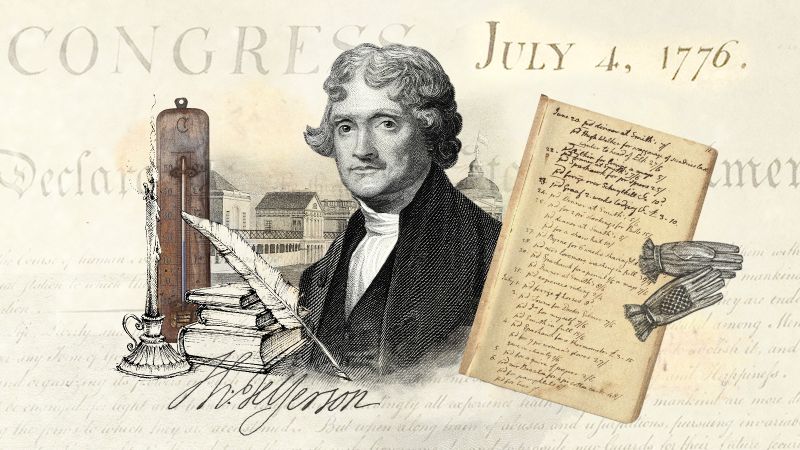
July 4, 1776: The day Thomas Jefferson went shopping
July 4 1776 – On the morning of July 4, 1776, Philadelphia experienced a mild start to the day, with temperatures hovering around 68 degrees Fahrenheit. By midday, the mercury had risen to 72.25 degrees, and by 1 p.m., it reached a warm 76 degrees. The temperature dipped slightly to 73.5 degrees by 9 p.m., according to records meticulously kept by Thomas Jefferson himself. These measurements, taken four times throughout the day, offer a peculiar glimpse into the life of the Founding Father who would later become the principal author of the Declaration of Independence. While the Continental Congress debated the final wording of the document, Jefferson’s attention was seemingly diverted to a more mundane task: purchasing goods for his household.
The Weather as a Historical Lens
Jefferson’s diary entries, preserved in his personal memorandum books, reveal that he spent part of the day acquiring a thermometer from John Sparhawk, an apothecary and bookseller on Second Street. Sparhawk, who also appears to have sold meteorological instruments, was the source of Jefferson’s new tool, which cost three pounds and 15 shillings. This purchase was part of a broader shopping spree, as the same day saw Jefferson buying seven pairs of women’s gloves for 17 shillings. He also contributed one shilling and six pence to a charitable cause. These details, though seemingly trivial, provide a humanizing contrast to the monumental events unfolding in the same city.
Andrew Davenport, vice president of research at Jefferson’s estate, Monticello, remarked on the irony of the day. “It’s a mundane day, except it’s a revolutionary one,” he said. “This reminds us that even during the most intense moments of history, people still needed to attend to their daily routines. The fabric of civic life—like household errands—was essential to building the nation.” Davenport’s observation underscores how the personal and the political often coexist, even in times of upheaval.
The Significance of the Declaration’s Adoption
July 4, 1776, is now recognized as the day the Declaration of Independence was officially adopted, marking a pivotal moment in American history. However, the actual formal decision to declare independence from Great Britain had been made on July 2, when the Continental Congress approved Richard Henry Lee’s “Resolution for Independence.” John Adams, in a letter to his wife Abigail on July 3, anticipated the global impact of this date. “The Second Day of July 1776, will be the most memorable Epocha, in the History of America,” he wrote. “I am apt to believe that it will be celebrated, by succeeding Generations, as the great anniversary Festival. It ought to be commemorated, as the Day of Deliverance by solemn Acts of Devotion to God Almighty. It ought to be solemnized with Pomp and Parade, with Shews, Games, Sports, Guns, Bells, Bonfires and Illuminations from one End of this Continent to the other from this Time forward forever more.”
Yet, the adoption of the Declaration on July 4 was not the most dramatic event of the day. James P. McClure, general editor of the Papers of Thomas Jefferson project and a historian at Princeton University, noted that much of the work behind the declaration had already been completed by that time. Jefferson, alongside Robert Hemmings, an enslaved teenager who managed his daily needs, had arrived in Philadelphia in May 1776 for the Second Continental Congress. On June 11, the Congress formed a committee of five to draft the Declaration, with Jefferson serving as its lead author. The committee submitted the draft to Congress on June 28, and the document was approved and ordered for printing in the morning of July 4, according to McClure.
Jefferson’s ability to multitask on this day has sparked debate among historians. While some argue that his focus on household matters was a sign of his efficiency, others suggest it reflected a broader pattern of how revolutionaries balanced their duties. Cara Rogers Stevens, a Jeffersonian scholar and historian at Ashland University in Ohio, offered a compelling perspective: “The fact that he was able to run a few errands on the same day might indicate that he wasn’t on as many committees as some of his contemporaries, like John Adams.” This theory highlights the differing workloads among the delegates, with Jefferson perhaps less burdened by the congress’s committees than others.
The question remains: why did Jefferson choose to shop on what is now considered one of the most consequential days in U.S. history? Was he simply a man of exceptional productivity, capable of managing both political and domestic responsibilities? Or did the day itself hold less significance than the celebrations that followed? For the people gathered in and around the Pennsylvania State House, now known as Independence Hall, July 4 was more of a continuation of their efforts than a defining moment. The day marked the end of a year of intense debate, committee work, and the administration of military and public affairs in a fledgling rebellion.
The Legacy of a Meticulous Record-Keeping
Jefferson’s habit of documenting his observations, whether they were about the weather or his purchases, has provided modern historians with a unique window into the past. His meticulous record-keeping, which included details of the day’s temperatures, reflects a broader commitment to precision—a trait that likely influenced his drafting of the Declaration. While the document’s language resonates with grandeur, Jefferson’s attention to detail in everyday matters suggests that his work on the Declaration was informed by a methodical approach.
McClure emphasized that the Continental Congress’s activities on July 4 were likely routine. “It’s not clear how exactly the day went down,” he said, “but historical records suggest the Declaration was approved and printed in the morning.” This timing allowed the document to circulate rapidly, setting the stage for the celebrations that would follow. The contrast between the formal adoption of the Declaration and Jefferson’s personal shopping trip invites reflection on the nature of historical significance. What might seem like an ordinary day to one individual could become a landmark event for another, depending on the context and the perspectives of those who remember it.
Jefferson’s actions on July 4, 1776, serve as a reminder that even in the midst of revolutionary fervor, life continued in its everyday rhythms. His ability to engage in both grand political acts and simple errands highlights the complexity of leadership during times of upheaval. As the nation looked to the future, the details of a single day—recorded in a memorandum book—offered a glimpse into the personal and professional life of a man whose words would shape the course of history.
