
‘Salami slicing’: How China is trying to increase control in the Pacific
China’s ‘Salami-Slicing’ Strategy: Expanding Influence in the Pacific
Salami slicing – Over the past several weeks, China has significantly pushed its maritime operations into uncharted territory, with its vessels engaging in law enforcement and seabed mapping activities beyond its historical reach. These actions, which include conducting research in a contested lagoon more than 500 miles from its shores, mark a strategic shift in Beijing’s approach to asserting control in the Pacific. Analysts describe this methodical expansion as a form of “salami-slicing,” a tactic involving small, incremental steps designed to strengthen territorial claims without triggering full-scale conflict.
Incremental Moves in a Strategic Region
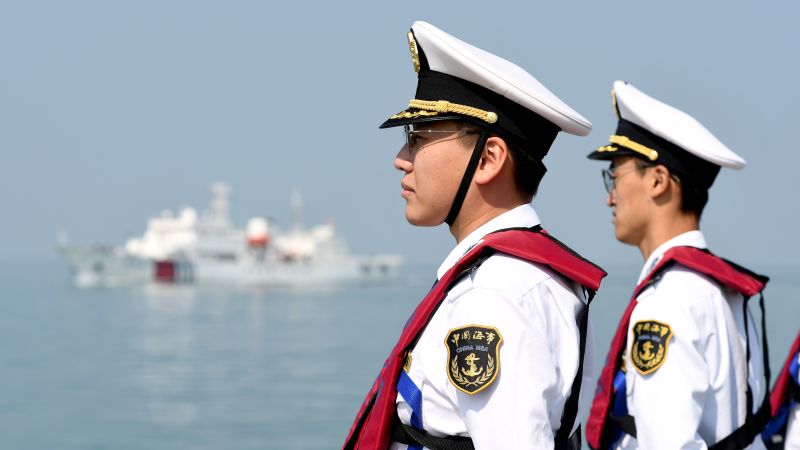
China’s efforts have focused on areas where its sovereignty assertions are debated under international law. By taking measured actions far from its mainland, Beijing aims to solidify its presence in the western Pacific without appearing aggressive. These maneuvers are seen as a way to gradually increase influence while avoiding direct confrontation with regional powers like the United States. The latest activity involved vessels from the China Maritime Safety Agency (MSA), a civilian organization responsible for maritime law enforcement, navigating through the Bashi Channel between the Philippines and Taiwan.
Observers note that this is the first time MSA ships have been observed east of the “First Island Chain,” a strategic arc stretching from southern Japan to the Philippines and along the edges of the South China Sea. This line, which Washington and Beijing both view as a critical boundary, has been a focal point of territorial disputes. The move signals China’s intent to project authority beyond this traditional demarcation, according to Ray Powell, director of the SeaLight project at Stanford University’s Gordian Knot Center for National Security Innovation. He called the operation the “Bashi Breakout,” emphasizing its symbolic importance.
“Beijing is essentially saying we have jurisdiction over this area on the other side of the First Island Chain. That’s pretty significant,” Powell told CNN.
China’s actions are part of a broader effort to create new maritime realities. The MSA’s recent missions are described as “sovereignty patrols” that reinforce Beijing’s claim over waters near Taiwan. This comes amid a complex geopolitical landscape, where the United States and China are vying for dominance in the region. The expansion of China’s territorial claims has long been a point of contention, with the 9-Dash Line—a network of dashed lines outlining its maritime boundaries—remaining a flashpoint for disputes.
A Political Signal to Taiwan
The move also serves as a clear message to Taiwan, which Beijing has designated as a future target for reunification. Taiwan’s President, Lai Ching-te, stated that China’s objectives are unmistakable: “Their real objective is to expand,” he said. Analysts suggest that the MSA’s presence in these waters is intended to create a perception of de facto control, undermining Taiwan’s sovereignty. The strategy aligns with China’s historical approach of using non-military vessels to assert authority while maintaining a low profile.
“China’s threats towards Taiwan know no limits,” Lai told reporters at a recent briefing.
China’s state-run tabloid, the Global Times, framed the MSA’s activities as a “sovereignty declaration with both legal significance and political signaling.” The publication highlighted the mapping of the seabed east of Taiwan, a first for China, as evidence of its growing maritime influence. Through the semi-official social media account Yuyuan Tantian, China further reinforced its stance, asserting that these waters now fall under its jurisdiction. The account criticized foreign claims that China lacks authority over the region, calling them “assertions that need to be challenged.”
Historically, China’s maritime expansion has included the 9-Dash Line, which it expanded to 10 dashes in 2023. The 10th dash now extends east of Taiwan, a move that has raised concerns among regional allies. While the People’s Liberation Army Navy has previously conducted exercises in these waters, analysts argue that the MSA’s operations are more insidious. Non-military vessels, they say, are perceived as less threatening, allowing Beijing to build a gradual but persistent presence.
Implications for Regional Stability
Experts warn that these incremental steps could reshape the strategic balance in the Pacific. By establishing a consistent presence in contested areas, China aims to make its claims seem more natural and irreversible. This tactic, which involves legal and political maneuvers, has been used to assert control over the South China Sea. In 2016, the Permanent Court of Arbitration in The Hague ruled that Beijing’s 9-Dash Line had no legal basis, but the country has continued to push its claims through repeated actions.
Analysts also highlight the dual purpose of China’s operations. While they bolster Beijing’s legal arguments, they also serve as a political signal to Taiwan and other Indo-Pacific nations. The MSA’s role as a policing force—enforcing environmental and maritime regulations—adds to its legitimacy in the eyes of regional stakeholders. This contrasts with the more confrontational image of China’s military presence, allowing the country to advance its goals without immediate backlash.
“The waters east of Taiwan Island will constitute our ‘nearshore waters’—the very waters where we maintain a presence and exercise jurisdiction and governance,” stated a post from Yuyuan Tantian.
Taiwan’s security officials have echoed concerns about the long-term impact of these maneuvers. They argue that the MSA’s activities create a false impression of control, making it easier for Beijing to justify future assertiveness. Lai Ching-te emphasized that China’s methods are constantly evolving, with new tactics designed to pressure Taiwan and neighboring countries. “Beijing continues to innovate ways to advance its territorial claims,” he said, underscoring the ongoing nature of the challenge.
The timing of these operations coincides with a recent visit by US President Donald Trump to Beijing, where diplomatic discussions focused on strengthening ties. However, Xi Jinping used the opportunity to stress that Taiwan remains the most critical issue threatening US-China relations. The MSA’s movements are seen as a continuation of this pressure, aiming to reinforce Beijing’s narrative that Taiwan is an inseparable part of its territory.
As China’s maritime reach expands, the question remains: how will these gradual steps affect the region’s stability? While the MSA’s role is to enforce regulations, its actions may eventually pave the way for more assertive military strategies. For now, the tactic allows Beijing to assert control without appearing to provoke a kinetic response. The Pacific, once a region of fluid dynamics, is becoming increasingly shaped by these quiet, persistent maneuvers. Whether these efforts will lead to a full-scale conflict or solidify a new equilibrium remains to be seen.
