Scientists attached transmitters to narwhals in the Arctic. The data they brought back was alarming

Scientists Attached Transmitters to Narwhals: Arctic Alarm
Earthguardiansonline.com – Scientists attached transmitters to narwhals in a bold field experiment off East Greenland, and the three years of data those six animals relayed home between 2017 and 2020 have left oceanographers deeply unsettled. Each compact satellite tag weighed no more than a pound, yet together the tagged narwhals revealed that warm, salty Atlantic water is now surging more than 180 miles into the region’s vast fjord network, eroding glacier undersides and accelerating ice loss at a rate that confirms the worst-case projections of climate models.
The study, published in a new peer-reviewed paper, validates a process oceanographers call “Atlantification”: the steady encroachment of denser, warmer Atlantic-origin water into seas once dominated by frigid polar outflow. When that water reaches the base of marine-terminating glaciers, it melts the ice from below, destabilizing the structure and hastening calving events that dump enormous icebergs into the sea.
Why Narwhals Outperform Icebreakers
East Greenland shelters the largest fjord system on Earth — a labyrinth of deep, ice-choked valleys where conventional research vessels confront unpredictable pack ice, extreme cold, and prohibitive operating costs. Icebreakers move slowly, burn fuel at extraordinary rates, and are often locked out entirely during winter months. The result: one of the most data-poor stretches of ocean remaining on the planet.
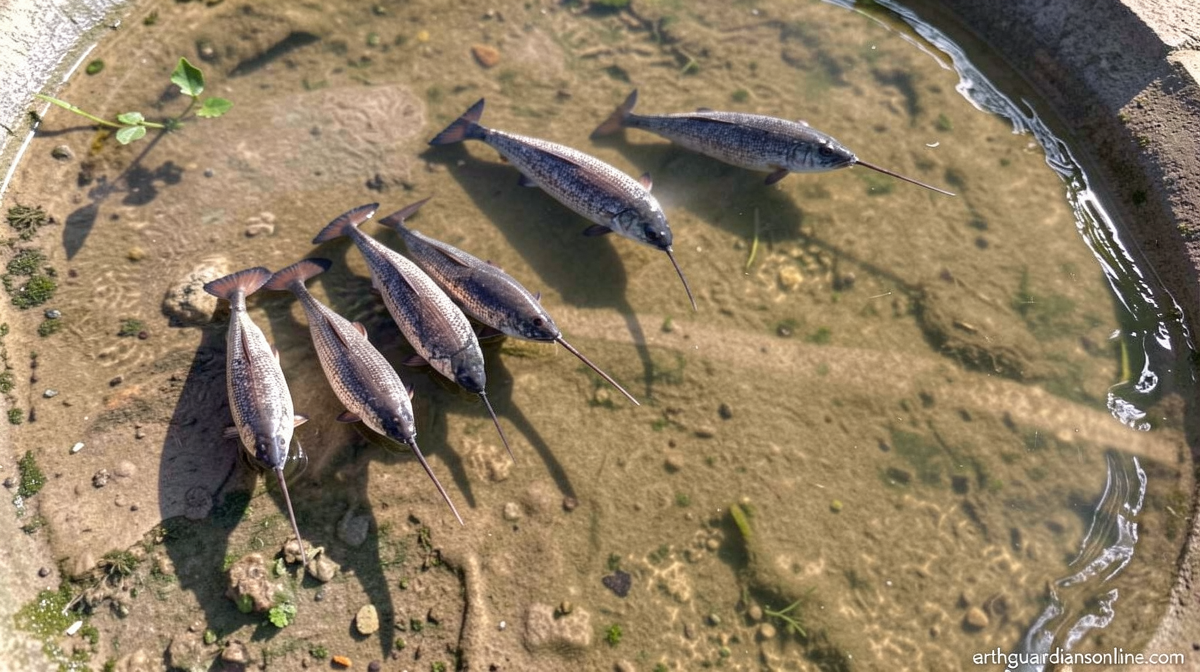
Narwhals, by contrast, treat those waters as home turf. These deep-diving cetaceans — instantly recognizable by the long spiral tusk, which is actually a modified tooth — plunge to depths approaching 6,000 feet, sampling the full water column from surface to abyss on every dive. They also revisit the same corridors repeatedly, yielding consistent longitudinal readings at fixed geographic points that no ship schedule can replicate.
Lead author Mads Peter Heide-Jørgensen, a professor at the Greenland Institute of Natural Resources, described the practical logic behind the approach:
“We can sit in front of our computers and the narwhals are swimming around in the icy waters in darkness.”
Local hunters captured the six animals and guided them into nets. Researchers then fitted the lightweight transmitters, engineered to log temperature and salinity continuously and beam each reading home via satellite. Heide-Jørgensen stressed that the procedure caused no lasting harm.
“We developed a smaller transmitter that could reliably collect temperature and salinity for a long time and transmit that through a satellite. It doesn’t harm them in any way.”
What the Data Reveals
Across the three-year tracking window, the six tagged narwhals generated more than 2,000 discrete observations of water temperature and salt content. Scientists merged those readings with historical ship-based measurements drawn from the World Ocean Database to construct a longer-term picture of water-mass change within the fjords.
The combined dataset exposed a persistent, long-term trend: warmer Atlantic-origin water is not merely edging into the outer fjords but advancing straight to the frontal faces of glaciers, where it erodes the ice from below. Heide-Jørgensen called the magnitude of the intrusion
“an eye opener.”
Why East Greenland Matters to the Whole Planet
The fjords of East Greenland do far more than shelter glaciers. They sit at the confluence of critical ocean currents that carry cold, dense polar water southward into the North Atlantic, redistributing freshwater and sustaining marine ecosystems. These flows are integral components of the Atlantic Meridional Overturning Circulation (AMOC), the great conveyor-belt of currents that moderates weather across the Northern Hemisphere. Scientists have warned that sustained warming and freshwater input could push the AMOC toward weakening or partial collapse — a scenario whose consequences would include accelerated sea-level rise along the eastern seaboard of the United States, severe cooling across western Europe, and intensified drought across parts of Africa.
Heide-Jørgensen framed the stakes plainly:
“In many ways, East Greenland is a bellwether for the climate changes we can expect in the North Atlantic.”
He also acknowledged the data gap the study was designed to fill:
“It’s a very understudied region … so we needed more data.”
Independent Experts React
Eric Achterberg, a professor at the GEOMAR Helmholtz Centre for Ocean Research Kiel in Germany, who was not part of the research team, called the narwhal-based methodology
“unique and elegant.”
Achterberg noted that the approach opens a template for other remote, ice-locked regions where traditional oceanographic sampling remains impractical, potentially transforming how the scientific community monitors polar water-mass change in coming decades.
Frequently Asked Questions
How long did the narwhal transmitter study run?
The tagging campaign spanned three years, from 2017 through 2020. During that window the six animals produced more than 2,000 individual temperature and salinity readings.
Were the narwhals harmed by the transmitters?
No. The tags weighed less than a pound and were designed to detach naturally. Heide-Jørgensen confirmed the procedure caused no lasting injury, and the animals resumed normal diving and migration patterns after release.
What is “Atlantification”?
Atlantification describes the progressive intrusion of warmer, saltier Atlantic water into Arctic seas that were historically dominated by cold polar outflow. Once that water reaches glacier bases, it melts ice from below and accelerates calving.
Why can’t ships simply measure these waters?
East Greenland’s fjords are among the most ice-locked and logistically expensive ocean regions on Earth. Icebreakers are slow, costly, and often unavailable during winter, leaving the area chronically under-sampled. Narwhals navigate the same corridors year-round at depths no vessel can match.
What happens if the AMOC weakens further?
Modeling studies project accelerated sea-level rise along the U.S. eastern seaboard, pronounced cooling across western Europe, and intensified drought across parts of Africa. East Greenland’s fjords sit at a critical node of the circulation, making them an early-warning indicator for the entire system.