
She was a first lady at 19. Now she’s making her fourth attempt to win Peru’s presidency
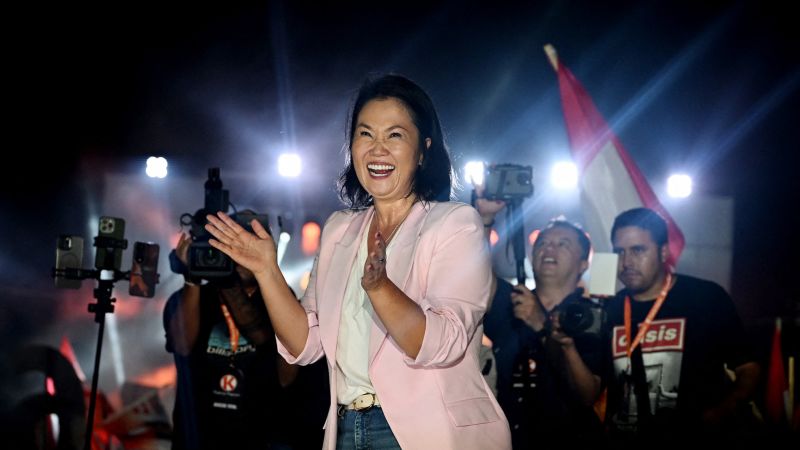
From First Lady at 19 to Fourth Presidential Bid: Keiko Fujimori’s Political Journey in Peru
She was a first lady at 19 – At the age of 51, Keiko Fujimori is once again standing at the center of Peru’s political stage, vying for the presidency in a runoff election that marks her fourth attempt to secure the highest office in the country. Her path to this moment began decades earlier, when she first stepped into the public eye as the first lady of Peru at just 19 years old. That moment came in 1994, during the inaugural Summit of the Americas, held under the leadership of U.S. President Bill Clinton. Keiko, then the daughter of then-President Alberto Fujimori, made a quiet but notable appearance, flanked by her father and dressed in black. Her reserved demeanor during the event contrasted sharply with the political fire that would later define her career.
The Early Years: A Shift from Family to Independence
Keiko’s political journey began after her mother, Susana Higuchi, ended her marriage to Alberto Fujimori following a public scandal. Susana had accused her husband of corruption, particularly in the handling of international donations. This separation paved the way for Keiko to take on a more active role in public life. While her father’s tenure as president, from 1990 to 2000, was marked by economic reforms and the defeat of leftist militant groups like Shining Path and MRTA, it also drew criticism for human rights violations and embezzlement. Keiko, emerging from this backdrop, would later inherit both the legacy and the scrutiny of her family’s political influence.
Her first major political step came in 2000, when she entered the National Congress as a member of the Popular Force party. This marked the beginning of her own political identity, separate from her father’s. Over the years, she built a reputation as a pragmatic leader, focusing on economic stability and national security. Yet, her rise was not without controversy. In 2015, she faced accusations of corruption, allegedly accepting funds from the Odebrecht construction company to finance her campaigns. These charges, which she consistently denied, led to a 13-month prison term. However, in January 2025, a court ruled that the case against her was null and void, clearing her of the allegations. Fujimori has since claimed she endured a decade of political persecution, which she believes has shaped her determination to lead.
2026 Election: A New Chapter Amidst Crisis
This Sunday, Keiko Fujimori faces Roberto Sánchez, a leftist candidate representing the Together for Peru party, in a decisive runoff election. The contest comes after three consecutive presidential bids in 2011, 2016, and 2021, all of which ended in defeat. Some polls suggest she holds a slight advantage this time, though the outcome remains uncertain. Fujimori has framed her campaign as a bid to restore order and stability to a nation plagued by political turmoil and rising insecurity. She argues that Peru’s recent decade has seen eight presidents, a reflection of deepening institutional crises and the impact of corruption scandals.
“We need order — order to live, order to invest, order to work,” Fujimori emphasized during a presidential debate, appealing to voters’ frustrations with the country’s fragmented political landscape. This sentiment echoes her broader narrative: that her leadership offers a clear alternative to the chaos that has characterized Peru’s recent governance. She also positioned herself as a defender of democratic values, contrasting her approach with that of her father’s era. “This election is not just about me, but about the kind of government we want for the next five years,” she said in a campaign speech. “Either we embrace disorder or restore the principles that have guided our nation for decades.”
A Changing Image: From Confrontational to Calculated
In recent months, Fujimori has sought to reshape her public image, adopting a more measured tone than in previous campaigns. She acknowledges that her earlier political style—marked by confrontational rhetoric and a focus on combating communism—was a source of criticism. “It’s true that we were confrontational, and we’ve corrected that,” she said in an interview, highlighting her efforts to appeal to a broader electorate. Political analysts like Julio Carrión, a professor at the University of Delaware, note that Fujimori’s strategy now emphasizes a calculated appeal to unity rather than ideological polarization. “She’s trying to distance herself from the narrative that framed her 2021 campaign as a battle between communism and democracy,” Carrión explained. “That approach, while effective in some ways, left her vulnerable to accusations of being a continuation of authoritarianism.”
Despite this shift, her political journey remains intertwined with her father’s legacy. Alberto Fujimori’s tenure, while transformative in economic terms, left a contentious mark on Peru’s democratic institutions. His government managed to pull the country out of economic collapse and quell violent leftist movements, but it also faced scrutiny for human rights abuses and corruption. Fujimori’s own rise to prominence was bolstered by the public denunciation of her father’s administration, which framed her as a symbol of political reform. However, her association with the Fujimori family has also drawn criticism, particularly from opponents who see her as a figurehead of an authoritarian tradition.
Legacy and Challenges: The Weight of History
Fujimori’s father, Alberto Fujimori, died in 2024, leaving behind a complex legacy that continues to influence Peruvian politics. During his presidency, Fujimori’s government achieved significant milestones, including economic stabilization and the eradication of leftist guerrilla groups. Yet, these accomplishments were overshadowed by allegations of corruption and human rights violations. A truth and reconciliation commission reported that over 60,000 people were killed during the internal conflict, and Fujimori was later convicted of crimes related to the Barrios Altos and La Cantuta cases. He received a 25-year prison sentence in 2009, though his political influence persisted long after his removal from power.
Keiko Fujimori’s campaign in 2026 is a testament to the enduring appeal of her family’s brand of leadership. While she has distanced herself from her father’s more controversial policies, she remains a central figure in Peru’s conservative political movement. Her support base includes those who view her as a champion of free-market policies and a stabilizing force in a country accustomed to frequent leadership changes. However, her path to the presidency has been marked by a series of setbacks, including the 2021 runoff election, which was marred by allegations of voting irregularities. At that time, Fujimori’s team accused her opponent, former President Pedro Castillo, of manipulating the vote, a claim that fueled accusations of her own alleged fraud.
“I know that throughout my political life I have made mistakes,” Fujimori admitted during the final debate, addressing Peruvians directly. “I learned from them, but I also came back stronger.” This reflection underscores her resolve to move beyond past controversies and focus on a forward-looking vision for Peru. Her campaign now emphasizes economic growth, reduced crime, and a return to institutional integrity. Supporters argue that her experience and resilience make her the best candidate to lead the nation out of its current crisis, while critics remain skeptical of her ability to break free from her family’s shadow.
As the election approaches, the political landscape in Peru remains volatile. The country has experienced a cycle of leadership transitions, with eight presidents since 2013, a period marked by scandals, protests, and a lack of consistent governance. Fujimori’s candidacy has become a focal point in this struggle, representing both the hopes of those who believe in her father’s reforms and the concerns of those who view her as a continuation of the Fujimori era. Whether she succeeds in this fourth attempt will depend on her ability to navigate the nation’s political fragmentation and unite a divided electorate under her vision of order and progress.
“Either we want chaos and disorder, or we restore order and work for the future of our country,” Fujimori added during the debate, her words a reminder of the high stakes involved in this election.
With the runoff election set to determine the next chapter in Peru’s political history, Keiko Fujimori’s journey from a young first lady to a seasoned presidential candidate reflects the country’s evolving dynamics. Her ability to adapt, reconcile past missteps, and reframe her narrative will be crucial in a race that is as much about legacy as it is about the future of Peru’s democracy.
