The Himalayas are unpredictable. But countries are building there like never before

Daftar Isi
When the Mountains Push Back: A Himalayan Disaster Meets an Infrastructure Gold Rush
Earthguardiansonline.com – More than 600 people have died and roughly 3,000 remain unaccounted for after a catastrophic glacial event tore through communities on both sides of the China-Nepal border. The toll, still climbing as of this writing, has landed squarely in the middle of a period when governments across the high Himalayas are pouring unprecedented capital into dams, tunnels, highways, railways, and bridges at altitudes where engineering margins are already razor-thin. Whether the latest catastrophe was directly triggered by any single construction project remains unclear. What it has done, however, is force a confrontation between two accelerating trends: the region’s extraordinary geological and climatic volatility, and the political will to tame it.
What Broke Loose
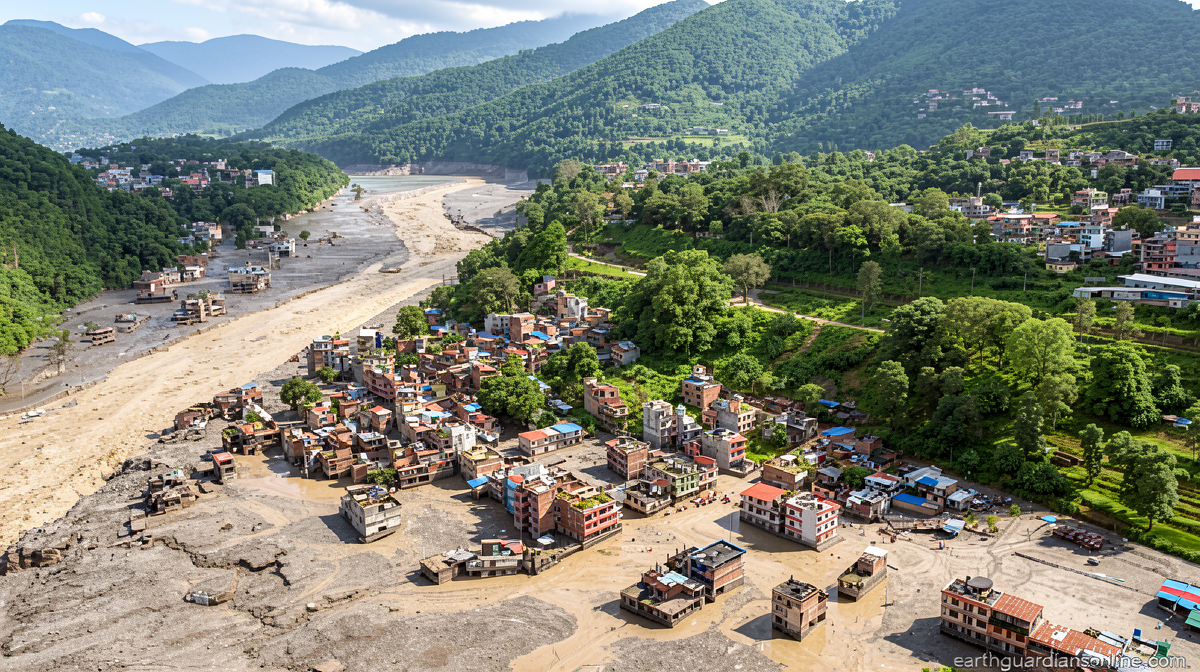
On Wednesday morning, a section of glacier calved from a mountainside, sending a massive landslide cascading downward. The debris dammed natural waterways almost instantly, and the resulting torrent swept through settlements, obliterated roadways and bridges, and destroyed hydropower installations in its path. The total human cost has not yet been fully tallied. Secondary hazards have compounded the emergency: barrier lakes formed from the initial debris field continue to threaten further flooding and slope failures, making every rescue operation a race against the next wave of destruction.
In Nepal, teams were still combing through rubble at multiple hydropower sites on Sunday, searching for more than 900 missing workers. Heavy machinery was deployed to excavate collapsed tunnel sections where crews had been trapped. On the Chinese side, conditions proved equally treacherous.
A Friday session of China’s ruling Communist Party leadership, chaired by President Xi Jinping, acknowledged the scale of the problem. The communiqué stressed
“enormous challenges to rescue and emergency response efforts” due to “numerous glaciers, glacial lakes, and potential geological hazards” and variable weather.
The Buildout: Why Everyone Is Pouring Concrete Into the Roof of the World
The Himalayan corridor is not a quiet backcountry. It sits atop shifting tectonic plates, is carved by rivers whose flow is governed by glacial melt, and feeds the floodplains of the Indian subcontinent where hundreds of millions depend on downstream water. It is, by any geological measure, one of the most seismically and ecologically fragile zones on Earth. Yet that very fragility conceals an enormous energy and mineral endowment that has drawn engineers, investors, and state planners into a decades-long competition to extract value from the high ground.
China’s High-Altitude Gambit
No state has committed to the Himalayan buildout with the scale and ambition of Beijing. The Chinese government treats Tibet and its borderland ranges as pillars of national security and energy independence. The centerpiece of that strategy is a $168 billion megadam now under construction — a project whose engineering parameters push close to the outer limits of what concrete and steel have achieved anywhere on the planet. Alongside it, ultra-high-voltage transmission corridors are being laid to carry clean electricity from the plateau to the eastern grid, a move designed to accelerate the phase-out of coal-fired generation.
Geopolitics sharpens the calculus. A persistent, high-altitude border standoff with India has given the infrastructure program a second, strategic rationale: physical presence, surveillance, and rapid-mobility corridors along contested ridgelines. The mountains, once dismissed by state planners as remote or ethnically volatile, have been recast as strategic assets.
Ruth Gamble, an environmental, cultural, and climate historian specializing in Tibet at La Trobe University in Australia, traces that reframing explicitly:
“The mountains got reframed from being what (the states) saw as a backwater or a place of potential ethnic instability… into being a resource.”
She notes the drivers are layered:
“It’s about hydropower but there’s also minerals and tourism,”
and adds that
“there’s (also) a military-industrial complex happening… and there’s a lot of infrastructure associated with that as well.”
India and Nepal Join the Rush
New Delhi has been funneling hundreds of millions of dollars into its own Himalayan corridor projects — hydropower plants, mountain highways, and rail links — while Kathmandu, though operating at a smaller scale, has likewise accelerated construction in its own highland valleys. The combined effect is a dense lattice of new structures in terrain where seismic events, monsoon-driven floods, and accelerating glacial melt already impose severe design constraints.
The Climate Variable: When the Safety Margins Shrink
Climate change is not a distant abstraction in the Himalayas. It is the mechanism by which the frequency and intensity of extreme hydrological events are already shifting. Engineers who designed a dam for a “100-year flood” may find that interval compressing to five or ten years within a single career span.
Austin Lord, a senior fellow in the Energy, Water, and Sustainability Program at the Stimson Center think tank in Washington, puts the problem in blunt terms:
“We’re getting ‘100 year floods’ every five to 10 years… the climate risks are evolving faster than our ability to shift the margins on what we think are the horizons of safety.”
He underscores the cooperative dimension:
“With so many unknowns, if we don’t start working on them together then we won’t make any progress, and we’ll just be overwhelmed again next time.”
What the Border Disaster Demands Next
The fact that the worst of the destruction straddled an international boundary makes the event more than a domestic emergency. It is, in effect, a live demonstration of shared-risk exposure. Glacial lakes do not respect treaty lines. Debris flows follow gravity, not cartography. Experts argue the severity of this particular event, combined with its transnational footprint, should prompt state planners to revisit how projects are sited, scaled, and stress-tested in the region — and to open formal channels for joint monitoring of glacial lakes, seismic precursors, and flood-routing models.
Whether that conversation actually begins, or whether the next construction bid simply supersedes the last disaster’s lessons, remains the central open question. The mountains, for their part, will continue to shift on their own schedule.
Related Reading
Frequently Asked Questions
What is The Himalayas are unpredictable But countries?
The Himalayas are unpredictable But countries is the main topic of this guide. The article explains the context, practical details, and next steps readers should understand.
Why does The Himalayas are unpredictable But countries matter?
The Himalayas are unpredictable But countries matters because readers are looking for a useful answer, not just a short summary. Good content should match search intent and help them decide what to do next.