Chinese government ships spotted in record numbers off Taiwan in July

Daftar Isi
Record Maritime Pressure: China’s Government Fleet Surrounds Taiwan Waters at Unprecedented Scale
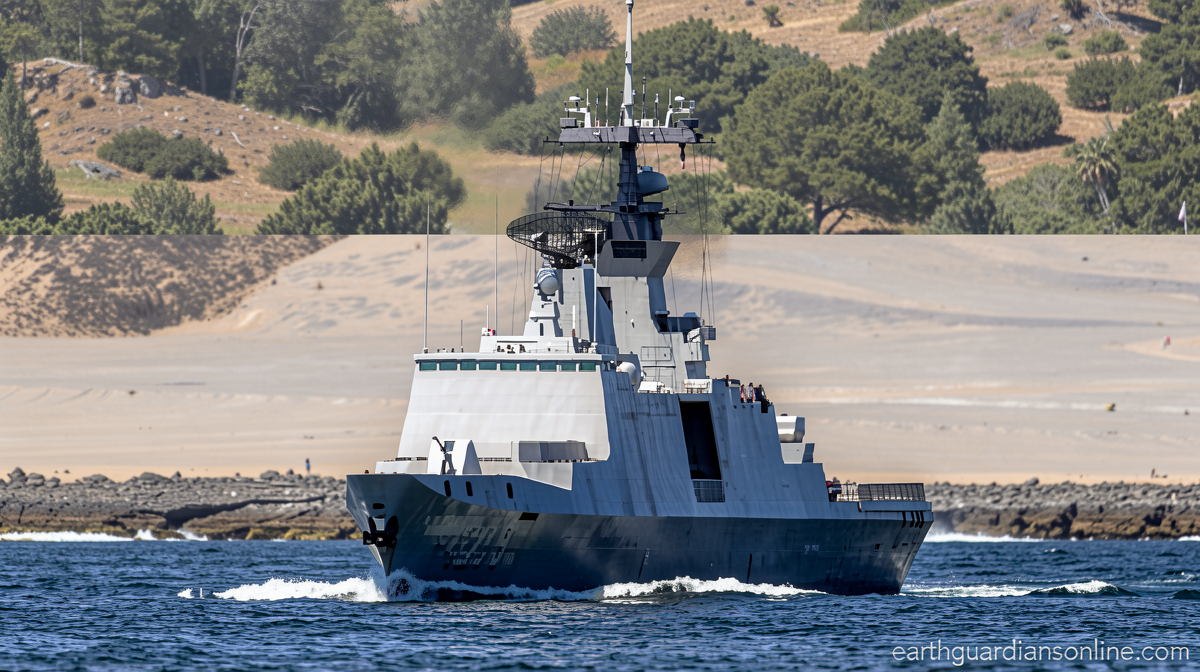
Earthguardiansonline.com – Beijing’s maritime footprint around the Taiwan Strait and adjacent Pacific waters reached a historic high in July, with coast guard authorities on the island logging 244 separate sightings of Chinese government vessels operating in the area. The tally — encompassing ships operated by the China Coast Guard, state scientific research bodies, and other civilian agencies — represents more than a fourfold increase over the count recorded in July of the previous year. Spread across the month, that translates to roughly eight government vessels appearing in the vicinity of the island every single day.
The figures, released by Taiwan’s coast guard, deliberately exclude activity near the island’s offshore outposts at Kinmen, Matsu, and Pratas. When those additional sightings are factored in, the total climbs to 425, nearly doubling the headline number. For comparison, the same period last year yielded 233 Chinese ships in the broader operational area. The count also omits warships of the People’s Liberation Army Navy, meaning the true volume of Chinese state vessels operating around the island is considerably higher than the published figure suggests.
A Campaign of Jurisdictional Assertion
Analysts at the Institute for the Study of War (ISW) characterized the surge as part of a deliberate, escalating effort to assert administrative control over waters surrounding the island.
China “is escalating its campaign to bring Taiwan’s surrounding waters under its jurisdiction and may be testing the willingness of foreign vessels to comply with (Chinese) authorities in disputed waters.”
The think tank noted that Beijing has been deploying vessels from its Maritime Safety Agency — a law-enforcement body rather than a military formation — into Pacific waters east of the island. China’s state-run Global Times tabloid framed the MSA deployments as “a sovereignty declaration with both legal significance and political signaling,” underscoring how the government is layering legal and political messaging onto what are, in practice, civilian-crewed ships.
Taiwan’s coast guard confirmed that these Chinese law-enforcement vessels have been issuing radio challenges to merchant ships transiting the waters. While no boarding actions have been carried out, the broadcasts have probed vessels for port entry and exit details — a procedural move designed to manufacture the appearance that Beijing exercises administrative authority over the sea lanes.
Such broadcasts have “already put pressure on these commercial ships,” although none of these vessels had changed course.
Earlier in the month, a typhoon passing through the region provided what ISW described as a natural laboratory for Beijing. The MSA issued an announcement during the storm instructing transiting vessels to “strictly comply with traffic control requirements” and “obey the instructions of on-site maritime management agencies” — language that, in the context of a weather event, allowed China to test whether foreign operators would accept its traffic-management directives without formal confrontation.
Rehearsing for Wartime Disruption
A senior Taiwanese official told reporters last month that the pattern of activity points toward a specific wartime scenario: Beijing may be conducting operational rehearsals aimed at severing the island’s Pacific-facing supply routes. The official emphasized that contingency planning is already underway.
“If the situation escalates to a blockade — which would amount to a quasi-war — we have plans to work with the navy to jointly protect Taiwan’s lifeline sea routes.”
The stakes are sharpened by the fact that, despite being a self-governing democracy with its own elected leadership, Taiwan remains subject to Beijing’s long-standing claim that reunification is inevitable — by negotiation or, if necessary, by force. The maritime pressure campaign thus operates in a space between peacetime administration and open conflict, what strategists call the gray zone.
China “likely intends to expand its de facto control around Taiwan as much as possible through means short of war, which erodes Taiwan’s sovereignty, strains Taiwan’s resources, and sets favorable conditions for future (Chinese) military operations against Taiwan.”
Taiwan’s Unmanned-Systems Response
On the island’s own side of the ledger, the opposition-controlled legislature approved a plan on Thursday to allocate more than seven billion dollars toward unmanned systems — spanning unmanned aerial vehicles, unmanned surface vessels, and unmanned underwater vehicles — over a six-year procurement window. The investment signals a strategic pivot informed by lessons drawn from the ongoing armed conflicts in Ukraine and Iran, where autonomous platforms have reshaped both deterrence calculations and battlefield dynamics.
The spending package is simultaneously intended to turbocharge a domestic drone manufacturing base. Taiwan has launched an islandwide industrial initiative aimed at positioning the country as a global leader in unmanned-vehicle production. The commercial momentum is already visible: in the first seven months of this year, the island exported drones worth roughly 2.6 times the total value shipped across all of 2025, according to official trade statistics.
The convergence of record maritime pressure from the north and a rapid buildout of autonomous defense and industrial capacity on the island suggests that the strategic contest over Taiwan’s surrounding waters is entering a phase where both sides are hardening their postures — one through persistent civilian-crewed presence, the other through a new generation of unmanned platforms designed to complicate any future attempt to close the sea lanes.
Related Reading
Frequently Asked Questions
What is Chinese government ships spotted in record?
Chinese government ships spotted in record is the main topic of this guide. The article explains the context, practical details, and next steps readers should understand.
Why does Chinese government ships spotted in record matter?
Chinese government ships spotted in record matters because readers are looking for a useful answer, not just a short summary. Good content should match search intent and help them decide what to do next.