
What happened when a White man carrying a large wooden cross met a Black man at the nation’s largest Confederate monument
earthguardiansonline.com – “`html
A Different Path to Stone Mountain
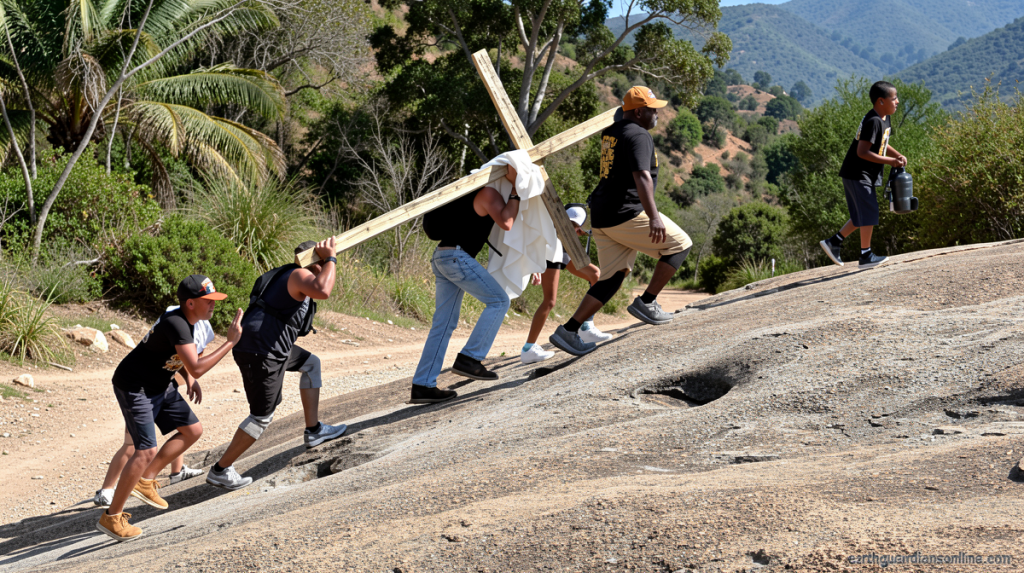
On Independence Day, Jean Shifrin found herself navigating a steep incline when an unusual procession emerged from behind her. Squinting against the bright morning light, the photographer asked herself what could possibly be happening. An eight-foot wooden cross was being carried upward by three men—two Black and one White—moving steadily along the slippery path. At the front, a heavily built African American man balanced the cross’s head upon his left shoulder while calling out “Yessir! Yessir!” in a commanding voice reminiscent of military training. Behind him, a White man with heavily tattooed arms, already flushed crimson from sun exposure, supported the central portion of the structure. A third Black man, solid in build, followed at the back of the group.
Following this trio was a lively crowd that included a young boy clutching a Bible and a middle-aged Chinese woman repeatedly encouraging them with “Jiayou!”—Mandarin for “Keep going!” Shifrin, a slender sixty-eight-year-old photographer, regularly encounters oddities on this particular mountain. Stone Mountain rises 825 feet above the Atlanta area as a massive granite formation. The site holds considerable historical significance as what many call the “Mount Rushmore of the Confederacy,” serving as a monument to White supremacy through an enormous carving etched into its stone face.
More Than One Way to Transform a Monument
Shifrin had previously viewed this location primarily as representing prejudice and division. However, during a period when she struggled with a severe genetic disorder that threatened her ability to walk, the mountain became something entirely different—a place of recovery and hope. Now she wondered whether the mountain could reveal yet another dimension to her understanding.
As she climbed and photographed visitors gathering at the summit, Shifrin realized there exists more than one method for challenging Confederate symbolism. She had documented Stone Mountain’s visitors for many years but had never witnessed anything comparable to the cross-bearing men on that July afternoon. What surprised her most was discovering that their motivation extended well beyond religious devotion.
For decades, supporters of Confederate monuments have argued they represent heritage rather than hatred. Yet Southern leaders were quite explicit regarding their reasons for secession. In his famous “Cornerstone Speech,” Alexander Stephens, who served as vice president of the Confederate States, directly challenged Thomas Jefferson’s assertion that “all men are created equal.” According to Stephens, speaking three weeks before hostilities began, “Our new government is founded upon exactly the opposite idea… Its foundations are laid; its corner stone rests upon the great truth that the Negro is not equal to the White man; that slavery, subordination to the superior race is his natural and normal condition.”
“I was revolted,” Shifrin recalled of her initial reaction to the carving in the 1990s. “The more I learned about the history of it and how it was started — it just got uglier and uglier.”
The memorial’s origins trace back to the early twentieth century, initiated by a Confederate widow who also proposed including KKK members in the design. More than half a century elapsed before completion in 1972. Today the carving forms part of Stone Mountain Park, a recreational destination situated sixteen miles from Atlanta that opened on April 14, 1965—exactly one century following Abraham Lincoln’s death.
Once considered the birthplace of the modern Ku Klux Klan and a gathering point for White supremacist organizations, the mountain has evolved considerably. It now functions as what some describe as a “mini-United Nations,” welcoming people of diverse racial, religious, and cultural backgrounds who come to exercise, meditate, and celebrate together.
“`
