
Why ‘The World’s Most Famous Arena’ actually makes sense for Taylor Swift and Travis Kelce
Why ‘The World’s Most Famous Arena’ Actually Makes Sense for Taylor Swift and Travis Kelce
Why The World s Most Famous – Taylor Swift, a global icon whose career thrives on visibility, fan engagement, and media attention, has chosen a remarkably private approach for her upcoming wedding. While the idea of secrecy might seem at odds with her public persona, sources close to the event reveal a strategic rationale behind the tight control over details. The couple’s decision to host the ceremony in New York City, specifically at Madison Square Garden, reflects a blend of practicality, security, and a desire to shield their personal moment from the prying eyes of the entertainment world’s most aggressive paparazzi.
The Case for a Sealed Environment
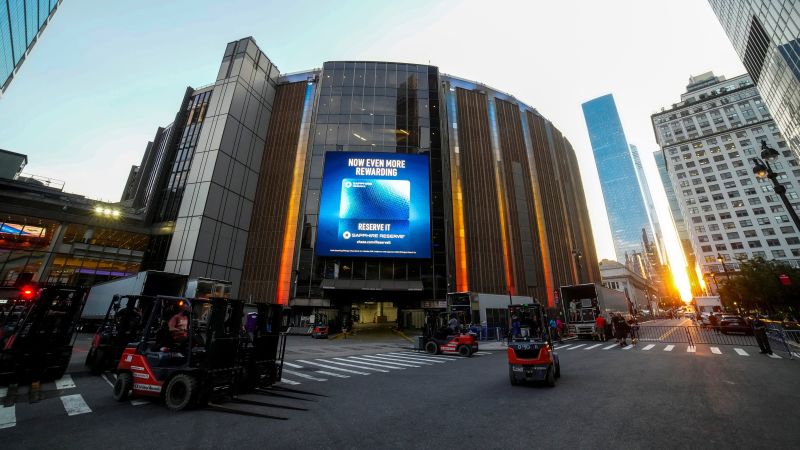
Madison Square Garden, often referred to as the “world’s most famous arena,” has become a symbol of high-stakes events. Its unique architecture—without windows, fully enclosed under a roof, and with controlled access—offers an environment where Swift and her fiancé, NFL star Travis Kelce, can maintain privacy. The venue’s design minimizes the risk of outsiders capturing candid moments, a critical consideration given the couple’s extensive public presence. “It’s not just about keeping the event quiet,” said one insider, “but about creating a bubble where family and guests can feel secure.”
Swift’s relationship with MSG dates back years, built on numerous performances and appearances. The venue’s management team has long worked with her organization, fostering a level of trust that extends beyond typical event planning. “She’s known the owner, James Dolan, for a decade,” another source noted. “That familiarity means she can rely on the staff’s discretion and expertise.” The security measures at MSG are also unparalleled, with a disciplined team that collaborates closely with the New York Police Department. This partnership has proven vital for high-profile events, including presidential visits and the pope’s appearances.
A Security Overhaul Inspired by Tragedy
The decision to prioritize security wasn’t made in a vacuum. It stems from a pivotal moment in 2017 when a suicide bomber attacked Ariana Grande’s concert in Manchester, England, killing 22 people and injuring dozens. For Swift, who had just completed her “1989 World Tour” and was planning a global tour, the incident underscored the need for a more robust security strategy. “That event was a wake-up call,” said a law enforcement official briefed on the planning. “It showed how quickly things can spiral when a high-profile artist is in the wrong place at the wrong time.”
Following the Manchester attack, Swift’s team revamped its protocols, integrating counterterrorism measures into its operations. This shift went beyond managing stalkers or navigating crowds—it involved tight coordination with local and federal agencies. The FBI’s Joint Terrorism Task Force and the NYPD’s intelligence bureau now play a central role in safeguarding her events. “The goal is to anticipate threats before they materialize,” explained a security consultant involved in the planning. “It’s about layered protection, not just reacting to what’s seen on the surface.”
The Vienna Threat and Its Impact
The urgency of this approach became evident in the lead-up to Swift’s 2024 concerts in Vienna, Austria. Just days before the three-night series, police uncovered a plot involving individuals inspired by ISIS. One suspect, working for a facilities company contracted to support the event, was identified as a potential insider. “The intelligence community flagged a pattern of behavior that suggested a coordinated attack,” said a law enforcement source. “Swift’s team had to act fast to ensure the safety of 200,000 fans.”
The incident led to the cancellation of all three concerts, a move that frustrated fans but validated the security measures in place. The Manchester attack had shown how vulnerable large gatherings could be, and the Vienna plot highlighted the importance of having a trusted venue with strong security infrastructure. “The Garden is one of the few places where we can control every aspect of entry and exit,” said a security operative. “That’s crucial when dealing with threats that could come from within.”
Why New York City? A Hub of Intelligence and Response
New York City itself offers additional advantages. The NYPD’s counterterrorism bureau, paired with the FBI’s Joint Terrorism Task Force, is the most advanced in the country. This dual-layer system ensures rapid response and thorough threat assessment. “The city’s law enforcement is proactive and well-coordinated,” said a security analyst. “That’s why it’s the go-to location for high-profile events that require both local and national attention.”
Swift’s team has also been tested by years of dealing with stalkers and obsessive fans. Some of these individuals have even been arrested or subjected to restraining orders. “Every public appearance is a potential security challenge,” noted a close associate. “She’s a global figure, so her movements are always under scrutiny.” This constant vigilance has made the Garden’s controlled environment a natural choice, as it allows her to move seamlessly between public and private spaces without interruption.
Moreover, the couple’s decision to host the wedding in a city with a history of high-profile security events reinforces their strategy. From presidential visits to international summits, New York has demonstrated its ability to manage large-scale threats. “It’s not just about the venue’s physical security,” said a planner. “It’s about the city’s infrastructure and the intelligence networks in place to protect her.” The combination of these factors creates a fortress-like setting, where even the most determined intruders are deterred.
Rehearsal and Control: The Final Pieces
While the details of the wedding remain tightly guarded, the planning process is meticulously structured. According to insiders, the event will involve a series of prearranged steps, including the use of vehicles to transport guests to a secluded tent. Once inside, a curtain will be drawn to separate the guests from the public eye, ensuring that the ceremony unfolds without distractions. “It’s about creating a controlled flow from start to finish,” said a source. “Every element is planned to minimize exposure.”
This level of control is particularly important for a figure like Swift, whose brand is built on narrative and anticipation. By limiting access to the venue, the team reduces the likelihood of leaked details or unscripted moments that could disrupt the carefully curated experience. “The fans are used to the spectacle,” said a planner. “But this is a personal moment that needs to feel special, not just famous.”
Ultimately, the choice of Madison Square Garden is a masterstroke of logistics and strategy. Its physical barriers, combined with the city’s security apparatus and Swift’s deep-rooted relationship with the venue, create an environment where privacy, control, and safety converge. In an age where threats are increasingly unpredictable, the couple’s decision to embrace the “most famous arena” as their wedding site is both practical and prudent. “It’s not about hiding from the world,” one insider said. “It’s about protecting what matters most.”
“The Manchester attack was a turning point. It made us realize that even in open spaces, the risks can be catastrophic.” – Law enforcement official
As the wedding approaches, the focus remains on ensuring that the event is as secure as it is memorable. For Swift, this is not just about the spotlight—it’s about crafting a moment that’s as safe as it is significant. In doing so, she’s transformed a symbol of celebrity spectacle into a fortress of personal privacy and protection.
