Drones are the latest buzzy tech aimed at stopping a school shooting. They’re part of a billion-dollar industry

Daftar Isi
Drones Are the Latest Buzzy School Safety Tech
Earthguardiansonline.com – Drones are the latest buzzy addition to the arsenal schools are assembling against active-shooter threats. These small, remotely launched craft can smash through a classroom window, sweep the room, and open a speakerphone line so teachers and responding officers can talk to students inside. Within roughly sixty seconds of entry, the unit is designed to disorient and incapacitate an armed intruder. Districts across several states are now putting the devices into service, a move that slots them into what has become a multi-billion-dollar school-security market.
A Multi-Billion-Dollar Safety Industry
Pinpointing the industry’s exact size is difficult, but the figures run into the billions. Justin Marston, co-founder and CEO of Campus Guardian Angel, places annual spending on school-safety tools—his own craft included, alongside resource officers and metal detectors—between $3 billion and $4 billion. The Urban Institute separately calculated that $2.62 billion went to school resource officers alone in 2023. Every dollar is aimed at confronting a uniquely American horror: gun violence inside classrooms.
Parents who have buried children lost in mass shootings are among the strongest forces behind the industry’s expansion. Marston frames the stakes plainly: “I think every parent will want to feel that there is some type of capability at their child’s school to confront and stop an active shooter threat versus having to wait the five to eight minutes for the police to get there.” He calls each unit nothing more than a “lump of plastic,” yet one that can face down an armed adult and neutralize the threat in a minute.
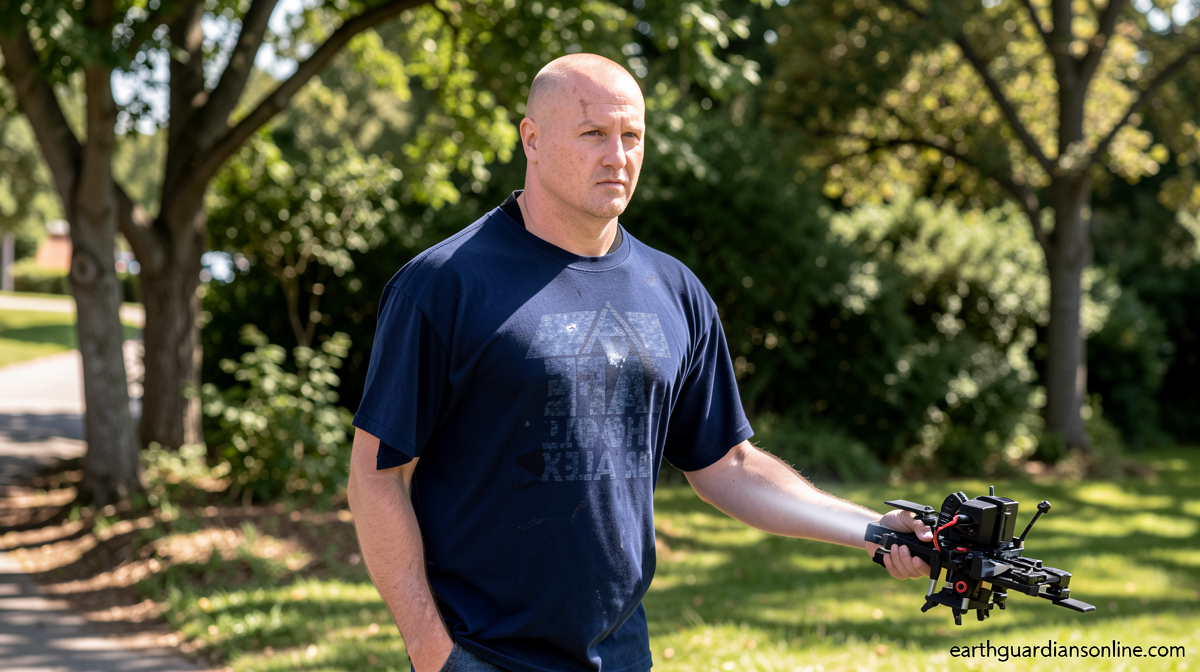
Mounted point-of-view cameras give law-enforcement teams real-time visual feedback during an incident. The craft are already operational in three Florida counties—supported in part by more than $1 million in state allocations—and in five Georgia schools funded by the state legislature. This month marks their first Colorado deployment, and Marston indicated Texas districts may follow shortly, per CNN affiliate KSAT.
From Parkland to Present: How Parents Shaped the Push
The Colorado school slated for deployment sits in the same county as a 2019 incident in which two shooters killed one student and wounded eight others. All four states now using the technology—Florida, Georgia, Colorado, and prospective Texas—carry the scars of high-profile school shootings: Parkland, Apalachee, Uvalde, and Columbine. Jennifer DePaoli, a senior researcher at the Learning Policy Institute, credits the 2018 Marjory Stoneman Douglas High School massacre in Parkland with accelerating the multi-billion-dollar safety sector.
Seventeen students and faculty members died that day, triggering a national reckoning with campus gun violence. In the months after, states poured at least $960 million into student-safety measures, according to The 74, a nonprofit education-news outlet. One parent-led outcome of Parkland was Florida’s Alyssa’s Law, named for 14-year-old Alyssa Alhadeff, who was killed. Her parents helped draft the statute, which mandates a silent panic-alarm system in public schools wired directly to law enforcement. Proponents argue the alarm can shave minutes off response times during shootings or medical emergencies. Alyssa’s mother, Lori Alhadeff, now lobbies for nationwide adoption.
A dozen additional states—New Jersey, New York, Texas, Tennessee, Utah, Oklahoma, Louisiana, Georgia, Washington, Oregon, Virginia, and West Virginia—have passed their own alarm mandates. Together these measures fall under what experts call “school hardening”: the installation of physical security infrastructure such as metal detectors, automatic door locks, and surveillance cameras, many of which have been standard fixtures for years.
Limitations and Real-World Failures
Hardening is not infallible. Students have slipped past malfunctioning metal detectors or simply entered through an unlocked side door. In January 2025, AI gun-detection software deployed across Metro Nashville Public Schools failed to flag a student’s weapon before he killed a 16-year-old girl and then fatally shot himself. District officials explained the shooter never came close enough to a camera for the system to register the firearm and trigger the alarm.
In a separate October incident, a student carried a loaded handgun into a Mobile, Alabama, school and walked past a functioning metal detector before being arrested, CNN affiliate WALA reported. These episodes underscore that no single technology—whether a buzzy drone, a panic alarm, or an AI camera—replaces layered planning, trained staff, and rapid police response.
“The goal is never to replace teachers or officers. It is to buy those sixty seconds so the next response can arrive with the shooter already contained.” — Justin Marston, Campus Guardian Angel
Frequently Asked Questions
How quickly can a school drone neutralize an active shooter?
According to Campus Guardian Angel, the unit is engineered to disorient and incapacitate an armed intruder in approximately sixty seconds after breaching a window and entering the room.
Which states currently operate school drones?
Florida (three counties), Georgia (five schools), and Colorado (first deployment this month) are active users. Texas districts have expressed interest and are exploring funding, per KSAT reporting.
What does “school hardening” mean?
The term describes the installation of physical security measures—metal detectors, automatic locks, surveillance cameras, panic alarms—designed to slow or prevent an armed intruder from reaching students.
How much do schools spend on safety each year?
Industry estimates place annual U.S. school-security spending between $3 billion and $4 billion, with $2.62 billion going to school resource officers alone in 2023, per the Urban Institute.