Trump’s ‘Lake America’ move revives one of his biggest political flops

Daftar Isi
Trump’s “Lake America” Order Lands as a Political Misfire Ahead of Midterms
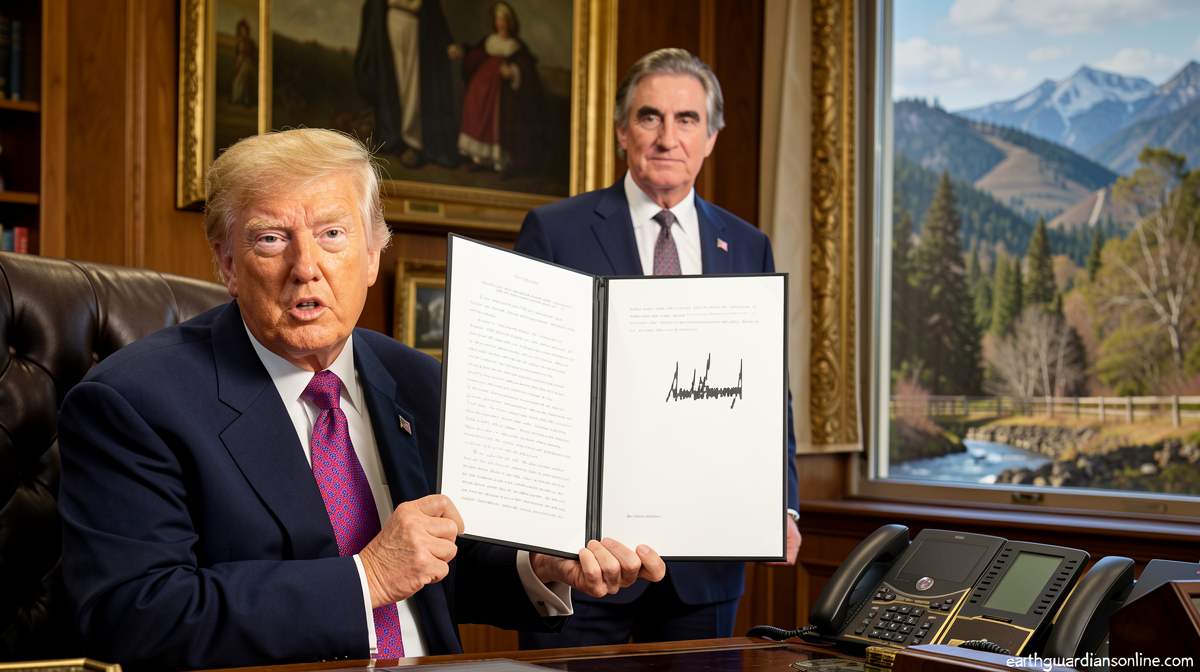
Earthguardiansonline.com – With the 2026 midterm elections drawing closer, President Donald Trump has once again chosen a symbolic gesture over substantive policy — and this time the target is a Great Lake. On Thursday, the president signed an executive order stripping the name “Lake Ontario” from maps and official documents, replacing it with “Lake America.” The stated rationale was straightforward: Canada had refused to fold under the pressure of a trade war Trump launched earlier in the year, and the president wanted a visible reminder of American dominance over shared geography.
The move arrives at a particularly awkward moment. Polling has consistently shown that roughly three-quarters of Americans believe the president is neglecting the issues they care about most — chief among them, bringing down the cost of everyday goods. Instead of addressing inflation, the administration has been waging a military confrontation with Iran (a factor pushing gasoline prices higher) and escalating a trade dispute with Canada (a factor that could further inflate import costs). Layering a vanity renaming on top of those conflicts risks reinforcing the perception that the White House is fixated on spectacle rather than stewardship.
The Gulf Precedent: A Polling Catastrophe Revisited
This is not the first time Trump has attempted to rebrand a major body of water. On his first day back in office last year, he signed an order renaming the Gulf of Mexico the “Gulf of America.” The public reaction was swift and overwhelmingly negative. An Ipsos poll conducted that same week found Americans opposed the change by a margin of 70 percent to 25 percent. Approximately eight in ten independents said they disapproved, and even 45 percent of Republicans registered opposition. The intensity of feeling was stark: 46 percent of respondents said they strongly opposed the renaming, compared with just 10 percent who strongly supported it.
A Marquette Law School poll released shortly afterward told a similar story, with Americans opposing the Gulf renaming 71 percent to 29 percent. What made the result especially damning for the White House was its ranking among other early-term actions tested in the same surveys. In the Marquette poll, the Gulf renaming was the single most unpopular item out of eight tested. In the Ipsos poll, it placed second most unpopular out of fifteen. In both instruments, it fared worse than Trump’s pardons of January 6, 2021 defendants — a move widely regarded as the archetypal controversial early-tenure decision.
Why Canada Makes This Worse
There is a structural reason the “Lake America” stunt is likely to underperform even the Gulf episode. Americans have historically shown considerably more sympathy toward Canada than toward Mexico. Decades of cross-border migration pressure along the southern frontier have created a constituency willing to tolerate, or even endorse, hardline measures against Mexico. Canada, by contrast, does not carry that baggage. Recent polling suggests Canadians are viewed more favorably by the American public, and when Trump first imposed tariffs on both countries early in his second term, the Canada-specific duties drew slightly higher opposition — with more than six in ten Americans opposing them.
The broader Canadian question has also been tested. Last year, Marquette polling found that 75 percent of Americans opposed the idea of making Canada the 51st state, a proposal Trump had floated publicly. Renaming a lake shared with that country, in retaliation for its trade posture, therefore lands in a context where the underlying grievance already lacks popular traction.
A Pattern of Renaming That Keeps Backfiring
The Lake Ontario episode is the latest entry in a recurring pattern. After a handpicked board of loyalists moved to rename the Kennedy Center after the president, a CNN poll conducted last month found that Americans said by a two-to-one margin that Trump had “gone too far” in reshaping institutions bearing historical names. A Pew Research Center survey found that only 9 percent of Americans considered it appropriate to attach Trump’s name to public entities while he still held office. Yet the administration continued pressing forward — including, as reported last week, by potentially substituting the president’s name for that of a Black war hero slated to have an aircraft carrier named in his honor.
Even within the Republican Party, cracks are appearing. Representative Tom Tiffany, the GOP nominee for Wisconsin governor, publicly stated Thursday that the lake’s name should remain unchanged — a notable break from party discipline on a purely symbolic issue.
The Ocean Joke and the Road to November
In the Oval Office on Thursday, Trump lightened the mood with a joke suggesting the renaming spree might not end with a lake.
“We have a gulf. We have a lake. Now all we need is an ocean,” he said. “So maybe we’ll have to change the name of the Atlantic and/or the Pacific. Maybe we’ll change them both.”
The quip was meant as bravado, but it underscored the core problem: each successive renaming deepens the impression that the president is treating national symbols as personal branding exercises rather than shared heritage. And unlike the Gulf episode, which at least carried the thin veneer of a geopolitical statement about a contested maritime zone, the Lake Ontario move lacks even that cover. The lake was not named after the Canadian province of Ontario in the first place — it received its name roughly two centuries ago, in the seventeenth century, from a French explorer’s account of the region. Renaming it to signal displeasure with Ottawa therefore misfires on geography as well as politics.
As the midterm calendar tightens, voters will be asked to weigh a president who is simultaneously fighting a war in the Middle East, escalating tariffs on a close neighbor, and rebranding North American geography. The arithmetic of that combination is unlikely to produce a favorable ballot outcome. The “Lake America” order, for all its theatrical ambition, may end up as the clearest single illustration of why.
Related Reading
Frequently Asked Questions
What is Trump s Lake America move revives?
Trump s Lake America move revives is the main topic of this guide. The article explains the context, practical details, and next steps readers should understand.
Why does Trump s Lake America move revives matter?
Trump s Lake America move revives matters because readers are looking for a useful answer, not just a short summary. Good content should match search intent and help them decide what to do next.