Children go underground as Ukraine starts new school year under constant Russian fire

Ukraine’s School Year Starts Underground
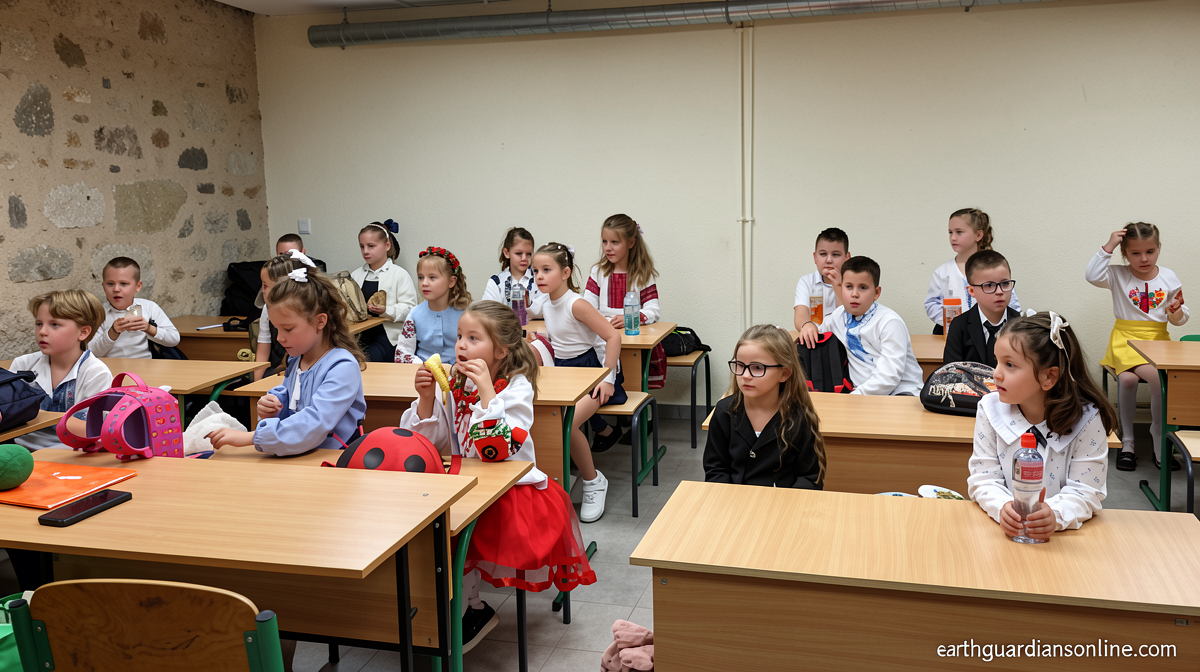
Earthguardiansonline.com – Children go underground as Ukraine opens the 2026–27 school term, and the first lesson of the year was delivered not from a chalkboard but from a concrete floor in a Kyiv basement. At the Ukrainian Global School, administrators made the call to relocate everyday instruction below ground after what local officials called the most sustained aerial bombardment of the capital since the full-scale invasion began in February 2022. The move was neither a drill nor a symbolic gesture; it was a practical answer to a threat that had become constant.
In the stretch from midnight Thursday through noon Tuesday, air-raid sirens sounded sixty times across Kyiv, stacking up roughly forty-seven hours of unbroken warning. Authorities confirmed at least fifty-three fatalities and more than one hundred injuries in the capital and the wider Kyiv region during that window. Faced with that volume of alerts, the school determined that hauling pupils into shelters only after each klaxon was no longer feasible. From that point on, the basement served as the classroom.
“This is a significant change,” the school told parents in a letter accompanying the new term. “Now, during an air raid alert, there’s no need to run anywhere, interrupt classes, or wait for hours to resume learning. The children are already where it’s safe. And school simply continues.”
The same letter tried to lighten the mood with a wry aside, framing the relocation as taking education “to a whole new level.” The joke, however, sat atop a grim reality: Moscow had escalated its campaign of strikes against Ukrainian civilians to a scale unmatched since the war’s opening salvos four years earlier.
Drone Saturation and the End of Quiet Hours
The escalation traces directly to Moscow’s capacity to mass-produce Iranian-designed Shahed drones, a capability that solidified at the start of the previous year. Earlier in the conflict, Russian forces typically fired their largest salvos overnight, exploiting reduced visibility and thinner air-defense coverage in the dark hours. In recent months that pattern has dissolved. New jet-powered drones, traveling roughly three times faster than the original Shahed airframes, have made continuous day-and-night bombardment feasible. Ukrainian air-defense operators describe these faster platforms as nearly impossible to intercept at scale, and the country is racing to field next-generation interceptors to close the gap.
The cumulative effect on daily life has been severe. For families in Kyiv, the question is no longer whether an alert will sound but how many times in a given day. Schools, hospitals, and residential buildings have all restructured their routines around the assumption of perpetual threat.
A Generation That Never Knew Peacetime School
Because the full-scale invasion launched just as the world was emerging from the Covid-19 pandemic, the cohort of children entering eighth grade on Tuesday represents the youngest Ukrainians who ever experienced uninterrupted, normal schooling. Pupils heading into fifth grade or below have never sat in a classroom during peacetime. For them, the war is not a disruption of childhood; it is the entirety of it.
Kyiv’s city administration urged parents to treat alert preparedness as inseparable from ordinary back-to-school tasks. Packing a backpack or laying out a uniform, the office noted, now sits alongside teaching a child where to crouch and what to do when the klaxon sounds.
“In the current circumstances, this is just as much a part of preparing for the new school year as packing a school bag or getting the uniform ready,” the Kyiv City office stated.
The President Visits a Shelter
President Volodymyr Zelensky traveled to a Kyiv school on opening day to mark the start of the term. The children, dressed formally — boys in button-down shirts, girls with traditional ribbons woven into their hair — were visibly excited to see him. The greeting, however, took place inside a shelter rather than a classroom, because another air alarm had sounded during the visit.
“There is an air raid alert right now. Unfortunately, the Russians are despicable … even among enemies, there is usually an understanding that children are children,” Zelensky told reporters.
Empty Desks and a Shrinking Student Body
As the conflict stretches into its fifth school year, the human cost is becoming visible in the arithmetic of enrollment. UNICEF estimates that more than 1.8 million Ukrainian children now live abroad, with additional hundreds of thousands displaced internally. Ukraine’s Ministry of Education reported that schools across the country are operating with significantly reduced class sizes, and many rural institutions have consolidated remaining pupils into fewer buildings to stretch limited resources.
Frequently Asked Questions
Why did the Ukrainian Global School move classes to a basement? After sixty air-raid alerts in roughly forty-seven hours produced at least fifty-three deaths in Kyiv and the surrounding region, the school concluded that interrupting lessons for each individual alert was no longer practical. Relocating instruction underground eliminated the need to evacuate mid-class.
How long has the full-scale invasion been affecting Ukrainian schooling? The invasion began in February 2022, meaning the 2026–27 term marks the fifth consecutive school year conducted under active wartime conditions.
What is the Kyiv city administration advising parents to do? Officials recommend treating shelter-readiness as a standard back-to-school task, on par with packing a bag or preparing a uniform. Parents are encouraged to walk children through crouch positions and alert-response procedures before the first day.
How many Ukrainian children are displaced? UNICEF estimates more than 1.8 million Ukrainian children are living abroad, with hundreds of thousands more displaced internally within Ukraine.