Aircraft carrier USS Abraham Lincoln arrives in Thailand after months of combat in Middle East

Daftar Isi
After Eight Months at Sea, USS Abraham Lincoln Finally Dockes in Thailand
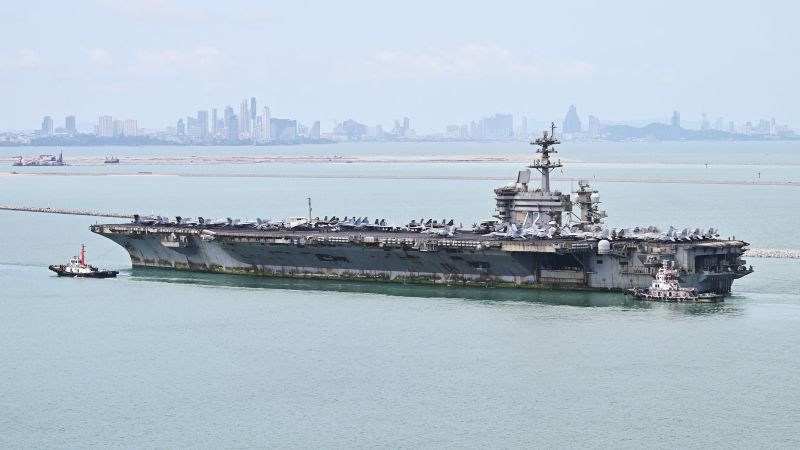
Earthguardiansonline.com – The rust-streaked hull of the USS Abraham Lincoln slid into the port of Laem Chabang on Wednesday, marking the carrier’s first port call in over eight months and bringing a grueling stretch of continuous sea duty to a close. The 100,000-ton vessel, which departed San Diego last November, will eventually return to Southern California later this year, completing what is expected to rank among the longest deployments in the history of the United States Navy.
The arrival caps a period of sustained combat and blockade operations in the Middle East during the ongoing war with Iran. The Lincoln’s commanding officer, Capt. Dan Keeler, framed the milestone in a public statement:
“We are all very excited to make Thailand the first port visit on our historic deployment.”
A Record-Setting Stint and Its Human Cost
US Sen. Richard Blumenthal, a Democrat from Connecticut who serves on the Senate Armed Services Committee, noted that the carrier has established a modern-day benchmark for consecutive days spent at sea while engaged in active combat and blockade duties. That distinction, however, came at a steep price to the well-being of the ship’s roughly 5,000 crew members.
Blumenthal wrote last month to Defense Secretary Pete Hegseth and the acting secretary of the Navy, expressing what he called “serious concern” over the escalating length of deployments and demanding answers about daily living conditions aboard the carrier. His letter catalogued a range of problems:
“There have been widespread reports of shortages of basic supplies, water contamination, plumbing issues, deteriorating mental health, deck safety concerns,” aboard the ship, as well as “disruptions in the mail system, which have caused many care packages in route to the ship to be lost in transit for months.”
At least one possible suicide attempt among the crew had been reported before the problems became public knowledge. Hegseth subsequently pushed back, declaring that conditions on the Lincoln had been “completely misrepresented,” though he offered no specifics about which reporting he found inaccurate. President Donald Trump, pressed on the question of the deployment’s length, waved off the concern entirely, remarking that the period at sea was “not nearly long enough.”
Pentagon Shuffles Carrier Coverage
Within days of the aboard-ship issues surfacing publicly, the Pentagon announced that the Japan-based carrier USS George Washington would be redirected to the Middle East to relieve the Lincoln. The George Washington has since taken up station there alongside the USS George H.W. Bush, preserving a two-carrier American naval presence while hostilities with Iran continue.
That rotation, however, drew sharp criticism from defense analysts and regional observers. Pulling the George Washington out of the Western Pacific removed one of the Navy’s largest capital ships from the area where it traditionally signals alliance commitments and deters adversaries such as China and North Korea. The move, critics argued, laid bare structural capacity shortfalls in a service already stretched thin by simultaneous commitments across multiple theaters.
Adm. Daryle Caudle, the Chief of Naval Operations, addressed the strain directly while speaking to reporters in Virginia last week. He acknowledged the toll that extended deployments exact on sailors and their families, and said the Navy would strive to introduce greater predictability into deployment timelines, while conceding that wartime exigencies complicate any fixed schedule:
“I would prefer, you know, seven-month deployments. I typically am not a big fan of extensions, and I push back hard on that. But the enemy gets a vote.”
Two Additional Warships Join the Port Visit
The Lincoln is not alone in Thai waters. The guided-missile destroyer USS Frank E. Petersen Jr. docked Wednesday at Sriracha, a short distance from Laem Chabang, while the guided-missile cruiser USS Robert Smalls arrived at Map Ta Phut, east of Pattaya. The simultaneous presence of three US warships underscores the scale of the Navy’s logistical and operational footprint in the region.
Pattaya’s Long Memory of American Sailors
The choice of a port near Pattaya carries historical resonance that stretches back more than half a century. During the Vietnam War, Pattaya became the quintessential rest-and-relaxation destination for US servicemembers rotating out of combat. The city sits less than an hour’s drive north of U-Tapao, where an airbase hosted dozens of B-52 Stratofortress bombers. From that base, the eight-engine aircraft could reach targets in North Vietnam in three to four hours, a substantial saving in time and fuel compared with launching from Andersen Air Force Base on Guam, the other principal B-52 staging point in the Pacific.
At the conflict’s peak, roughly 50,000 Americans were stationed at U-Tapao and other installations across Thailand. As a US treaty ally, the country offered a natural staging ground where troops engaged in Vietnam could decompress. A 2017 report by the Institute of Labor Economics estimated that between 11 percent and 16 percent of all visitors to Thailand during 1966–67 were American servicemembers on leave from the war. Around the bases and along the Pattaya coastline, a service industry grew up to cater to the influx of off-duty troops, reshaping the local economy in ways that persist to this day.
For the crew of the Lincoln, the port call represents more than a logistical waypoint. After months of sustained combat pressure, limited resupply, and the psychological weight of an unprecedented deployment, the opportunity to step ashore, receive fresh provisions, and reconnect with families represents a critical reset. Whether the Navy can sustain the tempo demanded by the Iran conflict without further eroding the readiness and morale of its sailors remains the central question the next several months will answer.
Related Reading
Frequently Asked Questions
What is Aircraft carrier USS Abraham Lincoln arrives?
Aircraft carrier USS Abraham Lincoln arrives is the main topic of this guide. The article explains the context, practical details, and next steps readers should understand.
Why does Aircraft carrier USS Abraham Lincoln arrives matter?
Aircraft carrier USS Abraham Lincoln arrives matters because readers are looking for a useful answer, not just a short summary. Good content should match search intent and help them decide what to do next.