Gaza building collapse kills at least 20, dozens more trapped under rubble

Daftar Isi
Gaza City collapse leaves at least 20 dead as rescuers search for survivors
Earthguardiansonline.com – A six-story residential building already weakened by war damage collapsed before dawn Wednesday in Gaza City, killing at least 20 people, including children, and burying many others beneath heavy debris.
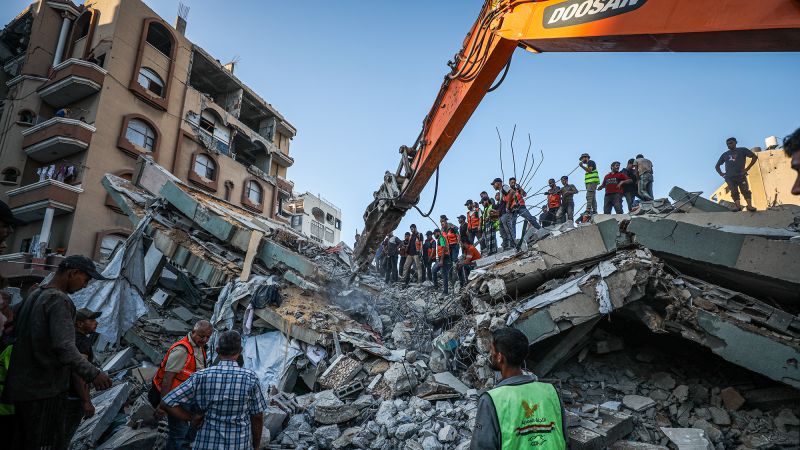
Emergency crews are searching the ruins of the Al-Sa’ada building in the Al-Rimal neighborhood, where Gaza’s Civil Defense agency says roughly 100 people remain unaccounted for. The building contained four apartments on each floor and had become shelter for displaced families facing a severe shortage of safe housing across the territory.
Residents were awakened at about 3 a.m. by the sound of the structure giving way, followed by cries from people trapped inside. Rescue teams continue to work through layers of concrete, twisted metal and damaged household belongings as families wait for news of relatives.
“Since midnight in Gaza City a tragic, painful scene has unfolded: a brutal humanitarian event, as you can see in front of you under this residential building, where dozens of innocent people were trapped,” Civil Defense spokesman Mahmoud Basal said Wednesday.
“People woke up at 3 a.m. to screams and the crying of children who were inside after the building completely collapsed on them,” he added. “We warn of further collapses like this incident in the Gaza Strip, in the areas where citizens are now sheltering.”
A building damaged earlier in the war
The Civil Defense agency said Israeli airstrikes struck the Al-Sa’ada building near the start of the Gaza war after the October 7, 2023 attacks. Its earlier damage left the structure vulnerable, highlighting a wider danger for civilians living in buildings that have been hit, shaken by nearby blasts or left without repairs.
Hamas’ media office said the collapse struck “dozens of displaced families who had been forcibly driven to seek shelter there, amid the complete absence of alternative and safe places of refuge.” It said thousands of damaged structures throughout Gaza could face a similar risk, including buildings now occupied by people who have nowhere else to go.
The disaster comes as Gaza’s housing crisis remains acute. The United Nations has said about 80% of structures in the territory have been damaged since the conflict began, and roughly two-thirds of those damaged buildings have been destroyed. The scale of destruction has left communities trying to distinguish between homes that are visibly unsafe and those that may still be at risk despite remaining standing.
For families displaced by fighting, the choice is often between overcrowded shelters, temporary accommodation and damaged buildings. That pressure is expected to intensify as winter nears, when exposure to rain, wind and colder temperatures makes secure shelter even more urgent.
Displacement and reconstruction pressures
Nearly 1.9 million Palestinians in Gaza, about 90% of the population, have been displaced during the war, the United Nations has said. Many have had to move repeatedly, uprooted by military operations, evacuation orders, destruction of homes or the search for food and shelter.
The collapse underscores how the consequences of physical destruction can persist even when a building is no longer directly under attack. Structural damage can weaken foundations, support columns, stairwells and exterior walls. Without extensive inspection and repair, families sheltering inside may remain exposed to sudden failure.
Unexploded ordnance adds another layer of danger in damaged urban areas, complicating both debris removal and efforts to assess or restore housing. The destruction of roads, utilities and public services can also slow emergency access when buildings fail or people become trapped.
No major reconstruction effort has taken hold in Gaza since a fragile ceasefire agreement between Israel and Hamas was reached last year. In late August, the United Nations said the proportion of damaged buildings in the territory had continued to rise despite the ceasefire.
Efforts connected to US President Donald Trump’s Board of Peace, formed to advance the US-brokered ceasefire arrangement, have yet to produce clear progress on rebuilding. The initiative has also faced recent criticism from Israel.
Rescue effort continues
The immediate focus in Al-Rimal remains the search beneath the collapsed building. Each hour can be critical for survivors who may be trapped in pockets beneath slabs of concrete or inside partially intact rooms. The confirmed death toll could rise as rescuers reach additional areas of the site and identify those missing.
For Gaza City residents, the collapse is also a warning that the threat posed by the war’s destruction extends far beyond active airstrikes. With so many people living amid damaged infrastructure and limited alternatives for shelter, the safety of surviving buildings has become a central humanitarian concern.
Related Reading
Frequently Asked Questions
What is Gaza building collapse kills at least 20?
Gaza building collapse kills at least 20 is the main topic of this guide. The article explains the context, practical details, and next steps readers should understand.
Why does Gaza building collapse kills at least 20 matter?
Gaza building collapse kills at least 20 matters because readers are looking for a useful answer, not just a short summary. Good content should match search intent and help them decide what to do next.