
Cuba’s president warns of ‘bloodbath’ if US takes military action
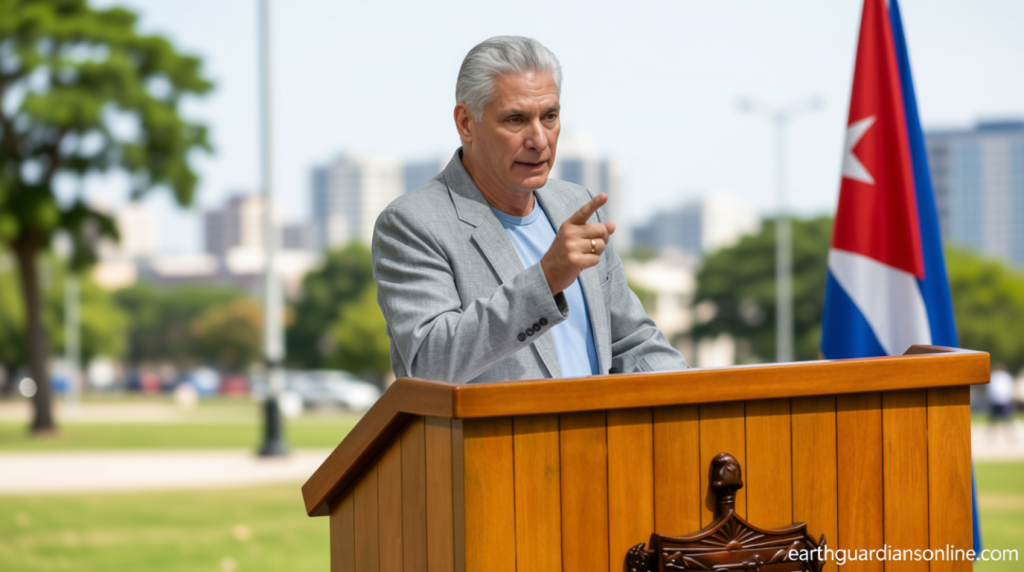
Cuba’s President Warns of ‘Bloodbath’ as Tensions with the US Reach a Critical Point
Cuba s president warns of bloodbath – On Monday, Cuban President Miguel Díaz-Canel issued a stark warning that a US military strike on Cuba would trigger “a bloodbath with incalculable consequences.” The statement came amid rising tensions between Havana and Washington, which have intensified in recent weeks. Díaz-Canel, speaking on X, emphasized that Cuba presents no threat to the United States and has no aggressive intentions toward any nation, including the US. “The government of that nation is well aware of this fact,” he asserted, underscoring Cuba’s resolve to defend itself against potential aggression.
Bilateral Tensions Intensify
The relationship between the US and Cuba has deteriorated to its lowest level in decades, fueled by ongoing pressure from US President Donald Trump and a worsening energy crisis on the communist-run island. Cuban energy officials have reported that a last-minute donation of Russian oil, which had temporarily缓解 the power shortages, is now depleted. This has left the country’s citizens bracing for more frequent blackouts, further straining the already fragile diplomatic ties. In recent months, Trump has consistently framed the Cuban government as a failing regime, predicting its collapse in public appearances.
“I think they’re going to have to come to us,” Trump told Fox News in an interview aired on Friday. “It’s a failed nation. It’s a totally failed nation.”
These remarks have amplified concerns in Havana, where officials argue that the US is not only imposing economic sanctions but also escalating the threat of military intervention. The Cuban government has labeled the US’s actions as part of a broader “multidimensional aggression,” including energy blockades, financial restrictions, and political pressure. Díaz-Canel added that while the right to self-defense is justified, the US cannot use this as a reason to wage war against the Cuban people, calling it a “deceptive and ridiculous” justification.
Legal Actions Against Raúl Castro
Amid the escalating conflict, the United States is reportedly preparing an indictment against former Cuban leader Raúl Castro. This legal move would mark a significant shift in Washington’s strategy, aiming to undermine the current government while targeting Castro’s legacy. According to sources, the indictment is part of a larger effort to portray Cuba as an adversary, even as its leaders maintain that the US is the primary aggressor.
Trump, though reluctant to comment on the specifics of the case against Castro, reiterated his stance on the Cuban regime during a recent press appearance. “They need help, as you know,” he said, deferring to the Justice Department to explain the charges. This sentiment aligns with his broader narrative of framing Cuba as a “failed nation” in need of intervention. The potential indictment has raised questions about its impact on domestic and international perceptions of the Cuban government, as well as its implications for the country’s political stability.
US Diplomatic Engagement with Castro’s Heir Apparent
While the US focuses on political and economic pressure, it has also maintained a high-level dialogue with Raúl Castro’s grandson, who serves as the bodyguard of the former leader. This unique connection, dubbed “the Crab” in media reports, highlights the complex dynamics of US-Cuba relations. Last week, the Director of the Central Intelligence Agency, John Ratcliffe, visited Havana for a rare meeting with officials from the Ministry of the Interior and the island’s intelligence leadership. The encounter suggests that the US is seeking to build alliances, even as it simultaneously threatens military action.
For many Cubans, the possibility of an attack feels increasingly real. Civil Defense officials have distributed a “family guide” outlining steps to take in the event of a hypothetical US military invasion. The guide, titled “Protect, Resist, Survive, and Prevail,” includes practical advice such as packing backpacks with non-perishable goods and remaining vigilant for air raid alarms. These preparations reflect a growing sense of urgency among the population, who are now actively preparing for the worst.
Global Perspectives on the Crisis
Foreign Minister Bruno Rodríguez reiterated Cuba’s position on Monday, stating that the country has “the absolute and legitimate right to defend itself against any external aggression.” His comments come as the Trump administration continues to push for a confrontational approach, with Rodríguez accusing Washington of constructing a “fraudulent case” to justify its economic war against Cuba. “Those who seek to illegitimately attack Cuba resort to any pretext, no matter how deceitful and ridiculous, to align with their own interests,” he wrote in a post on X.
The Cuban government has framed the US’s actions as a calculated strategy to destabilize the country and legitimize a military strike. Rodríguez emphasized that the current situation is a direct result of the Trump administration’s policies, which he described as “day after day” efforts to erode Cuba’s sovereignty. This narrative has gained traction in international circles, with some analysts suggesting that the US’s aggressive posture could lead to a broader regional conflict in Latin America.
Historical Context and Future Implications
The crisis unfolding between Cuba and the US is rooted in decades of ideological conflict and geopolitical maneuvering. Since the Cuban Revolution in 1959, the two nations have been locked in a struggle marked by trade restrictions, diplomatic isolation, and occasional military threats. The current tensions, however, are unprecedented in their intensity, with the energy crisis serving as a catalyst for renewed hostilities. As Cuba’s infrastructure struggles under the weight of sanctions, the potential for a US-led military operation has become a focal point of public and political discourse.
While Díaz-Canel has called for restraint, the US remains steadfast in its demands. The White House has not ruled out the possibility of direct military involvement, citing the need to protect its interests in the Caribbean. This has prompted Cuba to double down on its defense preparations, with the Civil Defense organization playing a central role in educating citizens about emergency protocols. The guide, which has been widely circulated, underscores the government’s commitment to rallying the population in the face of external threats.
As the standoff continues, the Cuban people are caught between the legacy of the Castro era and the new administration’s confrontational policies. The energy minister’s recent admission that Russian oil donations are exhausted has only heightened fears of a prolonged crisis. With the US pushing for a more aggressive stance and Cuba prepared to respond, the situation remains volatile. The outcome could determine the future of bilateral relations and set a precedent for how the US engages with other nations in the region.
In the coming days, the focus will shift to whether the Trump administration will take concrete steps toward military action or attempt to de-escalate tensions. The indictment against Raúl Castro and the CIA’s engagement with his grandson may serve as pivotal moments in this unfolding drama. For now, the Cuban government stands firm, warning that any attack will not only result in immediate casualties but also ignite a deeper conflict that could reshape the political landscape of Latin America.
CNN’s Patrick Oppmann contributed to this report.
