
A perfectly American start to the USA’s 2026 World Cup
A perfectly American start to the USA’s 2026 World Cup
The Spectacle of Unity
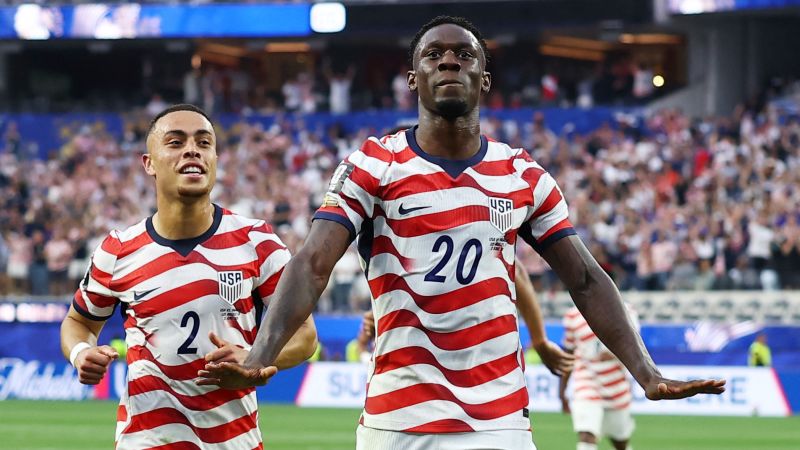
A perfectly American start to the USA – Folarin Balogun, with his deep understanding of the game, captured the essence of the US team’s debut perfectly. A man born in New York to Nigerian parents, he carries a British accent from his upbringing in England. This duality—Nigerian roots and British influence—mirrors the American identity itself, a nation long celebrated as a fusion of cultures blending into something greater. Yet, in today’s fragmented world, that idea of unity feels increasingly contested. The United States, once a symbol of collective harmony, now often appears divided, with identities carved by political lines and cultural boundaries. But on this day, amid the hum of anticipation, the nation found its rhythm again through the shared language of sports.
The opening match at SoFi Stadium, the venue for the 2026 World Cup, was more than a game—it was a cultural event. The stadium, a marvel of modern architecture, became a stage where Americana collided with global flair. Fans spilled into the streets, adorned in every shade of patriotic color, their enthusiasm a testament to the country’s enduring love for competition. From bold red-and-blue outfits to whimsical recreations of the Statue of Liberty, the scene was a mosaic of creativity and pride. Even the air buzzed with energy, as if the nation had momentarily forgotten its divisions and embraced the magic of collective celebration.
“Dreamy,” is how Balogun described the US’ commanding 4-1 victory over Paraguay. The win marked the first time the team had secured a three-goal margin in a World Cup since 1930, a milestone that felt like a long-awaited breakthrough. “It was dreamy,” he repeated, his voice tinged with disbelief.
The Edge of the Field
The match itself was a masterclass in American soccer’s potential. The stadium, a futuristic marvel designed to host the 2026 World Cup, was filled to capacity, its atmosphere electric with hope. Every detail, from the roar of the crowd to the choreographed chants of “U-S-A!”, seemed to echo a shared dream. As the game unfolded, the American ethos was on full display—flags waving, confetti cannons firing, and the iconic “Star-Spangled Banner” rising above the noise, nearly eclipsing the vocals of Dan + Shay in its fervor.
Christian Pulisic, the team’s talisman, was the first to feel the weight of the moment. The star midfielder, known for his explosive runs and precision, was forced to leave the field in the second half after a sharp kick to his left calf. Yet, his absence didn’t dim the glow of the victory. Pulisic, ever the optimist, brushed off the injury with a wry smile. “I’m really hoping that it’s nothing,” he said, his voice steady. “I’m taking a little bit of precaution and hoping it will be fine in a couple of days.” The doubt in his tone was a reminder that even the best teams face setbacks, but the momentary loss of a key player couldn’t overshadow the triumph.
A Legacy in the Making
The U.S. men’s national team has long been seen as a golden generation, a label that carries both promise and pressure. This squad, assembled from the U-14 prospects camp, represents a new era—players who have honed their skills on the world stage, not just in backyard matches. Their professionalism and cohesion set them apart from previous iterations, which often felt like a patchwork of talent rather than a unified force. The challenge of this World Cup, however, was not just to win games but to redefine the narrative around American soccer, which has struggled to carve its place in global football history.
As the match progressed, the narrative took a surreal turn. Seven minutes into the game, a moment of pure chaos led to an unexpected goal. Pulisic, the team’s linchpin, dribbled past two defenders and flicked a pass to Weston McKennie. The ball, intended as a cross, was deflected by a Paraguayan defender into the open net—a goal that officially marked Damián Bobadilla as the first player to score for the U.S. in the 2026 World Cup. The stadium erupted, the crowd’s cheers blending into a symphony of triumph. For a moment, it felt as though the world had paused to witness the dawn of a new chapter in American football history.
The Stadium of Dreams
The opening ceremony was a masterstroke of spectacle, with the air alive with the strains of David Bowie and Queen’s “Under Pressure.” Whether it was intentional or a nod to irony, the choice of music set the tone for a day where the U.S. team would face the world. As the clock ticked toward the goal, the pressure seemed to lift like steam from a boiling pot. The players, fueled by the energy of the crowd, executed with precision, their teamwork a reflection of the nation’s ability to unite in purpose.
The stadium’s design, a blend of modern innovation and American heritage, amplified the sense of occasion. From the towering flags to the iconic “Star-Spangled Banner” performance, every element was crafted to evoke pride. Even the concessions, offering Michelob beer in red, white, and blue cans, contributed to the patriotic fervor. Above it all, helicopters soared overhead for a flyover, while movie stars mingled with athletes, their presence a reminder of the global reach of American culture. Tom Cruise, for instance, sat beside David Beckham, the two of them part of a scene that felt as much like a movie as it did a sporting event.
Yet, amid the glamour, the true spirit of the moment shone through. Kareem Abdul Jabbar, a veteran of both basketball and football, received a thunderous ovation, while Jaxson Dart, the Giants’ quarterback, was met with boos—a sign of the diverse opinions that still define American fandom. Paris Hilton, ever the social media maven, was too engrossed in selfies to notice the stadium’s massive screens showcasing her every move. It was a celebration that captured the essence of the United States: a nation that thrives on diversity, yet still finds common ground in moments of collective joy.
For the U.S. team, this victory was more than a score on the scoreboard. It was a validation of their hard work, a testament to their ability to transcend the challenges of a fractured world. As the final whistle blew, the game was over, but the story was only beginning. The 2026 World Cup had arrived, and with it, the chance for America to reclaim its place as a force in global football. The crowd, the chants, the energy—it was all part of a larger narrative, one that reminded the world of the United States’ enduring spirit, even as it faced the complexities of modern identity.
