
Four UK pro-Palestinian activists jailed over raid at Israeli firm Elbit
Four UK Pro-Palestinian Activists Jailed Over Raid at Israeli Firm Elbit
Four UK pro Palestinian activists jailed – More than two years after a coordinated attack on an Israeli defense company’s facility in Bristol, four British activists have been sentenced to prison terms totaling over 20 years. The incident, which occurred in 2024, involved the destruction of property worth over £1 million, prompting the court to link the offense to a “terrorism connection” and impose harsher penalties. The group they belonged to, Palestine Action, has been a focal point of debate since its proscription under UK terrorism laws, despite a recent High Court ruling that deemed the decision unlawful.
The Raid and Its Aftermath
The assault on Elbit Systems UK’s factory took place amid ongoing Israeli military operations in Gaza, which began in response to a Hamas-led attack in October 2023. The activists targeted the site to disrupt production, aiming to influence British policy on Israel. The raid, which happened approximately 10 months into the conflict, saw the four individuals convicted of criminal damage and, in one case, grievous bodily harm. They had earlier been acquitted of aggravated burglary charges, highlighting the divergence between the offenses they were sentenced for and the nature of their actions.
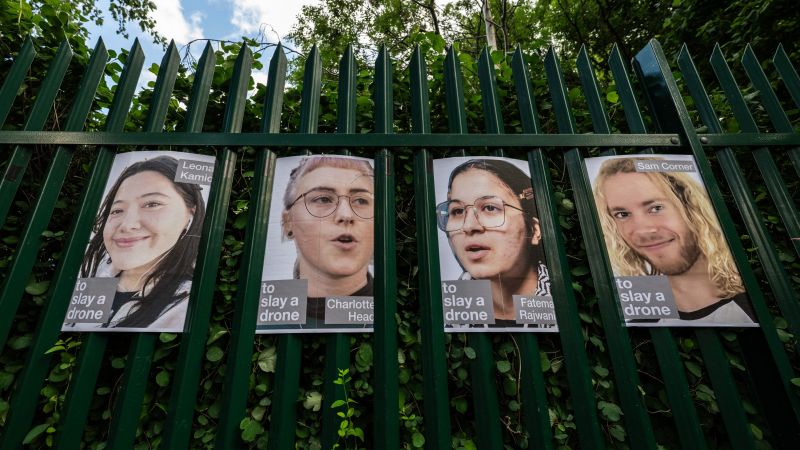
Charlotte Head, 30, Samuel Corner, 23, Leona Kamio, 30, and Fatema Zainab Rajwani, 21, were members of Palestine Action, a group that has faced legal scrutiny for its role in the incident. The sentencing at Woolwich Crown Court marked a significant escalation in their penalties, with the judge emphasizing the seriousness of the terrorism-related aggravating factor. Corner, who was found guilty of using a sledgehammer to strike a police officer, received the longest sentence of seven years and eight months, despite his lawyers arguing that his autism did not justify the force he applied.
Legal Rulings and Controversies
While the court acknowledged that Palestine Action was not a proscribed terrorist organization at the time of the raid, it determined that the actions had a clear connection to terrorism due to the scale of property damage and the intent to sway government policy. This reasoning sparked criticism from human rights advocates and high-profile supporters. “It is completely disproportionate to punish protesters for criminal damage as if they were terrorists,” said Kerry Moscogiuri, chief executive of Amnesty International UK. The group’s lawyers contended that the activists were not charged with any terrorist offense, yet their sentences were framed as if they were.
Outside the courtroom, police reported that over 100 people had been arrested for supporting Palestine Action, underscoring the group’s influence and the broader political tensions surrounding the issue. The High Court had previously ruled the proscription of Palestine Action as unlawful, but the government is appealing the decision, with a final ruling expected on Monday. This legal battle has intensified debates about the classification of the group’s activities and whether they should be seen as militant or merely political.
Impact on Elbit and Staff
Elbit Systems, the Israeli firm whose facility was attacked, stated in impact statements that it had received nearly £1.2 million from insurers to cover the damages. However, the company highlighted the long-term effects on staff safety and morale, particularly following the destruction of specialist military drone equipment, IT systems, and computers. These items, crucial for the firm’s operations, were damaged during the raid, raising concerns about the disruption to Israeli defense capabilities.
The activists, who described the attack as a necessary response to Israel’s “genocide” in Gaza, denied targeting people and emphasized their goal of destroying weapons. They argued that the court’s decision to classify the offense as terrorism was unjust, as criminal damage is typically not treated in the same manner as acts of terrorism within the UK legal system. “This is a dangerous precedent,” said one of their lawyers. “The evidence does not support treating their actions as terrorist offenses, yet the sentences reflect that interpretation.”
Public Reaction and Condemnation
A coalition of 100 public figures, including author Sally Rooney, activist Greta Thunberg, and actor Steve Coogan, signed an open letter condemning the sentences. They warned that equating criminal damage with terrorism could lead to a miscarriage of justice, particularly for individuals who have no prior criminal history. The letter urged the government to reconsider the severity of the punishments, arguing that the activists’ actions were motivated by a desire to halt violence rather than to commit attacks.
Amnesty International UK’s chief executive, Kerry Moscogiuri, warned that the labeling of the activists as terrorists could have lasting implications, given the permanence of the sentences. “Punishing protesters for criminal damage as if they were terrorists is not only unfair but also sets a dangerous standard for future cases,” she stated. The court’s decision has drawn attention to the broader implications of how the UK justice system handles politically motivated crimes, with critics suggesting it could criminalize dissent against Israel.
Broader Implications
The case has also sparked discussions about the UK’s stance on Israel and the role of international support in shaping legal outcomes. Notably, the UK recently blocked a visit by pro-Palestinian US streamer Hasan Piker, further illustrating the diplomatic tensions between the two nations. While the activists’ sentences are now in place, they will serve their terms with a one-year probation period after release, leaving room for future legal challenges.
As the debate over the classification of Palestine Action continues, the sentencing of these four individuals remains a pivotal moment in the UK’s approach to handling anti-Israel protests. The court’s acknowledgment of the terrorism connection underscores the gravity of the offense but also raises questions about the balance between national security and the rights of protesters. For the activists, the sentences will shape their futures, while for the UK, the case highlights the complexities of aligning political goals with legal accountability.
