‘I love the inflation’: Breaking down the Vance vs. Whoopi debate about what Trump said

‘I Love the Inflation’ Sparks Debate: Trump’s Remarks Under Scrutiny
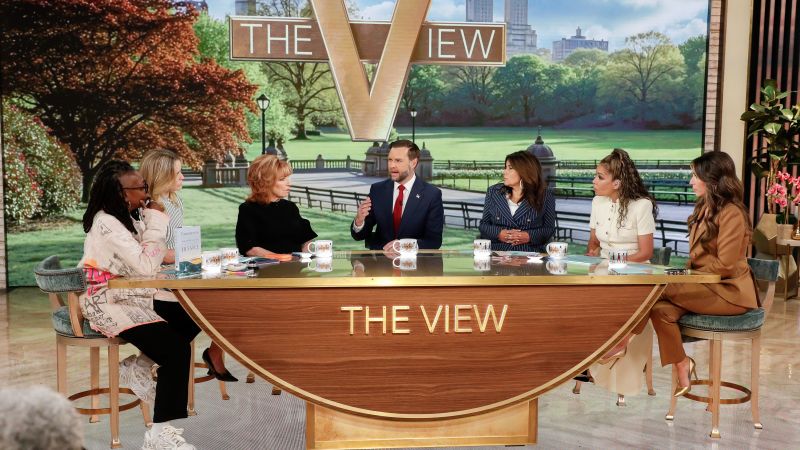
I love the inflation – President Donald Trump’s brief statement—“I love the inflation”—has ignited a fierce debate between Vice President JD Vance and co-host Whoopi Goldberg on ABC’s *The View*. The June 16, 2026, clip, shared widely on social media, became a flashpoint for analyzing Trump’s communication style. While Vance attempted to reframe the remark as an optimistic nod to future economic trends, Goldberg challenged the interpretation, emphasizing the president’s intent. This clash highlights the challenges of deciphering Trump’s rhetoric, where brevity often masks complexity, and context can shift dramatically within a single exchange.
Contextual Nuances in Trump’s Statement
Vance argued that the remark was part of a broader narrative, suggesting Trump’s words were a strategic pause in discussing the impact of military actions on inflation. “What he said is that he loves the fact that the inflation is going to come down when this war is over,” Vance explained, framing the president’s comments as a calculated observation. However, Goldberg dismissed this, stating, “That’s not what he said,” to underline the literal interpretation of Trump’s words. The tension between these perspectives reveals how the same phrase can be viewed through different lenses, depending on the speaker’s framing.
The full video of Trump’s remarks shows the phrase emerged in a moment of rapid-fire commentary. After being asked about the Consumer Price Index report, which noted a 4.2% price increase since May 2025—the highest in three years—Trump responded with unbridled confidence. “No, I love it. The numbers were great,” he said, before pivoting to a story about military operations in the Persian Gulf. This seamless shift, characteristic of Trump’s speaking style, connected economic data to geopolitical events, creating a narrative that linked inflation to strategic decision-making.
Trump’s Rhetorical Strategy: ‘The Weave’
Trump frequently refers to his delivery as “the weave,” a tactic that allows him to transition between unrelated topics with minimal transition. In this instance, his explanation of the inflation remark began with the phrase “because as soon as this war is over,” which Vance later attributed to Trump’s intended meaning. However, the video reveals Trump did not complete that sentence as Vance described. Instead, he focused on a specific military operation, illustrating how his rhetoric often prioritizes storytelling over structured argumentation.
“You know who doesn’t know about it: Iran, until right now,” Trump declared, recounting a covert strike that destroyed 22 ships. “We took out the other night, 22 ships. Late at night, with no lights, because they don’t have any radar, because we blasted the crap out of it.” This anecdote, though vivid, underscored his tendency to conflate economic statements with military achievements, framing inflation as a result of his aggressive foreign policy. By doing so, he reinforced the idea that his actions directly influence economic outcomes, even when the immediate context seems to suggest otherwise.
As the interview unfolded, Trump continued to intertwine his economic claims with geopolitical narratives. He recalled the pre-war economic boom, noting that stock markets had reached record highs and 401(k) accounts were at their peak. “We had just hit the highest stock market in history, highest 401(k)s in history,” he said, before shifting to a defense of attacking Iran’s nuclear facilities. “I hate to do this to you guys, but Iran’s going to have a nuclear weapon very soon. We have to go and attack,” he insisted. This pattern of association demonstrates how Trump uses economic language to bolster his political narrative, often at the expense of clarity.
Reframing the Narrative: Vance vs. Goldberg
Vance’s interpretation of Trump’s remarks sought to create a positive light, positioning the president as a forward-thinking leader who acknowledged inflation as a temporary challenge. “He was explaining what the president might possibly have intended,” Vance asserted, implying that the phrase was part of a larger, coherent thought. This defense aligned with Trump’s earlier attempt to downplay the controversy, where he had provided a similar explanation to a friendly newspaper. By recontextualizing the statement, Vance aimed to mitigate its potential impact on Trump’s public image.
Goldberg, however, emphasized the president’s directness, arguing that the phrase was meant to be taken at face value. “That’s not what he said,” she reiterated, highlighting the importance of literal interpretation in political discourse. Her critique underscored the risk of overanalyzing Trump’s comments, where a single phrase can be amplified or distorted by different interpretations. This exchange has sparked wider conversations about how leaders’ words are dissected, with the phrase “I love the inflation” becoming a symbol of the broader debate over economic policy and communication strategy.