
Why these adults are suddenly obsessed with a kids toy from the late 90s
Adults Revive Childhood Pastime with Resurgence of Beyblade Craze
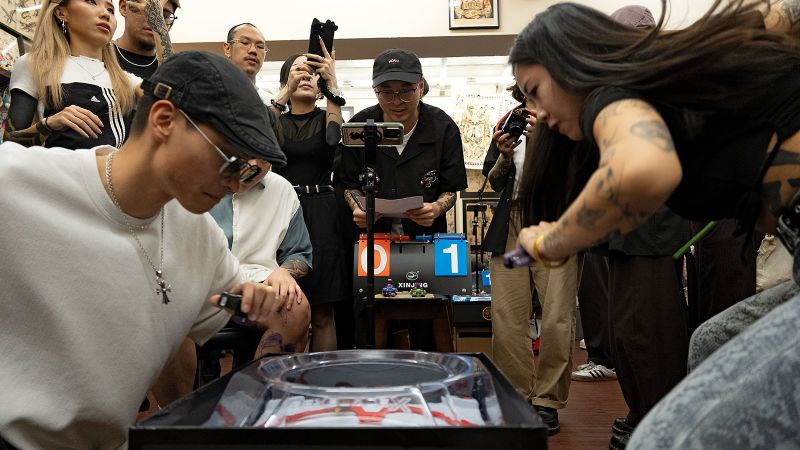
Why these adults are suddenly obsessed – Once a staple of playgrounds, the iconic spinning top toy Beyblade has found a new audience among adults in Asia. In a bustling corner of Hong Kong’s nightlife, a tattoo parlor has transformed into a battleground for enthusiasts, where the usual hum of machines and the sounds of ink being applied are replaced by the rhythmic clatter of steel and plastic. This unexpected shift in activity has drawn crowds of young adults, eager to engage in competitive play with their childhood favorites. The scene is one of camaraderie and intensity, as players gather to test their skills in impromptu matches, far removed from the casual pastimes of their younger years.
A Nostalgic Reawakening
The Beyblade’s resurgence is rooted in its origins as a Japanese innovation. First introduced in 1999, the toy was inspired by traditional beigoma spinning tops, blending cultural heritage with modern mechanics. Its popularity peaked in the late 90s and early 2000s, becoming a global phenomenon among children. However, as decades passed, the toy faded from mainstream attention, leaving many to believe it was a relic of the past. That perception is now changing, with a new generation of adults rediscovering its appeal through social media and community events.
At The 59 Tattoo in Wan Chai, the space has become a hub for these adult players. The parlor’s usual focus on tattoos has taken a backseat as tables are pushed aside to accommodate Beyblade tournaments. Marcus Yuen, the shop’s founder, recalls his own childhood memories of playing with the toy in parks. “Back then, kids would gather and compete with whatever they had,” he said. “But as we grew older, the excitement faded.” Yuen’s rediscovery of Beyblade came from a younger colleague, reigniting his passion and prompting him to host local competitions. “It’s a pure joy to see people reconnect with the game,” he added, noting that the tournaments have become a way to foster community bonds.
From Parks to Plazas: A New Culture of Play
While the tattoo parlor hosts structured matches, Beyblade battles are sprouting in unexpected places. In Tseung Kwan O, a suburban park has become a makeshift arena, with fans setting up battle stations across its grounds. The event draws a diverse crowd, including kids facing off against adults their parents’ age. This informal setting mirrors the spontaneity of street basketball, where no tickets are needed and the rules are simple: keep your Beyblade spinning and avoid being knocked out of the ring. The stadium—a large, circular plastic panel—serves as the battlefield, and the outcome often hinges on strategy, precision, and luck.
Players have also adapted to the absence of dedicated arenas. In some cases, Chinese woks have been repurposed as unconventional battle zones, with social media videos capturing the creativity and determination of participants. The game’s simplicity and accessibility have fueled its revival, allowing fans to bring their own makeshift stadiums to public spaces. “There’s something magical about the way the Beys move,” said Tria John Bernard Benito, a competitor in one of the park’s gatherings. “It’s like watching a miniature war unfold.” For Benito, the toy’s return represents more than just nostalgia—it’s a chance to reclaim the joy of childhood play.
Driven by Competition and Connection
The Beyblade’s comeback is not just a matter of nostalgia; it’s also fueled by the competitive spirit it evokes. Tiff Tam, 28, is one of the many adults who have embraced the trend, spending nearly $400 on a collection of customizable “Beys.” Named after weapons and characters like “Saber Samurai” and “Arrow Wizard,” these toys allow players to tailor their designs for maximum performance. Tam initially hesitated to join the craze, questioning its appeal. “I didn’t see why anyone would still care about this,” she admitted. But after trying it out, she was hooked. “The tension, excitement, and sense of rivalry are unforgettable,” she said.
Leo Tsoi, CEO of Toys “R” Us, described the phenomenon as “unprecedented.” The toy’s renewed popularity has led to long lines outside stores in cities like Hong Kong and Taipei, with some fans traveling to Japan to secure rare models. Scalpers have capitalized on the demand, reselling these coveted items for up to $80—ten times their original price. This surge in interest has created a cultural shift, as adults once again find value in a toy that was designed for children. “It’s amazing how something so simple can bring people together,” Tsoi remarked, highlighting the toy’s role in bridging generational divides.
The appeal of Beyblade extends beyond its physical form. For many, it’s a symbol of connection in a society increasingly dominated by digital interactions. “You can’t really compare the buzz of a live match to scrolling through a screen,” said one fan. The kinetic energy of the game—where players shout commands, hold their breath, and strategize in real time—creates moments of shared experience. In a world where smartphones often mediate human contact, Beyblade battles offer a rare opportunity for face-to-face engagement. “It’s like a return to the basics,” noted Hui, a co-organizer of the Tseung Kwan O gatherings. “We’re not just playing a game; we’re reconnecting with old friends and building new ones.”
The revival also reflects a broader trend in adult hobbies, where childhood toys are being reimagined for modern audiences. Beyblade’s return to prominence is a testament to the enduring power of play, as well as the nostalgia that lingers in the hearts of those who grew up with it. For some, like Yuen, it’s a way to relive memories of a simpler time. For others, like Benito, it’s a fresh start in a world that often feels too fast-paced to enjoy the small, joyful moments. As the craze continues to spread, it’s clear that Beyblade is more than just a toy—it’s a cultural phenomenon that has found a new lease on life.
A Social Experiment in Action
What began as a niche hobby has now evolved into a social experiment, proving that childhood games can still captivate adults. In Hong Kong, the tattoo parlor’s Beyblade tournaments have become a highlight of the week, drawing players from nearby neighborhoods and studios. The event’s success is a reflection of how deeply the toy has resonated with its new audience. “It’s not just about winning,” Yuen said. “It’s about the way people come together, even if they’re strangers.”
As the Beyblade’s popularity grows, its influence extends beyond the physical game. Online communities have formed around the toy, with fans sharing tips, battling in virtual spaces, and tracking the value of rare models. This digital engagement has amplified the toy’s reach, allowing it to transcend geographic boundaries. In Tokyo, Seoul, and Singapore, the craze is gaining momentum, with local events and stores catering to the demand. The toy’s journey from a child’s toy to a grown-up pursuit underscores its ability to adapt and thrive in changing times.
The Beyblade’s revival is a reminder that play can be a powerful force, capable of uniting people across generations and cultures. Whether in a tattoo parlor or a suburban park, the toy has become a symbol of resilience and shared nostalgia. For those who once dismissed it as a trivial pastime, the game now represents a meaningful connection to their roots. As the competitions continue to draw larger crowds, it’s evident that the spinning top has found a new home in the hearts of adults—proving that some childhood joys never truly fade.
