
Hobbit-like humans may have scavenged Komodo dragons’ leftovers to survive
Hobbit-like Humans May Have Scavenged Komodo Dragons’ Leftovers to Survive
Hobbit like humans may have scavenged – Recent findings challenge long-held assumptions about the lifestyle of Homo floresiensis, the diminutive hominin species discovered on the Indonesian island of Flores. Researchers suggest that these ancient human relatives, famously dubbed “hobbits” due to their small stature, might have relied heavily on scavenging rather than actively hunting large animals or using fire to cook their meals. This new study, published in the journal *Science Advances*, adds to a growing body of evidence that questions whether Homo floresiensis possessed the advanced cognitive abilities once attributed to its human ancestors.
Discovery in Liang Bua Cave
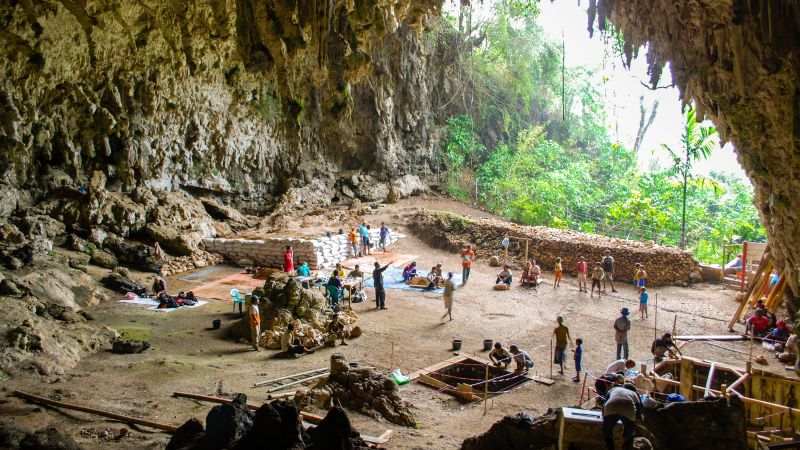
The initial discovery of Homo floresiensis in 2003, made in the Liang Bua cave on Flores, sparked intense debate about its place in human evolution. Fossils unearthed there revealed a hominin species with a brain size roughly equivalent to that of a chimpanzee, standing only about 3.3 feet (1 meter) tall. These traits, combined with the presence of stone tools and bones of extinct elephants like Stegodon florensis insularis, initially led scientists to speculate that the hobbits had hunted large herbivores and used fire to process their food.
However, a closer examination of the evidence now casts doubt on these assumptions. The team of researchers, led by Dr. Elizabeth Grace Veatch, a paleoanthropologist specializing in human diets and animal interactions, investigated how these early hominins survived on an isolated island. Veatch’s study focuses on the aftermath of Stegodon deaths, analyzing how their remains were altered by both natural processes and human activity.
“I wanted to see if we really could show that H. floresiensis was the hunter it had been portrayed as for decades,” Veatch wrote in an email, explaining the motivation behind her work. She is a lead author of the study and a research associate in the Human Origins Program at the Smithsonian Institution’s National Museum of Natural History.
The Komodo Dragon Connection
One of the most intriguing aspects of the study involved an unexpected collaboration with wildlife experts. To better understand how Homo floresiensis might have interacted with Stegodon remains, the researchers turned to Georgia’s Zoo Atlanta. There, they observed a Komodo dragon named Rinca feeding on a goat carcass, noting the specific bite patterns it left on the bones. This experiment helped the team compare the tooth marks of the giant lizards with those made by human tools, shedding light on the nature of the hobbits’ feeding habits.
The findings revealed that Komodo dragons typically target the most nutritious parts of an animal, leaving behind distinctive marks on the bones. In contrast, the cut marks made by Homo floresiensis tools were found in less desirable areas of the Stegodon remains. This suggests that the hobbits were not actively hunting the large herbivores but instead scavenging the leftovers left by the island’s sole carnivorous predator. The researchers argue that the tools used by Homo floresiensis were likely designed to extract meat from bones, not to kill the animals outright.
Reassessing Evolutionary Traits
The study’s implications are significant for our understanding of human evolution. Previously, the presence of stone tools and burned bones was interpreted as evidence of advanced hunting and cooking behaviors, traits commonly associated with larger-brained hominins such as Homo erectus, Neanderthals, and modern humans. However, this new research indicates that Homo floresiensis may have lacked the cognitive complexity to hunt or cook, instead adapting to a survival strategy that capitalized on the natural behavior of Komodo dragons.
Veatch and her colleagues conducted a multifaceted analysis of the Stegodon bones, using 3D scanning techniques to map the patterns of damage left by both predators and tools. Their comparison showed that the marks on the bones were more consistent with those made by Komodo dragons than by human activity. This aligns with the hypothesis that the hobbits were opportunistic scavengers, using their tools to access meat from carcasses rather than relying on brute strength or fire to prepare food.
Stegodon florensis insularis, the extinct elephant relative found alongside Homo floresiensis fossils, was a massive creature weighing approximately 1,260 pounds (570 kilograms) and measuring about 5 feet (1.5 meters) at the shoulder. While these animals were likely a primary food source, the evidence now points to a scenario where Homo floresiensis acted as a secondary consumer. The presence of thousands of stone tools near the fossils supports the idea that these early hominins were adept at processing meat, but the placement of the cut marks suggests they were not the ones responsible for killing the Stegodons.
“Thousands of tools have been found alongside Homo floresiensis fossils, suggesting the early hominins were crafting what they needed to extract meat from the bones of Stegodon,” said Briana Pobiner, a paleoanthropologist and coauthor of the study. This raises questions about the sophistication of their tool use and whether it was driven by hunting or scavenging.
Implications for Human Evolution
The study’s conclusions may shift how scientists view Homo floresiensis’ evolutionary role. If these humans were primarily scavengers, their survival strategy could have been more efficient for their small size and limited brain capacity. This challenges the notion that tool use and fire control are exclusive to advanced hominins. Instead, it highlights the adaptability of early human species and the possibility that different groups evolved distinct survival strategies based on their environments and available resources.
Veatch emphasized that the findings do not diminish the significance of Homo floresiensis but rather provide a more nuanced picture of its capabilities. “The potential connection between hunting tools and fire use in Homo floresiensis has even led some researchers to believe that the hobbits were closely related to Homo erectus,” she noted. However, the new data suggest that fire may not have been a critical part of their daily life, as the evidence of burned bones was not as prevalent as once thought.
By examining the interaction between Homo floresiensis and Komodo dragons, the research team uncovered a fascinating link between predator and scavenger. The Komodo dragon’s role as a natural predator on Flores may have created opportunities for the hobbits to exploit, allowing them to survive without the need for complex hunting techniques. This strategy would have been advantageous in an environment where resources were limited, and the risk of injury from large prey was high.
The study also underscores the importance of context in interpreting ancient behaviors. While Homo floresiensis may not have been as advanced as previously believed, their ability to adapt to their surroundings demonstrates a level of intelligence that should not be overlooked. The combination of tools and scavenging habits suggests they were resourceful, making the most of what was available rather than relying on elaborate hunting methods or cooking fires.
Looking Ahead
As the research continues, scientists are eager to explore more about the daily lives of these early hominins. The findings from this study could lead to further investigations into how Homo floresiensis interacted with other species on Flores and how their unique traits shaped their survival. This new perspective on scavenging behavior may also inform broader discussions about the diversity of human evolutionary paths and the range of strategies that early species employed to thrive in their ecosystems.
The study’s implications extend beyond the hobbits themselves. They challenge the assumption that advanced behaviors are the sole domain of large-brained hominins and open the door to new interpretations of ancient human societies. By reevaluating the evidence, researchers are uncovering a more complex and dynamic picture of human evolution—one that includes a variety of survival strategies and the influence of environmental factors on behavioral development.
