America wants to wean itself off Chinese technology. Will the pain pay off?

Daftar Isi
The Cost of Cutting China Out of America’s Tech Supply Chain
Earthguardiansonline.com – For years, US technology companies built their products around a simple commercial reality: China could supply a vast range of components quickly, cheaply and at a scale few other countries could match. That equation is now shifting as Washington expands restrictions on Chinese-made technology and pushes companies to find alternatives.
For startups such as San Francisco-based Chef Robotics, the transition is more than a policy debate. It is an immediate manufacturing problem involving price, availability and the technical ability to make specialized parts elsewhere.
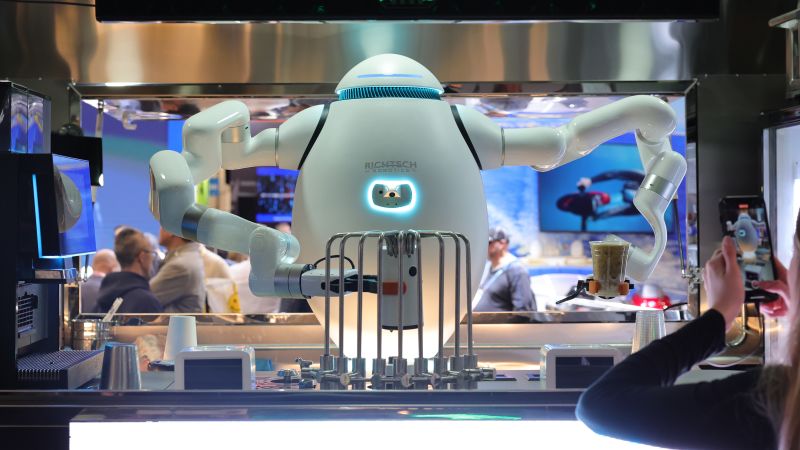
Chef Robotics sells robotic arms to food manufacturers seeking to automate the preparation of ready-made meals. Seven years after creating the company, founder Rajat Bhageria is trying to reduce its reliance on Chinese parts, even though many US robotics businesses have long depended on suppliers there.
China’s industrial base has become central to the global production of competitively priced electronics and automation equipment. As the country gains ground in areas including electric vehicles and factory automation, the United States has adopted a more protectionist approach under President Donald Trump. Restrictions now reach drones, mobile robots and other important electronic products.
“For a while of course, it was like, ‘Hey, let’s find the best components, and let’s find them at the cheapest price,’” Bhageria said.
That calculation has changed as investors and customers increasingly ask why foreign-made parts remain in a product’s supply chain.
“Why are you still using foreign-made parts?”
Security concerns meet manufacturing limits
The widening US-China technology confrontation is rooted partly in concern over the security implications of relying heavily on Chinese supply chains and systems. American officials have cited the protection of sensitive consumer and government information while also seeking to encourage domestic production.
Yet the effort to exclude Chinese technology may create difficult consequences for US companies. Manufacturing capacity lost over decades of outsourcing cannot be rebuilt instantly. Businesses, universities and consumers that need both advanced and ordinary electronics can face steeper bills and longer delivery times when domestic or non-Chinese suppliers are not ready to replace established Chinese manufacturers.
Ben Armstrong, executive director of MIT’s Industrial Performance Center, studies manufacturing competitiveness and automation. He says the underlying dependence is deeply embedded in modern life.
“A lot of our digital lives are built on the infrastructure of foreign-made components and goods assembled abroad, and that’s not going to change anytime soon,” Armstrong said.
“We just don’t know how to make them in the US. So, there will be a learning curve, and during that learning curve process, the price will be high,” he said.
The issue is not necessarily a lack of demand for American-made products. Rather, it involves whether suppliers have the equipment, expertise and production volume required for particular parts at a viable cost. A company may be able to assemble its final product in the United States while still depending on an international network for smaller, highly specialized components.
A difficult search for replacement suppliers
Chef Robotics completes final assembly of its machines in the United States. However, the utensil components mounted at the ends of its robotic arms are currently produced in China. Those parts are not yet covered by existing bans, giving Bhageria time to investigate other options before a possible expansion of restrictions.
“You can imagine what’s the next shoe to drop, right? Like, the next thing might be fixed robot arms.”
Bhageria began looking at moving production last year as Trump increased tariffs on Chinese imports. The investigation showed how hard it can be to shift even a seemingly narrow portion of a supply chain. Making the plastic grabbers in the United States appeared prohibitively expensive, while many potential suppliers beyond China lacked the capability to take on the work.
“It’s actually been a much harder process than we had initially hoped,” he said. “We will even talk to some really good machine shops in the US and they’re like, ‘We can’t do this.’”
Starting early may help Chef Robotics spread out the expense and disruption of changing suppliers. But the experience illustrates a wider challenge: policies meant to reduce exposure to Chinese technology can require companies to rebuild sourcing arrangements that took years to develop.
Restrictions Continue to Broaden
The administration has shown little sign of easing its campaign against Chinese technology. In July, the Federal Communications Commission added power inverters and newly advanced robotics to its restricted foreign-made technology list. The robotics category includes humanoid machines capable of running, jumping, dancing and fighting.
Other measures have affected transportation and aerial technology. The United States has prohibited cars that use Chinese software and imposed a 100% tariff on Chinese electric vehicles. Tariffs affecting drones began last month, after new drone models were banned in December.
Each new restriction can create another round of supplier reviews for companies that use electronics, batteries, sensors, displays or automation hardware. The consequences are not confined to small startups. Large American manufacturers must also assess how deeply Chinese technology is embedded in their products and future plans.
Ford, for example, faced criticism from the Trump administration earlier this month over alleged improper ties to Chinese technology. The issue centered on the automaker’s use of electric-vehicle batteries made by CATL. Ford rejected the assertion that it was handing US manufacturing over to Chinese entities.
The time required to make changes can be substantial. Michael Murray, chief executive of Kopin Corporation, which produces optical components for drones used by the US military, said relocating some micro-display manufacturing from China has taken the company more than two years.
What the transition may mean
The policy goal is clear: reduce strategic dependence on China while stimulating more American industrial capacity. The practical challenge is that supply chains are systems, not single purchases. Replacing one imported component may require new machinery, new supplier relationships, different materials, testing and production adjustments.
For companies like Chef Robotics, the question is not simply whether Chinese components can be removed. It is whether replacements can be made in sufficient quantity, at acceptable quality and without pricing the final product beyond customers’ reach.
The answer will shape how quickly the United States can turn technology restrictions into a durable domestic manufacturing advantage. Until then, businesses attempting to comply may face the same costly learning curve that Bhageria has already encountered.
Related Reading
Frequently Asked Questions
What is America wants to wean itself off Chinese?
America wants to wean itself off Chinese is the main topic of this guide. The article explains the context, practical details, and next steps readers should understand.
Why does America wants to wean itself off Chinese matter?
America wants to wean itself off Chinese matters because readers are looking for a useful answer, not just a short summary. Good content should match search intent and help them decide what to do next.