
Trump will present the World Cup trophy. It could be VERY awkward
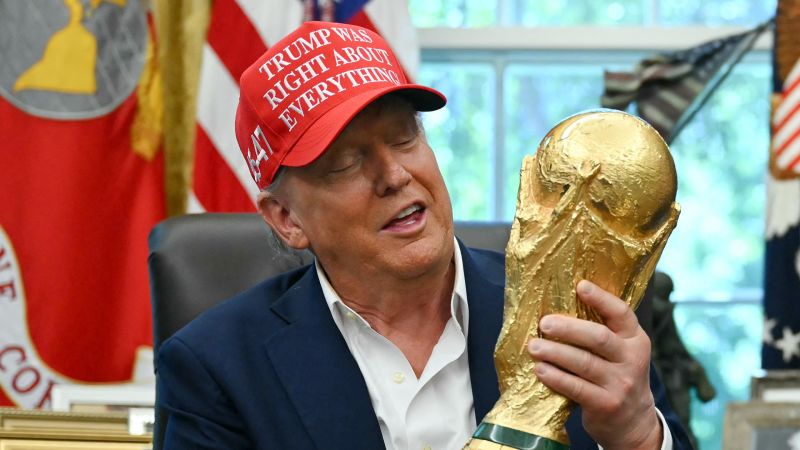
Trump to Present World Cup Trophy, Risking Political Tensions
Trump will present the World Cup trophy – This story was featured in CNN’s What Matters newsletter. Subscribe for free updates here. On July 19, 2026, US President Donald Trump is set to present the World Cup trophy, a moment that could highlight the country’s complex international relationships. While the final match’s outcome remains uncertain, the event itself has sparked concern about potential awkwardness, given Trump’s history of contentious rhetoric and policies toward global allies.
Controversies in Trump’s Foreign Policy
Trump has long been known for his assertive foreign strategy, often framing his actions as a form of “America First” diplomacy. His approach has included military interventions, economic sanctions, and verbal attacks on nations he perceives as adversaries. For instance, he has engaged in open conflict with Iran, despite the country’s continued presence in the World Cup. Iran’s team, facing additional restrictions during the tournament, has not been eliminated, raising questions about how Trump’s policies might affect global sports events.
“Iran is a disaster. Their leaders are weak, and their people are too.”
Similarly, Trump criticized Spain, calling it a “horror show” for opposing his war on Iran. His sharp words extended to other countries as well, including Australia, which he has previously named in his list of nations failing to support the conflict. Even though he launched the Iran war alongside Israel, Trump did not attempt to build a broad international coalition before doing so.
His relationship with NATO has also been volatile. The alliance, a cornerstone of Western European defense, has felt the strain of Trump’s unpredictable behavior. In a memorable jab, he referred to Brussels, the heart of NATO, as a “hell hole.” He further mocked Norway, labeling it a “joke” because he did not receive the Nobel Peace Prize there. FIFA, the international soccer governing body, later awarded him a peace prize in recognition of his role in the global competition.
Immigrant Players and Legal Ambiguity
The US Men’s National Team has surprised many with its dominant performance in the group stage, earning praise for its resilience and skill. However, the team’s success may also underscore a deeper issue: the role of immigrant players in American sports. Folarin Balogun, the team’s top scorer after two matches, exemplifies this. His Nigerian mother was seven months pregnant when she couldn’t leave New York, a situation that shaped his early life. Though he grew up in the UK and plays professionally for Monaco in France’s top league, Balogun’s eligibility to represent the US relies on birthright citizenship.
The 14th Amendment guarantees birthright citizenship to anyone born on US soil, but Trump’s administration is challenging this right. A recent Supreme Court decision, influenced by conservative justices, could allow him to revoke temporary legal status for Haitians, despite his earlier support for welcoming White South Africans to the US. This move highlights a shift in his approach to immigration, contrasting with his previous stance on asylum seekers.
“Haiti is a shithole country. Their people are taking our jobs and straining our resources.”
Trump’s policies have also targeted other nations. Mexico and Canada, fellow host countries, have faced tariffs and threats to their sovereignty. He proposed a border wall between the US and Mexico, while suggesting Canada’s independence might be at risk. Meanwhile, he has expressed interest in reclaiming the Panama Canal, a symbol of US influence that was transferred to Panama by Jimmy Carter.
Political Maneuvers and Global Alliances
Trump’s political strategies extend beyond sports. In South America, he has actively influenced elections, offering Argentina a bailout to support his friend, President Javier Milei, who is running in a tight runoff. The US also maintains a strong relationship with Paraguay, where it sees opportunities for data center development. Ecuador, too, has aligned with the US through military collaboration in drug raids.
However, his actions have not always been consistent. While he imposed 40% tariffs on Brazil to punish its opposition to former President Jair Bolsonaro, he praised Bolsonaro’s leadership despite his 27-year prison sentence for orchestrating an attempted coup. In Colombia, Trump endorsed a far-right opposition party, whose leader, Abelardo de la Espriella, a dual citizen, leads in the first count of a closely contested election.
His comments on South Africa have added to the tension. During a meeting in the Oval Office, Trump accused the country’s president of committing “genocide” against White farmers, a claim that has drawn criticism from international observers. This rhetoric contrasts with the Biden administration’s opposition to anti-LGBTQ laws in Ghana, where Trump’s government remained silent on a recent legislative change.
Acknowledging the Contradictions
Despite his divisive comments, Trump’s actions have sometimes led to unexpected outcomes. For example, his casual joke about Pearl Harbor during a welcome for Japan’s new leader this year showcased his ability to pivot quickly from criticism to diplomacy. Yet, the World Cup trophy presentation may serve as a reminder of the broader implications of his policies on international unity.
As the tournament progresses, the spotlight on Trump could reveal more about his diplomatic style. His interactions with leaders like those of France and Germany have been marked by a mix of charm and pressure, as both nations tried to navigate his demands without alienating the US. Meanwhile, his allies have strengthened ties with far-right parties across Europe, further entrenching his influence in global politics.
The US’s role in the World Cup may also reflect its soft power. While Trump’s actions often emphasize hard power, the tournament offers a platform for showcasing cultural and athletic diplomacy. The US team’s performance, bolstered by players like Balogun, could be a testament to the nation’s diverse roots. However, the question remains: will the ceremony itself be a source of tension, or will it provide an opportunity for reconciliation?
As the world watches the event, it will be a test of how Trump’s policies are perceived on the global stage. The trophy presentation may symbolize both the US’s international standing and the challenges it faces in maintaining alliances. With the final match yet to be decided, the World Cup serves as a microcosm of the broader political landscape, where Trump’s influence continues to shape outcomes both on and off the field.
