
US military surveillance blimp supporting CBP is lost at the southern border, wreckage found in Mexico
US military surveillance blimp supporting CBP is lost at the southern border, wreckage found in Mexico
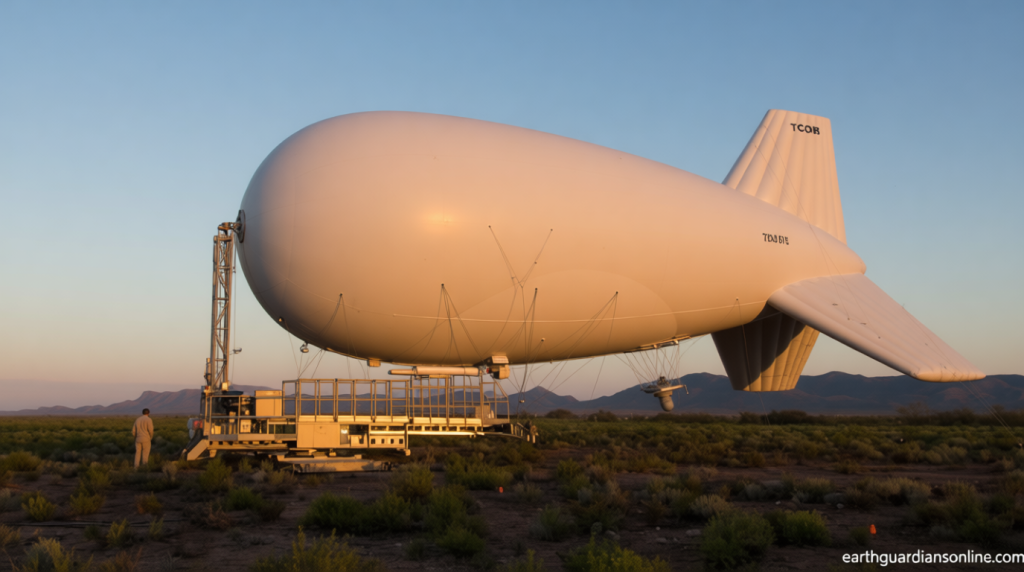
US military surveillance blimp supporting CBP is – A U.S. military surveillance blimp, managed by contractors near Laredo, Texas, detached from its mooring lines Monday evening and subsequently collided with the Mexican border, with debris located in the country. The incident occurred amid severe weather conditions, prompting a joint effort between U.S. and Mexican forces to locate and recover the craft. The blimp, which operates without a crew, did not result in any injuries to ground personnel, according to authorities. The exact location of the wreckage was confirmed by Mexico’s military, which discovered it “in a remote area southwest of Laredo,” as stated by a Joint Task Force-Southern Border spokesperson.
“The blimp’s tether cable became entangled with other lines during the storm, leading to its detachment. Operators attempted to resolve the issue but were unable to prevent the helium-filled craft from floating away,” the spokesperson added.
Monday’s weather brought heavy thunderstorms to the region, with wind gusts peaking at 44 miles per hour, as recorded by the National Weather Service. These conditions are believed to have caused the tether cable to snag with other equipment, creating a critical failure. The blimp, described as a “medium aerostat,” was part of a broader network of aerial surveillance systems deployed to monitor the border. While the military did not specify the exact model of the lost blimp, it emphasized the role of contractors in operating such assets under federal oversight.
U.S. Customs and Border Protection (CBP) has relied on contractor-operated blimps for aerial surveillance since 2012. These aircraft range from smaller tactical models to larger, more advanced systems equipped with high-resolution cameras and drone-detection radar. The current incident underscores the challenges of maintaining such equipment in volatile environments, where natural elements can disrupt operations. The CBP’s partnership with the military has expanded under President Donald Trump’s border security initiatives, integrating cutting-edge technology into its surveillance capabilities.
Despite the effectiveness of these systems, the program has faced periodic budgetary constraints. A Government Accountability Office (GAO) report from 2012 highlighted that the Department of Defense allocated over $5 billion to develop and acquire more than 140 surveillance blimps during the Iraq and Afghanistan conflicts. Many of these assets were later repurposed for border monitoring, reflecting their adaptability and strategic value. However, the reliance on contractors has also introduced complexities, including the need for continuous funding and coordination between agencies.
The recent loss follows a similar incident in March 2025, when a 200-foot aerostat operating on South Padre Island, Texas, broke free from its tether and drifted nearly 600 miles before crashing into power lines near Dallas. That event, which caused minor disruptions, raised questions about the reliability of long-range blimp operations. In contrast, the Monday incident involved a smaller craft, but its detachment still required immediate response from both sides of the border. Mexican and U.S. troops are now working together to retrieve the wreckage, which is believed to be intact despite the long journey.
CBP’s use of military-grade technology has been a cornerstone of Trump’s campaign to strengthen border security. The agency’s efforts include not only blimps but also laser systems and other advanced tools to intercept unauthorized aerial activity. However, these measures have occasionally led to unintended consequences, such as the FAA’s sudden closure of civilian airspace over El Paso in February. The decision came after CBP deployed a high-energy anti-drone laser system provided by the Pentagon, which was used to target balloons and other aerial threats.
While the Monday incident did not involve any direct threat to the public, it serves as a reminder of the vulnerabilities inherent in aerial surveillance. The blimp’s detachment highlights the need for robust maintenance protocols and real-time monitoring, especially in regions prone to extreme weather. The Joint Task Force-Southern Border has since reiterated the importance of securing equipment, emphasizing that the blimp’s loss was an isolated event rather than a systemic failure.
Details about the specific model of the lost blimp remain classified, but its role in border operations is clear. Contractors under the task force are responsible for maintaining and operating these systems, which provide critical data to Border Patrol agents. The incident has sparked discussions about the balance between technological innovation and operational safety, with officials acknowledging the risks of deploying such equipment in unpredictable conditions.
The U.S. military’s involvement in border surveillance reflects a broader strategy to leverage aerospace assets for security purposes. From high-altitude blimps to drones and satellites, these tools are designed to enhance monitoring capabilities and respond to threats with speed and precision. However, their deployment also requires careful coordination with local and international partners, as demonstrated by the ongoing efforts to recover the wreckage in Mexico.
As the search for the lost blimp continues, the event has drawn attention to the growing reliance on aerial platforms for border control. While these systems offer significant advantages, they also introduce new challenges, such as the potential for equipment failure and the logistical demands of cross-border recovery. The incident may prompt a review of current protocols, ensuring that future operations account for environmental variables and technical risks.
CBP’s role in President Trump’s border security agenda remains pivotal. The agency’s integration of military resources has intensified its ability to monitor and intercept cross-border activity, yet it has also led to occasional disruptions. The use of the anti-drone laser system, for instance, demonstrated the dual-edged nature of such advancements—enhancing surveillance while creating temporary closures of critical airspace.
With the wreckage now in Mexican territory, the situation has taken on an international dimension. This collaboration between the two nations underscores the shared responsibility in border security and the necessity of joint operations to address incidents that transcend national boundaries. As the military and CBP assess the damage, they are also evaluating how to prevent similar occurrences in the future.
Editor’s Note: This story and headline were updated based on additional reporting to clarify that the blimp was operated by military contractors. Davis Winkie’s work at CNN is supported by a partnership between Outrider Foundation and Journalism Funding Partners (JFP). CNN retains full editorial control of the reporting.
