
US service member arrested at Capitol after calling for Trump’s impeachment
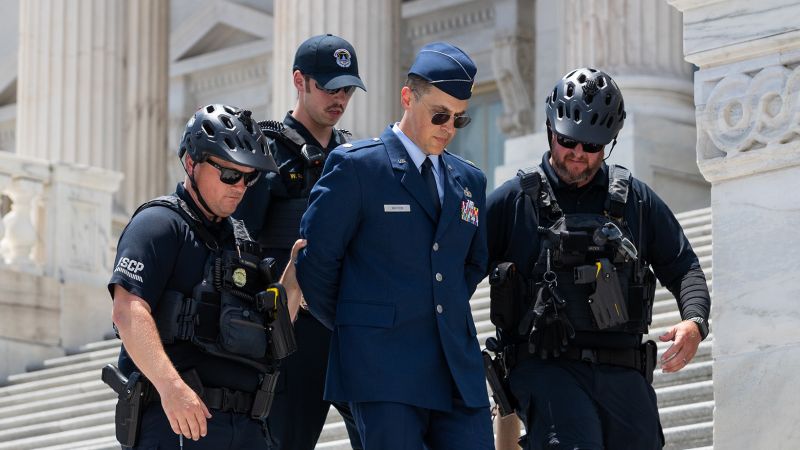
U.S. Air Force Major Detained at Capitol Following Speech on Trump’s Impeachment
US service member arrested at Capitol – On Wednesday, a U.S. Air Force major was detained near the entrance of the U.S. Capitol after delivering a speech advocating for the impeachment and removal of President Donald Trump and Vice President JD Vance. The incident, which occurred during a public gathering organized by the Removal Coalition, a grassroots activist group, sparked discussions about the boundaries of free speech and military protocol. Capitol Police confirmed the arrest, emphasizing that the individual had crossed into a restricted area without proper authorization. This marks a notable moment in recent political discourse, as it highlights the intersection of military service and public dissent during a pivotal period in U.S. governance.
The Protest and Its Context
The event unfolded at the heart of Washington, D.C., where the removal of Trump from office remains a focal point of political debate. Jason Watson, the Air Force major, addressed the crowd in a formal news conference, donning a military uniform to underscore his authority and commitment. His participation in the demonstration was not incidental; he had actively sought out the Removal Coalition, aligning himself with their cause. Democratic Representative Al Green of Texas joined the assembly, lending credibility to the gathering and signaling bipartisan interest in the issue.
Watson’s speech centered on the Trump administration’s policies, including recent military operations in Venezuela and Iran, as well as the immigration enforcement measures implemented under Trump’s leadership. He argued that these actions contravened key constitutional principles, a claim that resonated with attendees. “For this, the president and vice president must be impeached, convicted, and removed,” Watson declared, his words captured in a video shared by the Removal Coalition. The video, which went viral, became a focal point for supporters and critics alike, amplifying the controversy surrounding the arrest.
Capitol Police Statement on the Incident
According to Capitol Police, Watson was permitted to approach the steps of the House by a member of Congress before the demonstration escalated. The police stated that the major had ignored their lawful instructions to halt the gathering, leading to his arrest under Section 22-1307 of the District of Columbia Code, which addresses crowding, obstructing, and incurring discomfort on public property. “The man refused our lawful orders and was then arrested for 22-1307,” the statement clarified, noting that the Capitol grounds offer alternative spaces for political expression. The police emphasized that such demonstrations require accompaniment by a congressional representative, a rule designed to maintain order during high-profile events.
The arrest was not an isolated incident. Capitol Police had previously cited similar violations, underscoring their authority to enforce regulations in the area. While Watson’s actions were seen as a bold statement, they also raised questions about the balance between individual rights and institutional discipline. The military uniform he wore during the protest added a layer of complexity, as it symbolized both his service and his political stance, prompting debates about the extent of military members’ freedom of speech.
Legal Proceedings and Public Reaction
Following the arrest, a DC Superior Court official informed CNN that Watson would be released, with no immediate plans to file charges. This decision came after a review of the circumstances, including the presence of a congressional delegate and the nature of the demonstration. However, the DC attorney general, who holds the final authority on prosecution, did not respond to CNN’s request for comment, leaving the matter open to interpretation.
Watson’s legal status remains uncertain, as he has yet to secure representation. This lack of legal counsel has fueled speculation about the potential consequences of his actions, particularly in light of the Uniform Code of Military Justice. Under this code, service members are required to follow orders and may face disciplinary action for contemptuous speech against top officials. Article 88 of the code explicitly prohibits soldiers from publicly criticizing the president, vice president, Congress, or other high-ranking individuals, a provision that could be invoked in Watson’s case.
Despite these restrictions, Watson’s protest was framed as a necessary act of defiance. Jessica Denson, founder of the Removal Coalition, explained that the major had contacted them via email, expressing a desire to speak out. “We started having conversations and took this desire very seriously,” she said, highlighting the group’s role in facilitating the demonstration. Denson emphasized that the coalition had carefully considered the risks involved, believing Watson’s actions would contribute meaningfully to the broader movement for accountability.
Political Implications and Support
Rep. Al Green, who attended the event, later posted a video on social media praising Watson’s decision. “I just left the Capitol grounds, and I was there to witness a major in the United States military bend the arc of the moral universe toward justice,” he stated, capturing the symbolic weight of the protest. Green’s endorsement of Watson’s actions underscores the bipartisan nature of the debate over Trump’s leadership, as well as the willingness of some lawmakers to support military members in expressing political views.
The incident has reignited discussions about the role of the military in political activism. While service members are expected to remain neutral, Watson’s arrest challenges the notion that such neutrality is absolute. His choice to don a uniform during the rally was intentional, aiming to assert his legitimacy as a representative of the public interest. This act has been interpreted as both a gesture of courage and a potential violation of military decorum, depending on one’s perspective.
As the situation unfolds, CNN continues to follow the developments, with reporters Lauren Chadwick and Katelyn Polantz contributing updates on the case. The broader implications of Watson’s arrest extend beyond his personal circumstances, touching on issues of free speech, military discipline, and the evolving relationship between the armed forces and civilian governance. For now, the major stands as a symbol of dissent, his actions a testament to the power of individual voices in shaping national discourse.
Legacy of the Protest
The protest by Jason Watson has become a case study in the challenges faced by active-duty military personnel who seek to engage in political advocacy. While the Uniform Code of Military Justice provides clear guidelines for conduct, the incident raises questions about the flexibility of those rules in modern political contexts. Critics argue that the code’s strict provisions could stifle dissent, while supporters contend that it ensures military cohesion and adherence to civilian leadership.
Watson’s arrest also reflects the broader tensions within the Capitol’s environment, where political demonstrations are tightly regulated. The steps of the House, often a stage for public statements, now serve as a site of contention between institutional authority and individual expression. As the Removal Coalition and its allies continue their efforts, the case may set a precedent for future protests involving military members, influencing both policy and public perception.
Ultimately, the incident underscores the dynamic nature of political activism in the United States. Jason Watson’s decision to stand up for his beliefs, even at the risk of arrest, highlights the courage required to challenge power. Whether his actions will lead to legal consequences or be celebrated as a milestone in the fight for accountability remains to be seen, but his presence at the Capitol has already sparked a wave of commentary and debate.
