
The American town that keeps rising from the ashes
The American town that keeps rising from the ashes
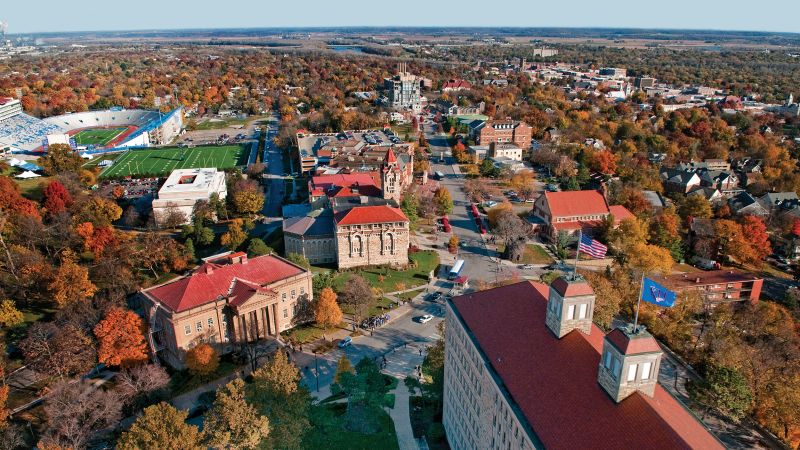
The American town that keeps rising – Lawrence, Kansas, is a hidden gem in the heart of the Midwest, where the charm of a bustling downtown street meets the echoes of a storied past. Massachusetts Street, often affectionately called “Mass” by locals, is more than just a commercial corridor—it’s a living testament to resilience, culture, and community. While the avenue is lined with boutiques, eateries, music venues, and a vibrant mix of residents and students, its character is rooted in a history of conflict and transformation. This small city, located on the eastern edge of Kansas, has repeatedly faced trials that shaped its identity, yet each time, it has emerged stronger, more united, and more determined to preserve its soul.
A History of Resilience
The town’s story began in 1854, when abolitionists laid the foundation for what would become a beacon of progress. Yet even in its early days, Lawrence was no stranger to upheaval. Just months after its founding, it became a target of pro-slavery militias, who launched a brutal siege to seize control. The attack was part of the broader Kansas conflict, a struggle that defined the nation’s path toward freedom. Two years later, the city was violently ransacked, with its hotel reduced to ashes—a stark reminder of the turbulence that shaped its beginnings.
Despite these early trials, Lawrence’s spirit endured. The town quickly became a vital stop on the Underground Railroad, offering sanctuary to those fleeing enslavement. But the challenges didn’t end there. In 1863, as the Civil War raged across the country, Confederate raiders led by William Quantrill descended upon Lawrence, killing over 150 men and boys. The attack, known as Quantrill’s Raid, left the city in ruins, yet it also solidified its reputation as a place of courage and rebirth. The phoenix, now the town’s official symbol, was not just a metaphor—it became a promise that Lawrence would rise again, stronger than before.
Fast forward to the 1970s, and Lawrence faced another test. Racial tensions and anti-war protests simmered for years, eventually erupting into violence centered on the University of Kansas. The unrest revealed the city’s deep divisions but also its capacity for growth. In response, the university launched an African and African-American Studies program, while Lawrence itself became a hub for grassroots activism, including early movements for LGBTQ+ rights. These developments marked a turning point, reinforcing the city’s role as a progressive force in American history.
The Fight for Preservation
Today, the fight in Lawrence is not against war or slavery, but against the forces of commercialization that threaten its cultural heart. In the 1980s, as shopping malls began to dominate the American landscape, Lawrence stood firm. The city resisted two major proposals: one for a sprawling “cornfield” development outside town and another for a massive downtown project that would have replaced historic buildings with a covered retail space. The resistance was led by Sarah Fayman, a textile store owner who had been in business for over a decade, and a coalition of local merchants. Their efforts culminated in the formation of Downtown Lawrence Inc., a grassroots organization that rallied public support to protect the city’s identity.
“Closing Massachusetts is a dead end,” read a protest button badge displayed at the Watkins Museum of History. The phrase, once a rallying cry, now serves as a reminder of the 1980s battle that defined Lawrence’s modern ethos. Fayman, who still owns her shop, recalls the struggle as “a very Lawrencian kind of thing.” Her determination, paired with the collective will of residents, ensured that the street remained a cultural cornerstone rather than a casualty of progress.
The heart of Lawrence has never been static. In the 20th century, it became a battleground for preservation versus development, a conflict that continues to shape its character. The city’s downtown, now a vibrant mix of independent businesses and historic landmarks, was once on the brink of being swallowed by a uniform retail complex. The struggle to save Mass Street was not just about saving buildings—it was about safeguarding a sense of community and continuity in an era of rapid change.
Walking through the city today, one can’t help but notice the quiet vitality of its streets. On warm days in late spring or early summer, the town feels like a place of endless possibility, where friendly conversations and the promise of new experiences linger in the air. Yet beneath this idyllic surface lies a history of resistance, from the abolitionists who founded the city to the activists who fought to keep it alive in the face of adversity. This duality—of peace and protest, of growth and preservation—defines Lawrence in a way few American towns can.
A Legacy in the Present
The Watkins Museum of History, nestled at the southern end of Massachusetts Street, is a key to understanding this legacy. Housed in a 19th-century former bank, the museum offers a window into the city’s past, with exhibits that highlight the street’s role as a commercial and cultural nucleus. One of its most striking displays is a button badge from the 1980s, bearing the words “Closing Massachusetts is a dead end,” a symbol of the era’s fierce defense of the city’s heritage.
Visitors to the museum often find themselves drawn to the stories of ordinary people who made extraordinary choices. Sarah Fayman, whose shop has been a fixture on Mass Street for years, represents the ongoing effort to balance tradition with innovation. Her legacy is woven into the fabric of Lawrence, where the past and present coexist in a dynamic interplay. The city’s history is not just a series of events—it’s a living conversation, one that continues to unfold in the streets and shops that have endured for generations.
Lawrence’s ability to rise from the ashes is a testament to its people. Whether it’s the quiet resilience of its residents, the vibrant energy of its downtown, or the activism that has driven its evolution, the city has always found a way to reclaim its narrative. Its story is one of courage, creativity, and community—a reminder that even in the face of conflict, there is always a chance for renewal. As the sun sets over Mount Oread, casting long shadows across the plains, Lawrence stands as a beacon of what happens when a town chooses to fight for its soul rather than let it be consumed by the march of time.
Today, the struggle for Lawrence is not just about preserving its physical landmarks, but about honoring the values that have sustained it for over 150 years. The city’s downtown is a microcosm of this effort, where independent businesses thrive alongside the echoes of history. As the World Cup draws near, the Eldridge Hotel, a symbol of Lawrence’s ability to rebuild, will host international visitors—a modern chapter in an old story of resilience. The town may have weathered wars, riots, and the threat of commercial homogenization, but its spirit remains unbroken. Lawrence, Kansas, is not just a place—it’s a living monument to the American spirit, forever rising from the ashes, ready for the next chapter.
