A landslide at a landfill in the capital of Guinea kills 30 people, officials say

Daftar Isi
Thirty Dead as Conakry’s Largest Waste Dump Collapses Under Monsoon Rains
Earthguardiansonline.com – A towering mound of accumulated garbage gave way in the pre-dawn hours of Sunday, swallowing informal dwellings at its base and claiming at least 30 lives in Conakry, the capital of Guinea. The collapse at the Dar Es Salam open-air dump — the city’s biggest waste disposal site — was triggered by a sudden downpour that began near 2 a.m., sending torrents of water cascading down the refuse slope and sending tonnes of debris tumbling into the shacks clustered along its perimeter.
The disaster underscores a recurring pattern in West African megacities: communities pressed by poverty settle on the margins of industrial and waste infrastructure, where the cost of land is zero but the risk of catastrophe is ever-present. Guinea, despite possessing the world’s largest known bauxite reserves alongside substantial deposits of iron ore, gold, and diamonds, still leaves nearly half its population below the national poverty line. The World Bank places that figure at 43.7 percent, a statistic that helps explain why families continue to build tin-roofed shelters within earshot of a mountain of rotting waste.
The Collapse and Immediate Aftermath
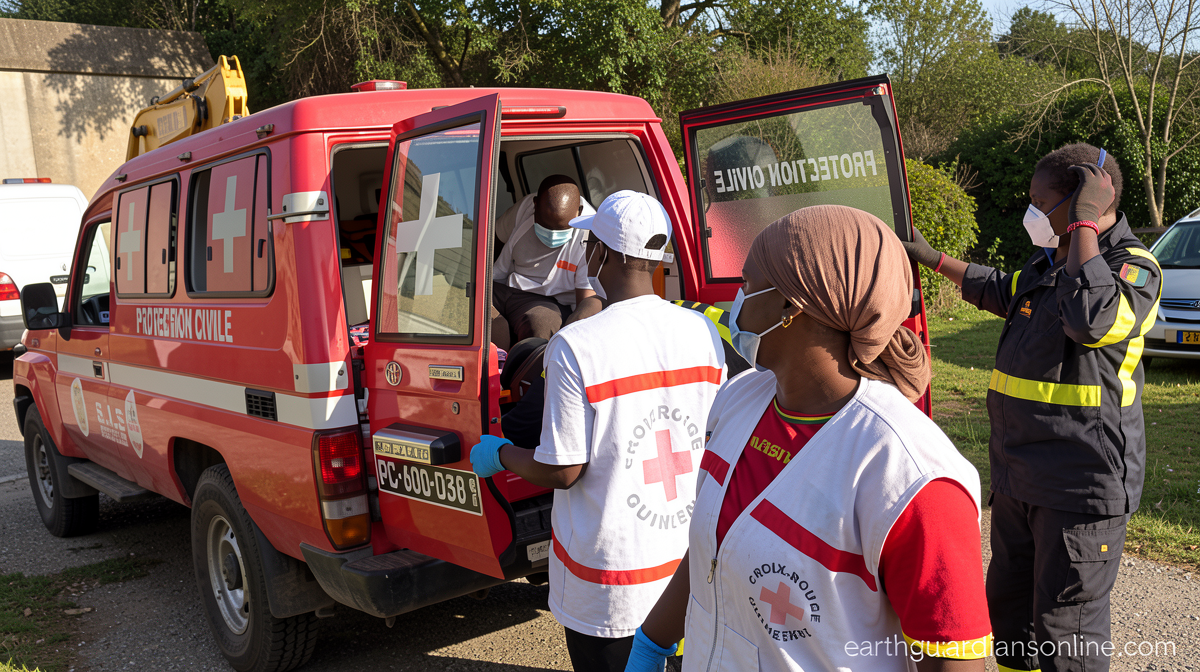
Rescue crews moved into the debris field as soon as daylight permitted, digging through collapsed structures and half-buried refuse in search of survivors. Six victims sustained serious injuries and were transported to nearby medical facilities. Several homes were flattened entirely, their contents buried under layers of compressed garbage and mud. Authorities confirmed the death toll at 30, though officials cautioned that the final count could rise as search operations continued through the day.
The timing of the rainfall proved decisive. Meteorological conditions in Conakry during the August rainy season regularly produce intense, short-duration downpours. When water saturates a steep, uncompacted slope of mixed organic and inorganic waste, the material’s shear strength drops sharply. Within minutes of the downpour beginning, the upper reaches of the Dar Es Salam heap lost cohesion and slid downward, reaching the settlement zone with little warning beyond the sound of shifting earth.
A Site Already Marked for Closure
Compounding the tragedy, the Dar Es Salam dump had been scheduled for formal closure that very Sunday. Lt. Col. Baldé Mamadou Bailo, the sanitation officer attached to the military engineering battalion responsible for municipal waste operations, confirmed the designation. In practice, however, closure of a site of this scale requires coordinated relocation of every household in the buffer zone — a process that had only partially begun.
Eviction notices had been distributed to residents living in the informal settlements ringing the landfill. Many families heeded the warnings and moved out in the preceding days. Yet a significant number remained in place on Sunday morning, either because they lacked alternative housing, because the notices arrived too late, or because the economic cost of abandoning a dwelling — however precarious — proved prohibitive. Those who stayed paid the ultimate price.
Government Response and Relocation Promises
Dienabou Touré, Guinea’s minister of territorial administration and decentralization, arrived at the disaster site and addressed survivors and bereaved families directly.
“We will ensure that the remaining families are relocated elsewhere,” Touré stated at the scene.
The minister’s remarks pointed to a broader administrative challenge: Conakry’s urban planning framework has long struggled to keep pace with rapid population growth and informal settlement. Designating a landfill for closure is a straightforward bureaucratic act; actually clearing the human settlements that have grown up around it, providing replacement housing, and guaranteeing that displaced residents are not simply pushed to another hazardous margin is a far more complex undertaking.
Mineral Wealth, Urban Poverty
Guinea’s economic profile presents a stark paradox. The country sits atop the largest bauxite deposits on Earth — the raw material from which aluminium is smelted — and also holds commercially significant quantities of iron ore, gold, and industrial diamonds. Revenue from these commodities flows largely to multinational extractive firms and, through taxation, to the central government in Conakry. Yet that wealth has not translated into adequate municipal infrastructure, particularly in waste management and housing.
The Dar Es Salam site functioned as an open-air dump: no engineered containment, no leachate collection, no slope stabilization. For years, trucks deposited household and commercial waste in ever-growing layers until the heap reached a height and gradient at which gravity, aided by seasonal rains, made failure a matter of timing rather than probability. The Sunday collapse was, in engineering terms, predictable. What made it a catastrophe rather than a near-miss was the presence of people sleeping at its foot.
As Guinea’s population continues to urbanize and its rainy seasons deliver heavier precipitation events, the question facing Conakry’s planners is no longer whether informal settlements will form near waste and industrial sites, but whether the state can identify, fund, and execute relocation before the next storm arrives. Thirty lives lost on a Sunday morning that was supposed to be the landfill’s final day of operation make that question impossible to defer.
Related Reading
Frequently Asked Questions
What is A landslide at a landfill?
A landslide at a landfill is the main topic of this guide. The article explains the context, practical details, and next steps readers should understand.
Why does A landslide at a landfill matter?
A landslide at a landfill matters because readers are looking for a useful answer, not just a short summary. Good content should match search intent and help them decide what to do next.