China postpones launch of unprecedented water-hunting moon mission amid space race

Daftar Isi
China’s Chang’e-7 Lunar Water Probe Slips Past Its Launch Window
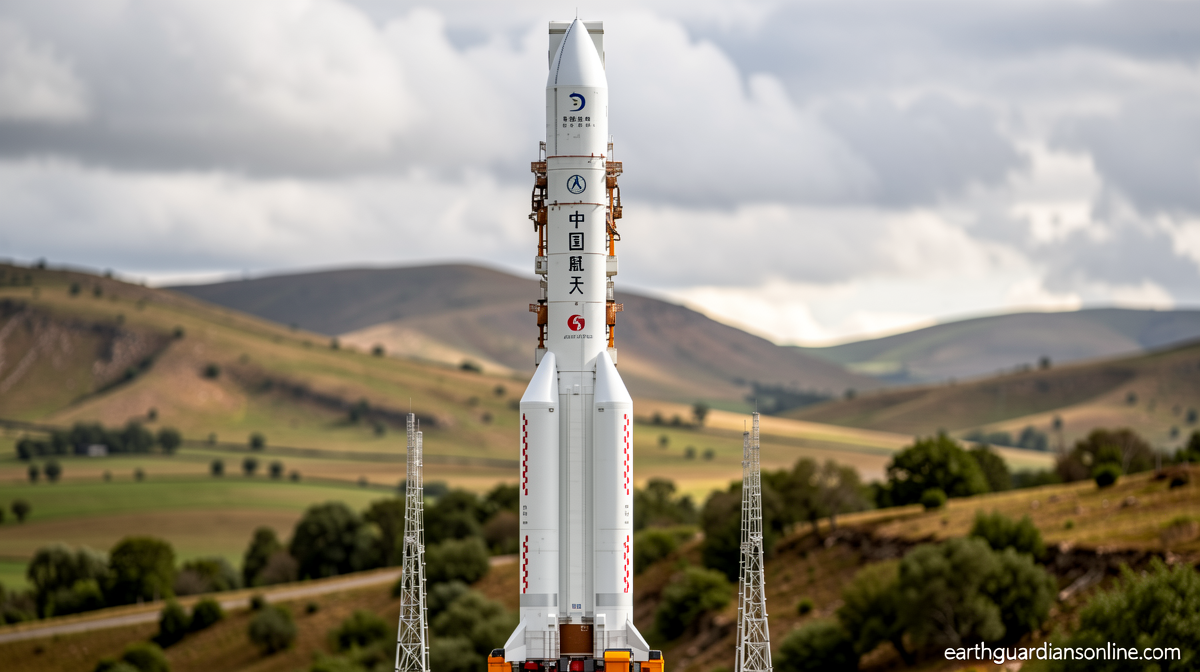
Earthguardiansonline.com – Beijing’s most ambitious attempt yet to drill into the frozen heart of the Moon’s south pole has been pushed back. The China Manned Space Engineering Office confirmed that the robotic Chang’e-7 spacecraft will not fly during the originally scheduled window later this year, ending a countdown that had drawn global attention to what could become the first direct, in-situ analysis of lunar water ice.
The probe was slated to depart as early as Sunday evening or Monday morning, Beijing time. In its place, state media carried a terse explanation: the spacecraft simply does not satisfy the required launch parameters. Officials framed the decision in language emphasizing caution over schedule.
“The lunar probe does not meet launch conditions,” the statement read, adding that “the assessment was conducted following the principle of prudence, reliability and absolute mission success.”
No further technical detail was offered. Engineers, analysts, and space agencies on both sides of the Pacific will now wait to learn whether the slip is a matter of days, weeks, or something longer.
Why the South Pole Matters
The lunar south pole has become the gravitational center of a new era of space competition. Permanently shadowed craters near that pole are believed to trap water ice in quantities large enough to sustain human presence. That single resource — frozen H₂O locked in ancient impact basins — can be split into breathable oxygen and hydrogen, purified into drinking water, or combined into liquid rocket propellant. For any nation contemplating a long-duration lunar base or a staging point for Mars missions, access to in-situ water is not a luxury; it is the difference between a sustainable outpost and a resupply-dependent outpost.
Until now, all evidence of lunar water has come from orbit. NASA’s Lunar Reconnaissance Orbiter and other satellites have mapped hydrogen signatures and estimated the volume of ice deposits from afar. Yet no spacecraft has ever broken the surface, driven a drill into the regolith, and returned a physical sample for laboratory analysis. Chang’e-7 was built precisely to close that gap: carry a drill, a mass spectrometer, and a suite of sensors capable of characterizing ice grain size, purity, and distribution at the point of extraction.
A Competitive Field That Keeps Moving
The postponement lands at a moment when American and commercial partners are accelerating toward the same terrain. Within roughly twelve months, multiple US-linked spacecraft are expected to target the south-polar region:
Astrobotic Technologies, headquartered in Pittsburgh, has its Griffin lander on a trajectory that could place it at the lunar south pole as early as late 2026. Separately, Jeff Bezos’s Blue Origin has outlined plans to deliver up to two robotic landers to the Moon next year. One of those vehicles is expected to carry VIPER, the Volatiles Investigating Polar Exploration Rover, a NASA-built prospecting robot engineered to traverse polar terrain, sample subsurface ice, and relay composition data back to Earth.
The competitive picture was already complicated by a near-miss earlier in the decade. Intuitive Machines, a Texas-based firm, launched a water-hunting drill to the south pole in 2025. The spacecraft touched down but tripped on the notoriously rugged, low-visibility terrain of the polar region and was unable to complete its science objectives. The episode underscored how unforgiving the landing environment remains and why Beijing’s own engineers may have judged the Chang’e-7 stack not yet ready for the risks of a south-polar insertion.
What the Delay Signals
For China’s lunar program, the slip is not merely a scheduling hiccup. It arrives at a transitional moment in which the country’s ambitions are migrating from broad survey work toward targeted resource exploitation. Yuqi Qian, a lunar geologist at the University of Hong Kong, framed the stakes plainly:
“With Chang’e-7, China’s lunar program is shifting from an exploration program to a resource utilization program.”
Qian added that a successful Chang’e-7 campaign would make
“important progress on this question, sharpening and focusing experiments for further exploration and testing.”
In other words, the mission is intended to convert decades of orbital speculation into actionable engineering data: how deep the ice sits, how pure it is, how much energy a drill needs to reach it, and whether the quantities justify the enormous cost of building and operating a permanent polar base.
Broader Implications
The postponement does not remove Chang’e-7 from the race; it compresses the timeline. If Beijing recovers within weeks, the mission could still precede or coincide with American landers, preserving China’s claim to first physical contact with lunar ice. If the delay stretches into months, the competitive calculus shifts, and US partners may reach the drill site first — a symbolic and practical milestone that would reshape negotiations over lunar resource rights under the Outer Space Treaty framework.
For readers tracking the broader space race, the key variable now is not whether water ice exists at the south pole — orbital data makes its presence near-certain — but who first demonstrates that it can be extracted, processed, and used in place. That demonstration, more than any flag-planting ceremony, will define which nation holds the practical high ground in the next chapter of lunar exploration.
Related Reading
Frequently Asked Questions
What is China postpones launch of unprecedented water?
China postpones launch of unprecedented water is the main topic of this guide. The article explains the context, practical details, and next steps readers should understand.
Why does China postpones launch of unprecedented water matter?
China postpones launch of unprecedented water matters because readers are looking for a useful answer, not just a short summary. Good content should match search intent and help them decide what to do next.