Why are far-right masked men protesting at British ports?

Daftar Isi
Masked Men in Black Take to British Roads as Anti-Migration Tensions Boil Over
Earthguardiansonline.com – Two separate incidents within a single weekend have thrust the question of small-boat migration back into Britain’s most volatile political spotlight — this time not through parliamentary debate or ministerial statements, but through balaclava-clad men linking arms across highways and shouting slogans at lifeboats. In Portsmouth on Sunday night and in Dover on Saturday, groups of masked protesters attempted to physically prevent migrants from reaching shore or being transported onward, triggering prolonged standoffs with police and drawing sharp condemnation from government and opposition figures alike.
The Portsmouth Standoff
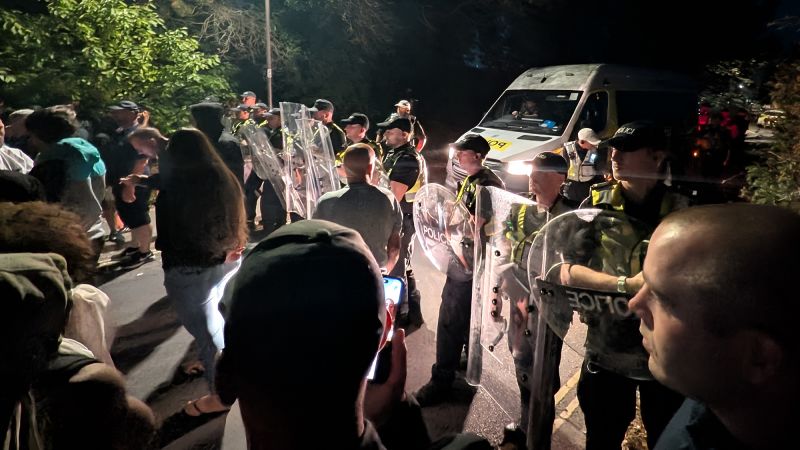
The Sunday incident unfolded along the coastline of Portsmouth, a major naval city in southern England. A small vessel carrying migrants had just made landfall when a crowd of men dressed predominantly in black moved to intercept lifeboats before they could complete their rescue operation. When that effort failed, the group shifted tactics, staging a road blockade aimed at stopping buses from carrying the asylum seekers to a nearby processing centre. Police held the line until early Monday morning, and footage captured at the scene showed the demonstrators chanting “stop the boats” and “I’m England ’til I die.”
The Hampshire and Isle of Wight Constabulary confirmed that no arrests were made at the Portsmouth event. The force said an investigation had been opened to identify those responsible for any assaults on officers, criminal damage to vehicles, or other offences committed during the confrontation.
Dover: A Repeat Performance
The Portsmouth episode was not an isolated flare-up. On Saturday, a near-identical protest had already played out in Dover, the Kent port through which ferries shuttle passengers and freight between England and France. Social-media video from the busy harbour area showed masked men in black linking arms across a main road, chanting the same “stop the boats” refrain. Routes leading to the port were blocked, and the National Highways agency reported a four-mile traffic jam building up on Saturday morning. Kent Police confirmed that no arrests were made there either.
The Dover constituency’s Labour MP, Mike Tapp, reacted with characteristic bluntness on social media.
“I bet if you asked any one of those ‘protesters’ they wouldn’t know small boat crossing are down by 40% and we are working hard to fix the mess. Go home, enjoy your weekend/get a job.”
Tapp labelled the demonstrators “idiots coming to Dover to cause disruption,” a remark that captured the frustration of local residents who have watched their town become a recurring flashpoint in Britain’s migration debate.
Who Is Behind the Protests?
Both events appear to have been coordinated by an organisation calling itself the Patriot Platform, led by Daniel Thomas — better known by his online alias, Danny Tommo. Thomas is a former associate of Tommy Robinson, the far-right political activist and former journalist who has built a substantial following through anti-Islamic campaigning and high-profile court battles. British media have noted that Thomas served a prison sentence after pleading guilty to attempted kidnapping in 2016.
The Patriot Platform describes itself as a Christian “army of patriots.” Thomas frames the group’s mission in sentimental, familial terms, saying members are protesting out of a “love for our children, country and most importantly the future that we are leaving for our children.” The organisation positions its street actions as a form of public-service security provision, arguing that Britain has become “ever-more dangerous” and that its members are filling a gap left by the state.
Advocacy Groups Sound the Alarm
HOPE Not Hate, a British advocacy organisation dedicated to countering far-right extremism, has been monitoring the Patriot Platform and its smaller allied groups. The charity characterised the weekend’s events as evidence of a broader pattern.
“This shows the growing trend of anti-migrant vigilantism coming to a head in the public eye.”
The group went further in its written statement, questioning the credibility of a movement whose members march through town centres in balaclavas while promoting themselves as a “safety-first community group.”
“In reality, Thomas has little hope of persuading others that Patriot Platform is a safety-first community group when its members march through the streets wearing balaclavas and have been exposed for their violent criminal records.”
Government and Political Reactions
The UK Home Office issued a statement condemning what it called “the intimidating and thuggish behaviour” in Portsmouth, while stopping short of a blanket ban on protest.
“The right to peaceful protest is fundamental to our democracy, but it must never cross a line into disorder.”
In Westminster, the hard-right Reform UK party — whose popularity surged during England’s local elections in May — has made small-boat crossings a centrepiece of its platform. Leader Nigel Farage branded the asylum seekers “an invasion” in a speech delivered on Friday. On Saturday, speaking to GB News, Farage attempted to distance himself from the masked demonstrators while reaffirming his own hardline position.
“Nobody feels more strongly about stopping the boats than me,” Farage said, adding that he condemned the “disgusting” tactics of the weekend. “Turning up in balaclavas is not the way to do it.”
Context: Numbers, Politics, and a Fractured Public Debate
The political heat surrounding migration persists even as the underlying numbers have shifted. According to Home Office data, the count of migrants crossing the English Channel in small boats has fallen to its lowest level since 2020. That statistical reality, however, has done little to cool the rhetoric. For years, the sight of a dinghy or rigid inflatable boat appearing off the Kent or Sussex coast has served as a potent visual shorthand for anxieties about border control, national identity, and the pace of demographic change.
The weekend’s protests illustrate how those anxieties are increasingly being channelled not through elected representatives or established campaign groups, but through informal street actions that blur the line between demonstration and obstruction. The use of balaclavas — a choice that obscures individual identity and lends an air of coordinated militancy — has drawn particular criticism from both government and opposition politicians, who have pointed to the difficulty of holding individuals accountable when faces are hidden.
For the communities of Dover and Portsmouth, the practical consequences are immediate: disrupted transport links, delayed ferry departures, and the daily burden of hosting arrivals who need processing, housing, and integration support. Whether the next small boat to land on a British shore will be met with a lifeboat crew, a police cordon, or a wall of masked men remains an open question — one that British politics, for now, has no clean answer.
Related Reading
Frequently Asked Questions
What is Why are far right masked men protesting?
Why are far right masked men protesting is the main topic of this guide. The article explains the context, practical details, and next steps readers should understand.
Why does Why are far right masked men protesting matter?
Why are far right masked men protesting matters because readers are looking for a useful answer, not just a short summary. Good content should match search intent and help them decide what to do next.