DNA evidence from Thomas Jefferson’s hair reveals the truth about his relationship with Sally Hemings

Daftar Isi
DNA Evidence From Thomas Jefferson Clarifies Hemings History
Earthguardiansonline.com – DNA evidence from Thomas Jefferson is offering the clearest scientific support yet for the conclusion that he fathered at least one child with Sally Hemings, an enslaved woman in his household. Researchers combined genetic material from historic hair samples with DNA comparisons involving several branches of the Jefferson and Hemings families.
The researchers concluded there is a 99.96% probability that Jefferson fathered at least one of Hemings’ children. Their findings are described in “History by a Hair: Thomas Jefferson, Sally Hemings & Solving a 200-Year-Old Mystery,” published September 22 by Smithsonian scholar and ambassador-at-large Richard Kurin.
Kurin also served as senior author of a methods paper posted on the bioRxiv preprint server September 21. The research has not yet been peer reviewed, but its analysis uses multiple genetic comparisons rather than relying on one family line.
A Hair Sample Found in Jefferson’s Bible
The investigation began in 2011, when Smithsonian National Museum of American History staff opened a Bible once owned by Jefferson and discovered a reddish-blond hair pressed between its pages. The find appeared to offer a possible way to address a historical question that had remained unsettled for generations.
Initial testing did not confirm that the Bible hair belonged to Jefferson. Scientists compared its mitochondrial DNA with DNA from a living descendant of Jefferson’s mother. Because mitochondrial DNA passes through maternal lines, researchers expected a match if the sample came from Jefferson, but the results did not match.
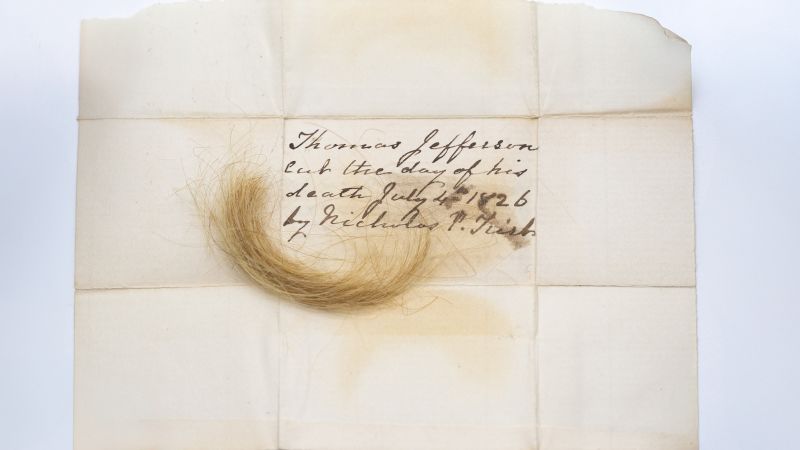
That result led the team to examine other hair samples historically attributed to Jefferson, including a lock said to have been cut at his deathbed. The specimens were contained in a packet provided by the Thomas Jefferson Foundation at Monticello and had not previously been available for this type of analysis.
How the Family Comparisons Strengthened the Case
Scientists reconstructed historic DNA sequences and studied genetic material from 16 living people. The comparisons included descendants associated with Jefferson and his wife Martha, his brother Randolph, and Hemings’ sons Eston and Madison.
Hemings had four children who survived to adulthood. Eston and Madison identified Jefferson as their father. By examining several family branches, the researchers aimed to determine whether the genetic signal pointed to Jefferson specifically or only to another man in the broader Jefferson family.
“What made this study so powerful is that researchers weren’t just comparing two genomes,” population geneticist Éadaoin Harney of the 23andMe Research Institute said. “Instead, they collected DNA samples from multiple people from different branches of the family tree.”
That broader analysis is important because close relatives can share substantial inherited DNA. Comparing multiple descendants and lineages allowed researchers to test competing explanations and assess the strength of the connection indicated by the evidence.
Why the Earlier 1998 Study Left Questions Open
The new DNA evidence from Thomas Jefferson builds on a major 1998 study led by the late Eugene Foster, a retired pathology professor affiliated with Tufts University and the University of Virginia. Foster’s team found a rare Y-chromosome haplotype shared by male descendants of Thomas Jefferson’s uncle and descendants of Hemings.
A haplotype is a group of genetic variations commonly inherited together. Since Y chromosomes generally pass from fathers to sons, the earlier research linked Hemings’ descendants to a male member of the Jefferson paternal line.
However, the 1998 study could not identify Thomas Jefferson himself because it lacked DNA directly attributed to him. Critics argued that another male relative might have carried the same paternal-line marker. The newly analyzed hair samples address that central limitation.
“He didn’t have Thomas Jefferson’s DNA,” Kurin said of the earlier research. “He didn’t have something to directly compare living descendants of the Jefferson family to Madison Hemings and Eston Hemings and others that might have been the descendants of Thomas Jefferson.”
FAQ: What the New Findings Mean
Does the study prove every detail of the Hemings family history?
The research supports a strong genetic conclusion that Jefferson fathered at least one child with Hemings. It does not, by itself, answer every historical question about their lives or establish paternity for each child individually.
Has the research been peer reviewed?
No. The methods paper was posted on bioRxiv, a preprint server, and had not undergone peer review at the time described. Readers should consider that status alongside the study’s multiple family-line comparisons.
Why does DNA evidence from Thomas Jefferson matter?
Directly attributed DNA helps researchers distinguish Jefferson from other men in his extended family. That is the key advance over earlier work that could establish a Jefferson paternal-line connection but could not isolate Thomas Jefferson himself.