Germany’s far-right AfD is poised for power – and split on whether to cozy up to Trump

Daftar Isi
AfD’s Saxony-Anhalt Gambit: What a Historic State Victory Would Mean for German Politics
Earthguardiansonline.com – Sunday’s state election in Saxony-Anhalt carries a weight far beyond one eastern German region. The Alternative for Germany (AfD) enters the ballot race with a commanding lead in opinion tracking, and if it converts that advantage into an outright parliamentary majority, the far right will govern a German state for the first time since the end of the Second World War. Polling firm Infratest dimap projects the party at roughly 42 percent of the vote — a figure that represents a dramatic surge from its support levels just a few years earlier and one that, under Germany’s proportional-representation system, could hand the AfD a seat at the levers of state government without needing a coalition partner.
The Domestic Wall
Yet the path from a strong showing to actual governing power is anything but automatic. German intelligence services have formally designated the AfD as an “extremist” party, a classification rooted in what authorities cite as the party’s rhetoric surrounding Muslim citizens and its positions on immigration. Mainstream conservative and progressive parties alike have publicly distanced themselves from the AfD. Across the political spectrum, every other party observes what is known as the “firewall”: an unwritten but firmly enforced convention against forming coalitions with the AfD or cooperating with it in parliamentary proceedings. Should the AfD fall short of an absolute majority on Sunday, the remaining parties could assemble a patchwork coalition specifically designed to lock the far right out of the state cabinet.
That domestic quarantine, in turn, has pushed the AfD to look outward — particularly toward the United States and the political movement surrounding President Donald Trump.
Bridging the Atlantic
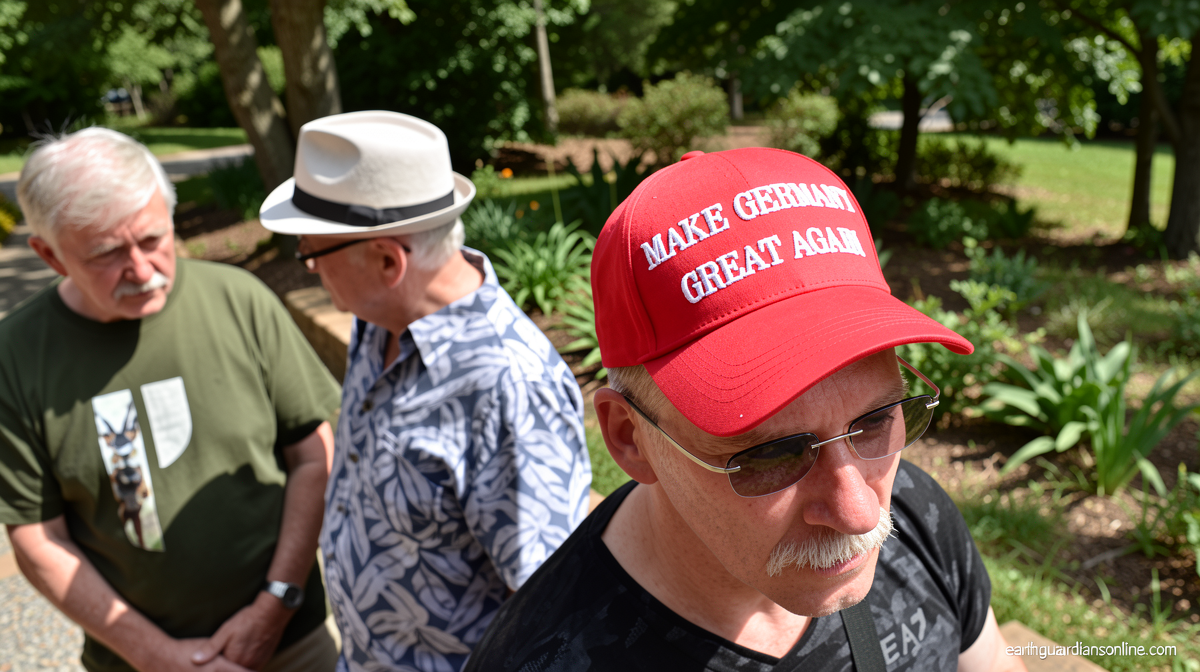
The connections between the AfD and America’s MAGA ecosystem extend well past shared ideological vocabulary. Party co-leader Alice Weidel met Vice President JD Vance on the margins of the Munich Security Conference last year. Before that encounter, Weidel appeared alongside Elon Musk in a livestream broadcast on his social platform, X. A small delegation of AfD parliamentarians also made the trip to Washington to attend Trump’s second inauguration ceremony. At AfD rallies, supporters now routinely wear caps emblazoned with the slogan “Make Germany Great Again,” a branding choice that mirrors its American counterpart almost verbatim.
Washington officials have reciprocated with visible political support. In his 2025 address at the Munich Security Conference, Vance called on German legislators to dismantle the firewall convention and work with the AfD in parliament. Secretary of State Marco Rubio went further, publicly condemning the German government’s decision to label the party extremist and describing that designation as “tyranny in disguise.”
Cracks in the Alliance
However, the transatlantic embrace is not uniform within the AfD. As Trump’s foreign-policy agenda has drawn increasing scrutiny across Europe — most recently over the military campaign in Iran, the saber-rattling posture toward Greenland, and the intervention in Venezuela — factions inside the party have begun recalculating how closely they want to be associated with the American president. The broader German public has grown skeptical of Washington’s actions. A March survey conducted by public broadcaster ARD found that 58 percent of respondents regarded the strikes on Iran as unjustified. In January, a separate ARD poll showed that 72 percent of Germans considered the arrest of former Venezuelan leader Nicolás Maduro unwarranted.
“I think there is ideological alignment on key issues, and I think the AfD is also learning from the MAGA movement,” said Almut Möller, director for European and global affairs at the European Policy Centre, a Brussels-based think tank. “The two parties particularly align when it comes to rhetoric about how the country should ‘care about (its) own people and stop caring about everybody else.'”
Möller cautioned, however, that the relationship is far from seamless. “Having said that, it is not a straightforward relationship to handle at all times,” she noted, pointing to areas where German economic interests collide with American policy — notably the tariff regime imposed by the Trump administration and the spike in fuel prices triggered by the Iran conflict.
Domestic Agenda: Remigration and Beyond
Back in Berlin, the AfD’s campaign messaging centers on what it calls “remigration” — a program of large-scale deportation of migrants and refugees paired with the expansion of mass detention infrastructure. Party officials have repeatedly invoked anti-Muslim language and singled out both Muslim and Ukrainian residents when describing whom they would prioritize for removal. Additional pledges include creating separate school tracks and other structural changes to the German education system.
Markus Frohnmaier, the AfD’s foreign-policy spokesperson and a sitting Bundestag member, told reporters in his parliamentary office days before the Saxony-Anhalt vote that he has made multiple trips to the United States this year and has cultivated close working relationships with figures in the MAGA movement. He stressed that the two camps share substantial common ground, particularly on immigration policy, even as he acknowledged that the party’s leadership has oscillated between praising Trump’s domestic stances on culture-war and nationalist issues and criticizing his interventions abroad.
What a Victory Would Signal
Should the AfD cross the majority threshold in Saxony-Anhalt, the result would represent the first time since 1945 that a party classified as extremist by the domestic intelligence apparatus holds executive authority in a German state. It would also test, in practice, whether the firewall convention can survive contact with a sitting government. For the broader European political landscape, the outcome would sharpen questions about how far American populist politics has penetrated continental party systems — and how quickly that penetration can translate into governing power.
Related Reading
Frequently Asked Questions
What is Germany s far right AfD is poised?
Germany s far right AfD is poised is the main topic of this guide. The article explains the context, practical details, and next steps readers should understand.
Why does Germany s far right AfD is poised matter?
Germany s far right AfD is poised matters because readers are looking for a useful answer, not just a short summary. Good content should match search intent and help them decide what to do next.