Massive blasts in Moscow shatter even Putin’s protective shell

Putin’s Protective Shell Cracks Amid Moscow Bombings
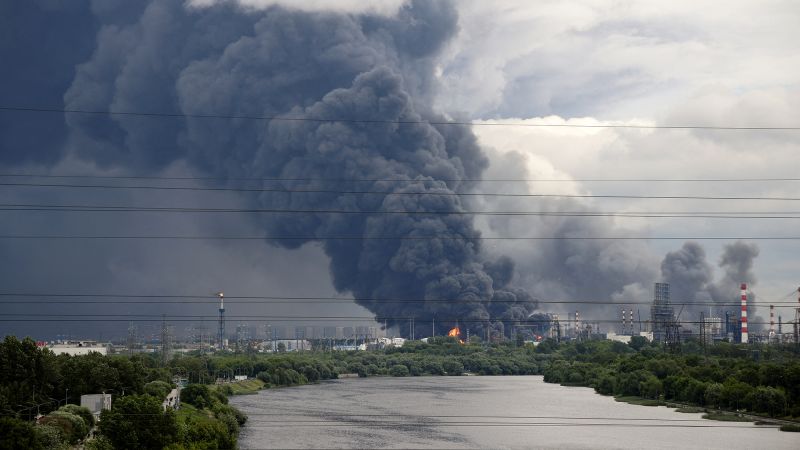
Massive blasts in Moscow shatter even – The damage’s impact has likely reached even the most secluded corners of the Kremlin. Russian President Vladimir Putin, who has long maintained a firm grip on information flow, now faces a stark reality as Ukraine’s relentless drone attacks disrupt Moscow’s skyline. Thursday’s aerial strikes, which left thick black smoke swirling over the capital, have pierced the president’s carefully constructed shield of denial. For the first time, the once-unshakable leader appears visibly shaken by the visible consequences of his war effort, which has stretched into its second year.
Ukrainian Drones Challenge Russian Air Defenses
Videos shared by Russians on social media reveal a chilling transformation in the dynamics of the conflict. What was once a narrative of Russian dominance over Ukrainian skies has flipped, with cheap, mass-produced drones now targeting the heart of the capital. These unmanned aircraft, previously used by Russia to bomb Ukrainian cities, now fly in waves over Moscow, striking refineries and igniting fires that spread across the city. The footage shows a refinery lid blown off, sending plumes of smoke into the atmosphere, while debris rains down in areas once considered safe from the war’s reach.
“The attacks are a direct response to Russia’s nightly bombardment,” said Ukraine’s President Volodymyr Zelensky, addressing the global audience during a recent address. “We are not just defending our homeland—we are striking back at the very infrastructure that sustains the war.”
The attacks have exposed the vulnerability of Moscow’s air defenses, which were once portrayed as an impenetrable network. Now, the capital’s skyline is marred by the aftermath of what some call a “strategic shift” in the war. The destruction of key refineries threatens to disrupt fuel supplies, potentially leading to long lines at gas stations—a stark contrast to the grandeur of the Victory Day parade that was recently scaled back due to the bombings.
For the first time, the Kremlin’s message management has faltered. The repeated images of devastation, shared by citizens on platforms like Telegram and VKontakte, have bypassed official channels and reached the public with unfiltered clarity. This surge in real-time reporting suggests a growing disillusionment with the government’s portrayal of the conflict. The once-mighty Russian military, now seen as struggling to defend its own capital, faces a crisis of credibility.
Zelensky’s Strategic Gambit and G7 Dynamics
Zelensky’s resolve has been reinforced by the outcomes of the G7 summit in Evian. During the meeting, President Donald Trump’s shifting stance on the war—alternating between indifference and support—left the Ukrainian leader with a renewed sense of purpose. While Zelensky initially sought Trump’s backing for a full-scale ceasefire, he now appears content with the mere suggestion that Ukraine might eventually produce its own air defense systems under license. This move signals a pragmatic shift in strategy, as Kyiv seeks to leverage Western technology to sustain its war effort.
European leaders have remained cautiously optimistic, with Italy’s Prime Minister Giorgia Meloni hinting at the potential for renewed diplomacy. “A middle power can play a pivotal role in bridging the gap,” she noted in a statement following the summit. Yet, the path to peace remains uncertain. The UK, France, and Germany released a joint declaration 11 days prior, reaffirming their commitment to a unilateral ceasefire as a key condition for negotiations. However, the Kremlin’s continued aggression has made such terms seem increasingly distant.
Thursday’s attacks mark a pivotal moment in the war’s trajectory. Ukraine launched its most significant drone offensive in two years, according to Russian state news agency TASS, with coordinated strikes that left the capital reeling. The visual evidence of destruction has forced Putin to confront the tangible costs of his campaign, both in terms of lives lost and infrastructure damaged. Analysts suggest that the attacks could serve as a catalyst for a broader reassessment of the war’s goals, though the president’s decisions remain as opaque as ever.
Despite the visible toll, Putin has not yet signaled a decisive pivot toward diplomacy. His recent acknowledgment of economic damage caused by Ukrainian strikes was met with a call for more retaliation, underscoring his commitment to the status quo. As blackened rain falls on Moscow’s streets, the question lingers: will the leader who once seemed invincible now seek an exit strategy, or will he double down on his war effort?
The conflict has reached a critical juncture. Ukraine’s ability to target Russia’s capital with precision has shaken the foundation of Putin’s narrative. The once-unshakable belief that the war would be swift and decisive has been replaced by a recognition of the battle’s mounting complexity. With the destruction of key refineries and the growing dissent in Moscow, the Russian leader’s choices have become increasingly scrutinized. Yet, the war’s outcome still rests in his hands, as the global audience watches the next chapter unfold.