On the ground in China’s wiped-out border zone, the fate of hundreds is still unknown

Daftar Isi
What Remains of Gyirong Port: A Moonscape Where Hundreds May Still Be Buried
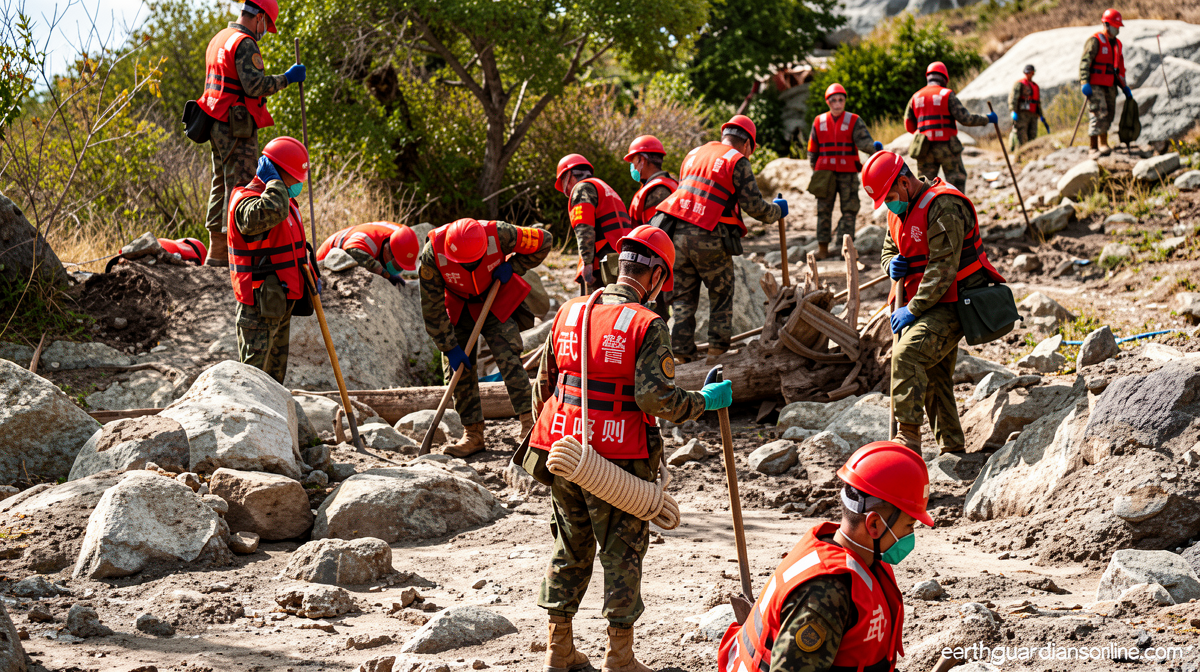
Earthguardiansonline.com – Where a thriving border crossing once hummed with the daily traffic of traders, tourists, and commuters shuttling between two nations, there is now nothing but a jagged scar of rock, gravel, and thick sludge. Gyirong Port, the high-altitude gateway linking China’s Tibet Autonomous Region to Nepal’s Rasuwa checkpoint just across the river, has been erased from the landscape. Emergency crews continue combing through the debris field, searching for survivors or remains among the stones and mud, while families on both sides of the border wait for answers that have yet to arrive.
The Moment Everything Vanished
On August 26, a catastrophic landslide triggered a wall of water that struck the port with explosive force, sending a torrent of debris and floodwater surging across the checkpoint and tearing into Nepal beyond. Surveillance recordings captured the instant of impact: figures scrambling for cover, vehicles swallowed by the deluge, the entire built environment of the crossing consumed in seconds. Since that moment, no survivor has been pulled from the rubble at the port itself.
The crossing had been a vital artery of movement. Hundreds of people routinely passed through each day, heading toward or away from Rasuwa. Travel agencies, a supermarket, and a bridge spanning the international river all occupied the site. Each of those structures has been flattened, overwritten by the mass of mud and water that claimed everything in its path.
A Checkpoint Reduced to Foundations
The most visible symbol of the destruction is the five-story border checkpoint building, a structure that once dominated the surrounding terrain in the imposing architectural style typical of Chinese government installations. What remains is the ghost of its foundations, barely distinguishable from the surrounding rubble. The entire built environment of the port has been obliterated, leaving search teams to work through an open moonscape of broken stone and saturated earth.
Numbers That Tell Only Part of the Story
China’s most recent official tally, issued nearly two days before the organized media visit, placed confirmed deaths at 31 and missing persons at 531 on its side of the border. Local authorities in Tibet indicated earlier in the week that more than 250 of those missing were foreign nationals. Across both countries combined, authorities have confirmed over 1,000 fatalities, with thousands still unaccounted for.
A stark asymmetry has emerged in how the two nations communicate casualty figures. Nepal has issued frequent updates on the number of people rescued or confirmed dead within its territory. On the Chinese side, detailed information about who was present at the port when the flood struck has been slow to surface. No public list of names has been released identifying those believed to be trapped or lost on the Chinese side of the crossing.
Geography That Defies Rapid Response
The remoteness of the disaster zone made the first days of rescue nearly impossible. The region sits at extreme altitude, with vast distances separating it from any major urban center. A team traveling from Lhasa, the Tibetan regional capital, covered roughly eight hours of driving to reach Dingri, the nearest city with an airport, climbing through terrain that peaks near 13,000 feet (approximately four kilometers). From Dingri, another six hours of travel brought them down to the port’s lower elevation of about 6,000 feet, following a narrow double-lane road that threads hairpin turns through pine-draped mountainsides.
Those roads were not passable until Wednesday — seven days after the disaster struck. Only then could thousands of rescue workers and heavy machinery enter the zone in force. Before that clearance, a far smaller number of responders had been conducting operations by trekking in on foot, arriving by boat along the river, or landing by aircraft.
Even after roads opened, rescue operations have been repeatedly slowed or halted by the threat of secondary disasters: fresh landslides, breaches of newly formed water barriers, and the ever-present risk of further slope failure in terrain still saturated and unstable.
Transparency Under Scrutiny
The absence of a named list of missing persons has drawn pointed questions, particularly from families desperate for any word about loved ones they believe were at the checkpoint when the flood hit. Beijing has characterized its information flow from the remote disaster area as open and timely, pointing to the invitation extended to roughly a dozen reporters from international news organizations for a carefully arranged visit to the site.
The trip was jointly organized by China’s Ministry of Foreign Affairs and the State Council Information Office. Reporters were issued hard hats and boots to navigate the treacherous mud and mitigate the ongoing landslide risk. While the itinerary was planned by officials to grant access to the restricted area, participating outlets maintained full editorial control over their reporting.
What Comes Next
For the families waiting in cities across China, Nepal, and beyond, the question is not whether the disaster happened — that is recorded in surveillance footage and confirmed by every official channel. The question is who is still beneath the stones, and whether the names will ever be spoken aloud. Until that list emerges, the rubble at Gyirong Port remains not just a site of rescue operations but a site of unbearable uncertainty, where the fate of hundreds hangs in the mud and silence of a border that no longer exists.
Related Reading
Frequently Asked Questions
What is On the ground in China s wiped?
On the ground in China s wiped is the main topic of this guide. The article explains the context, practical details, and next steps readers should understand.
Why does On the ground in China s wiped matter?
On the ground in China s wiped matters because readers are looking for a useful answer, not just a short summary. Good content should match search intent and help them decide what to do next.