
Venezuelans search for a future as well as survivors after twin quakes pile disaster on years of crisis
Venezuela’s People Seek Resilience Amid Earthquake Catastrophe
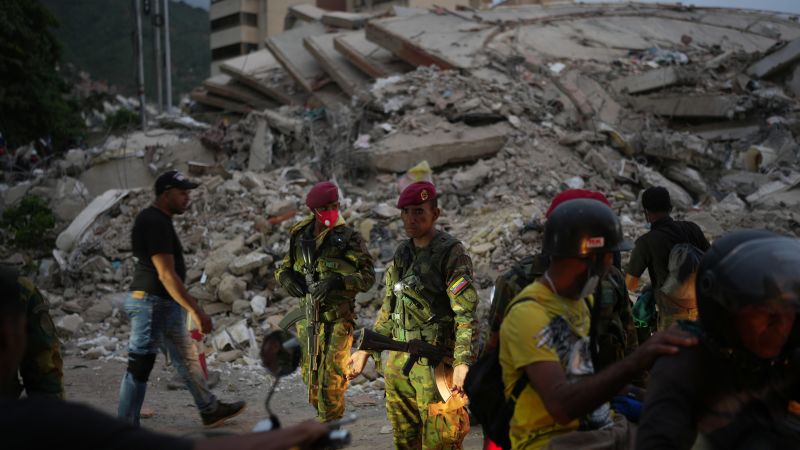
Venezuelans search for a future as well – In the wake of catastrophic twin earthquakes that struck Venezuela, residents are confronting a profound dilemma: will their nation endure the aftermath of this disaster, or has the crisis become insurmountable? The tremors, measuring 7.2 and 7.5 on the Richter scale, shattered homes and infrastructure, leaving over 1,400 dead and countless others still unaccounted for. As rescue operations continue, the emotional toll on communities grows, with survivors recounting the horror of losing loved ones and the struggle to rebuild lives amid a backdrop of economic and political instability.
A Nation in Peril
The earthquakes, which occurred within seconds of each other, have exposed vulnerabilities in a country already strained by years of turmoil. President Nicolás Maduro’s government, facing widespread criticism for its handling of the economic crisis, now grapples with a new challenge: providing aid to those displaced by the disaster. Decades of mismanagement have left Venezuela’s infrastructure fragile, making recovery efforts more arduous. In the capital, Caracas, families have turned to makeshift solutions, such as scavenging supplies from stores in the port city of La Guaira, a region severely affected by the quakes.
Stories of Survival and Loss
Neida Pernilla, a resident of Caracas, spoke of her narrow escape from destruction. “I believe we must draw strength from every hardship,” she said, reflecting on how her apartment was reduced to rubble. Despite the devastation, she and her relatives remained unscathed, a stroke of luck in a city where the disaster’s reach has been devastating. “Life is fleeting, just a moment,” Pernilla added. “We must give thanks to whatever faith we hold and strive to be more compassionate, more united, in this time of sorrow.”
“I think we have to learn from everything we’re going through. That life is fleeting — just a moment. We have to thank God, the Virgin Mary, whatever we have faith in, for the fact that we’re alive, and we need to be more human, more cooperative, more humble.”
Mileidy Duque, a 43-year-old mother in La Guaira, recounted the anguish of searching for her missing family. “It’s so sad, not just for me, but for all of Venezuela,” she said, standing near the ruins of the Luisa Caceres de Arismendi building, a government housing complex inaugurated by Maduro in 2015. Duque’s family, who lived on the second floor, feared the worst when the structure collapsed. “I feel like my hands are tied, it’s very difficult,” she explained, her voice trembling as she spoke of her 82-year-old mother, brother, daughter, and son-in-law who remain trapped in the wreckage.
La Guaira’s Crisis
La Guaira, a critical economic hub located just 20 miles from Caracas, has become a focal point of the disaster. The twin quakes have left its streets littered with debris, while collapsed roads and damaged bridges isolate the city from aid. Food and clean water shortages have worsened, prompting desperate measures among residents. “We’ve had to take supplies from stores ourselves,” Duque said, highlighting the extent to which the government’s inability to respond has forced people to fend for survival.
“This situation is so sad, not just for me, but for all of Venezuela. I have no words to explain how it feels to fear that your family is trapped in there.”
For Lindomar Milla, the tragedy has brought both grief and a sense of closure. His sister and brother-in-law were among the confirmed victims from the Playa Los Cocos neighborhood in La Guaira. “I’m heartbroken, but I thank God that I know where they are,” Milla said, sitting outside the city’s morgue. His words underscore the emotional weight of the disaster, as families across the country await news about their loved ones. “There are families from all over the nation who still don’t know if their relatives are dead or alive,” he added, his tone heavy with sorrow.
Historical Echoes of Tragedy
Residents of La Guaira recall a previous catastrophe that struck the city in 1999. Torrential rains triggered massive landslides, resulting in an estimated 15,000 deaths. Though the official toll was never finalized, researchers at the Central University of Venezuela provided a grim estimate. “This was much worse than the mudslides,” Milla noted, emphasizing the magnitude of the current disaster. Survivors now describe navigating the ruins of buildings that once stood tall, a stark reminder of the city’s history of resilience and loss.
The 72-Hour Window
The search for survivors has intensified as the 72-hour golden window for rescue efforts begins to narrow. Hundreds of aftershocks have continued to shake the region, complicating efforts to locate those buried beneath the rubble. “Each moment feels like a battle against time,” said Susana Henríquez, who stood near the remnants of the Petunia residential complex in Palos Grandes, an upper-middle-class neighborhood. Her home in Petunia II remained standing, but the adjacent tower in Petunia I collapsed, leaving its residents in peril.
“We want to trust that our neighbors in the Petunia I will be rescued alive.”
Henríquez, whose own family is now separated by the disaster, spoke of the emotional toll on communities. “I have so many friends there,” she said, her eyes glistening with tears. “Their names are more than just numbers—they are people, families, and lives we’ve known.” Her words capture the essence of the tragedy, as the scale of loss begins to overshadow the physical destruction. The tropical heat has only added to the suffering, with many in impacted areas donning face masks to protect against the pungent odor of decay.
Fractured Infrastructure, Fractured Hope
The earthquakes have not only targeted physical structures but also the fragile hope of Venezuelans. La Guaira, once a symbol of economic promise, now stands as a testament to the country’s struggles. “The road to recovery is long, but we must not lose faith,” said one survivor, echoing the sentiments of many. The government’s response has been criticized as slow and insufficient, with acting President Delcy Rodríguez reassuring citizens that they are not alone. Yet, the reality on the ground suggests otherwise, as families take matters into their own hands.
As the days pass, the emotional landscape of Venezuela shifts. Moments of relief—such as the rescue of a survivor—bring fleeting joy to the streets, but the sorrow of the missing lingers. “It’s like living in a nightmare that never ends,” Henríquez said, describing the surreal atmosphere of the city. The twin quakes have compounded years of hardship, from hyperinflation to food shortages, creating a perfect storm of crisis that tests the limits of human endurance.
A Call for Unity
Despite the devastation, there is a flicker of optimism. Neighbors, once divided by political tensions, now unite in shared grief and determination. “We are all in this together,” Pernilla said, her voice steady amid the chaos. As the search for survivors continues, the resilience of Venezuelans shines through. Whether in Caracas or La Guaira, families are digging through debris, offering support, and holding onto the belief that recovery is possible, even in the face of overwhelming loss.
