The idyllic holiday island that once housed a Nazi fortress

Daftar Isi
Beneath the Baltic Pines: Poland’s Secret Underground Fortress
Earthguardiansonline.com – Drive just outside the resort town of Świnoujście, where Poland’s Baltic coastline dissolves into rolling dunes and dense stands of pine and beech, and you would expect nothing more than wind-swept silence. Wolin Island, a long, narrow strip of sand and forest, has long marketed itself as an untouched natural retreat. Yet beneath that tranquil surface lies one of the most unusual military installations in Central Europe: a sprawling subterranean complex that served first as a Nazi coastal fortress, then as a Cold War nuclear command post, and now as a privately operated museum where visitors descend into tunnels that have not seen daylight in decades.
From Versailles Defiance to Wartime Silence
The story begins in the mid-1930s, when the German command made a decision that directly contravened the 1919 Versailles Treaty — the agreement that had barred German rearmament after World War I. Two coastal defense batteries, designated Goeben and Vineta, were constructed between 1936 and 1939 along what was then German territory (the area now known as West Pomeranian Voivodeship). The Vineta Battery, the section open to the public today, comprised a network of reinforced concrete bunkers: four crowned with rotating cannon mounts, and a fifth housing command functions, ammunition stores, and utility systems.
Hitler’s intention was straightforward — establish an impregnable coastal shield before launching the next continental war. What no one anticipated was that the complex would never face meaningful combat. The front moved with such speed during World War II that this stretch of coast remained remarkably quiet.
“As the World War II front was moving very quickly forward, this area was very calm during the war, and the Nazis converted the whole complex into a school for the navy,” explains Kacper Stachula, a local guide born and raised in Świnoujście who now leads regular tours through the tunnels.
Red Army Capture and Soviet Stripping
In May 1945, retreating German forces detonated their ammunition stores and attempted to demolish the compound. The effort failed; much of the reinforced structure survived intact. The Soviet Red Army took possession shortly afterward. Over the following years, Soviet personnel removed most of the metal fittings and valuable equipment, while local residents scavenged whatever remained accessible. For a decade, the site sat essentially abandoned, its purpose unclear to anyone in the region.
The Cold War Transformation
The turning point arrived in the 1950s, when the Polish socialist government designated the site as an emergency command center — a fallback headquarters “in case of World War III,” as Stachula puts it. Two waves of major modernization followed, in 1955 and again in 1965. The driving impetus was Poland’s ultra-classified contingency plan for an invasion of Denmark, formulated in the wake of the Warsaw Pact’s signing in 1955. The site, dubbed the “Polish front,” was ideally suited to the role: remote, forest-shrouded, and already equipped with hardened underground infrastructure.
The Polish army undertook an ambitious engineering program. Where the original Nazi bunkers had stood as isolated structures, engineers now linked all five with new tunnel corridors, added dedicated utility chambers, and installed underground water-pumping systems. The finished network stretched nearly a mile. The perimeter was partitioned into five distinct security zones, each gated behind its own documentation requirement. Soldiers lived and worked underground for months at a time, turning the complex into a functioning subterranean garrison.
A Museum That Plays the Part
Today the Wolin Underground City operates as a privately owned museum, and its curators have embraced the theatrical dimension of the site. Because the complex is vast and partially labyrinthine, independent wandering is not permitted. Visitors are assembled into groups styled as “platoons,” and their guides assume the personas of stern Polish army commanders. Forming ranks, obeying sharp commands, and enduring the occasional shouted reprimand are woven into the tour experience.
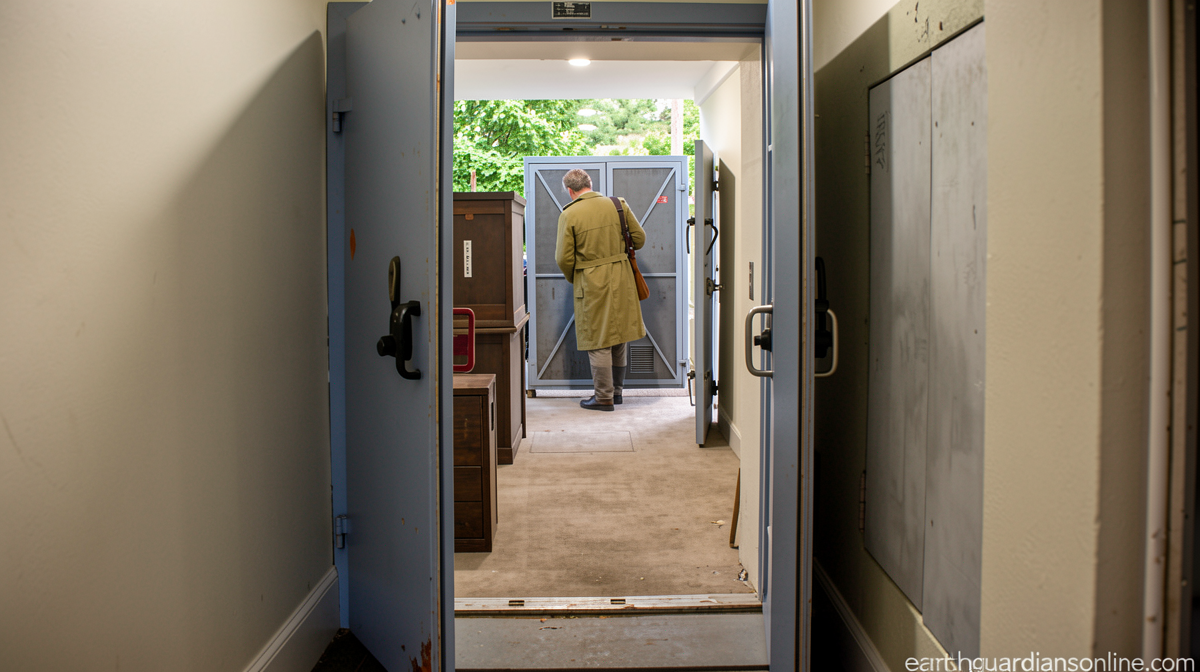
The surface approach already sets the tone. A Soviet-era armored personnel carrier sits parked beside the ticket desk. Sections of missile fuselage rest among the beech trunks. A heavy-duty ZIL — the ubiquitous Soviet military truck — idles nearby. Then the massive bunker door grinds open, and the temperature drops to a constant ten degrees Celsius (50 °F), indifferent to whatever season reigns above.
What surprises most first-time visitors is the absence of decay. Unlike countless abandoned military sites that drip with rust and fungal rot, these chambers feel neutral, almost clinical. The habitability of the space is striking: if a nuclear exchange had erupted overnight, personnel could have continued operations here with minimal disruption.
Why It Matters
Wolin Underground City occupies a rare position in European heritage tourism. It is not merely a ruin to be admired from a distance; it is a working narrative of how a single stretch of Baltic sand was claimed by three successive powers — Weimar-era Germany, Soviet-occupied Poland, and Cold War Warsaw Pact command — each layering its own purpose onto the same concrete bones. For visitors from Świnoujście’s summer crowds, the descent offers something the dunes cannot: a tangible, cold, close-quarters encounter with the machinery of twentieth-century conflict, preserved under a canopy of pine roots and Baltic wind.
Related Reading
Frequently Asked Questions
What is The idyllic holiday island that once?
The idyllic holiday island that once is the main topic of this guide. The article explains the context, practical details, and next steps readers should understand.
Why does The idyllic holiday island that once matter?
The idyllic holiday island that once matters because readers are looking for a useful answer, not just a short summary. Good content should match search intent and help them decide what to do next.