Two Florida cities claim the Cuban sandwich. What’s the real story?

Florida’s Cuban Sandwich Debate Runs Deep
Earthguardiansonline.com – In Florida, the Cuban sandwich is more than a pressed lunch. It is a point of local pride, a family tradition and a reminder of the Cuban migration that helped shape the state’s food culture. Tampa and Miami both insist that the sandwich belongs to them, while Key West has also entered the historical argument. The fuller story, however, begins in Cuba and unfolds through generations of workers, bakers, restaurant owners and families.
The question of which Florida city can claim the sandwich’s American home has no simple answer. Each city developed its own connection to Cuban food, and each has strong opinions about what a proper version should contain. Tampa often points to its cigar-industry history and its customary addition of salami. Miami emphasizes its Cuban community and a distinctive style of bread with a thin, crisp exterior.
A Sandwich With Cuban Roots
The Cuban sandwich is widely traced to Cuba, where an earlier form was known as a mixto, meaning “mixed” in Spanish. Its beginnings were less rigid than the sandwich traditions that developed later in Florida. Bread, cheese and whatever protein was available could form the basis of a meal, much like a Spanish bocadillo.
By the late 19th century, the mixto had become a more recognizable idea: a sandwich that could include more than one meat. Research by Bárbara C. Cruz uncovered advertisements from Havana bakeries promoting mixto sandwiches, showing that the term had already taken hold in Cuba. Before that, diners might have selected a sandwich centered on ham, pork or steak rather than a combined filling.
“The Cuban sandwich absolutely has its origins in Cuba,” said Bárbara Cruz, a Cuban-American professor at the University of South Florida in Tampa.
Jeff Houck, who wrote “The Cuban Sandwich: A History in Layers” with Cruz and Andrew T. Huse, has described the Cuban version as practical rather than fixed by strict rules. On the island, the contents could reflect what was on hand. The sandwich was also associated with evening outings, when people might eat while riding through town in carriages.
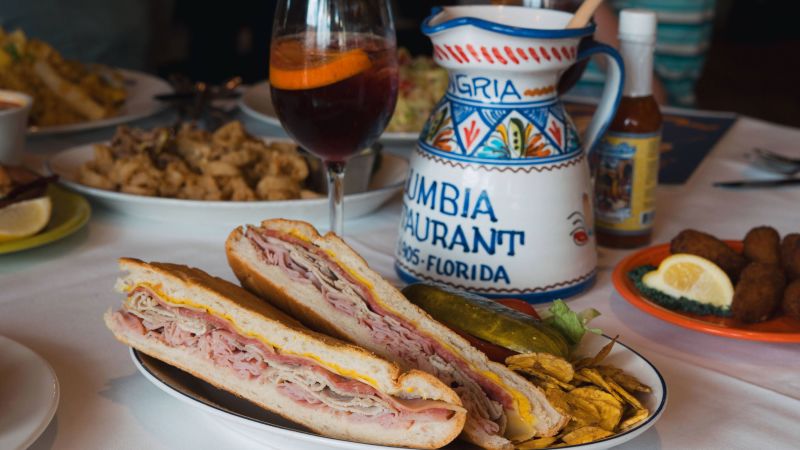
That flexible beginning helps explain why arguments over ingredients can become complicated. The modern sandwich is often built from roast pork, ham, Swiss cheese, pickles and mustard inside Cuban bread, then pressed until warm and crisp. But the layered formula Americans recognize today emerged through a longer journey between Cuba and Florida.
Tampa’s Case: Cigar Workers, Bread and Salami
Tampa’s defenders connect the sandwich to the city’s historic cigar industry, which drew Cuban migrants and created communities where Cuban food became part of daily life. Andrew Tambuzzo, a Tampa native with Sicilian and Cuban heritage, grew up with Cuban sandwiches appearing at major family gatherings.
“As far back as I can remember eating, I’ve been eating Cuban sandwiches in Tampa. They were always there at birthday parties, anniversary parties, funerals,” said Tambuzzo.
At The Boozy Pig, his Tampa craft butcher shop and café, Tambuzzo serves a version called a mixto, a nod to the sandwich’s Cuban name. He sees Tampa’s migration history as central to the dish’s Florida evolution and argues that the city has a particularly strong claim because of its bread tradition.
“I think Tampa is where it all started because of the migration here for the cigar industry. Also, Tampa has the original Cuban bread,” said Tambuzzo.
The Tampa style is especially known for salami, an ingredient that distinguishes it from the Miami version. That variation reflects the city’s overlapping Cuban and Italian influences, including the presence of Italian immigrant communities. For Tampa diners, salami is not an unnecessary addition but part of the sandwich’s local identity.
Miami’s Case: A Daily Part of Cuban-American Life
Roughly 280 miles southeast of Tampa, Miami offers an equally personal defense. Cuban sandwiches are woven into everyday life in Little Havana and throughout the city, where Cuban cafés, markets and bakeries have long made the dish familiar to residents.
Chef Michelle Bernstein, owner of Café La Trova on Calle Ocho as well as several other Miami restaurants, recalls eating Cuban sandwiches as a child. Though she is not Cuban, she was raised in Miami near a Cuban butcher and market. Her mother would set her at the counter with a Cuban sandwich and banana milkshake while she shopped.
“Miami doesn’t just eat the Cuban sandwich, we claim it as ours. It’s an identity. You grow up here and the Cuban sandwich is in your blood the same way café con leche is,” said Bernstein.
Miami’s bread is often a major point of distinction. Its exterior can be exceptionally delicate and crisp, creating a light crackle when the sandwich is pressed. That texture matters to diners who believe the bread is as important as the meats, cheese, mustard and pickles held inside it.
Why There May Never Be One Winner
The competing claims make more sense when the sandwich is viewed as a shared cultural inheritance rather than a single-city invention. Cuba supplied the original mixto tradition. Florida communities then adapted that foundation through their own immigrant populations, businesses and eating habits.
Even the name reveals the layered history. “Mixto” recalls the Cuban idea of mixed fillings, while “Cuban sandwich” became the familiar label in the United States. The dispute over salami, bread and birthplace is ultimately a debate about how communities preserve memory through food.
A well-made Cuban sandwich remains persuasive evidence for every side: toasted bread that crunches at the first bite, warm roast pork and ham, the sharpness of mustard and pickles, and the mellow richness of Swiss cheese. Whether it is served Tampa-style with salami or made in Miami with its fragile crust, the sandwich carries a history far broader than any single counter, bakery or city block.
Related Reading
Frequently Asked Questions
What is Two Florida cities claim the Cuban?
Two Florida cities claim the Cuban is the main topic of this guide. The article explains the context, practical details, and next steps readers should understand.
Why does Two Florida cities claim the Cuban matter?
Two Florida cities claim the Cuban matters because readers are looking for a useful answer, not just a short summary. Good content should match search intent and help them decide what to do next.