A dolphin saved its founder 4,000 years ago. Now this city is returning the favor

Daftar Isi
Taranto’s Ancient Dolphin Pact Gets a Modern Chapter
Earthguardiansonline.com – Four millennia ago, a sailor named Taras — said to be the offspring of Poseidon — watched his vessel break apart somewhere between the Greek mainland and the Italian coast. According to the myth that still anchors the identity of a southern Italian port city, his divine father sent a dolphin to haul him to safety. Taras rode the creature to the Ionian shore, stepped onto dry land, and founded a settlement. He gave it his own name, leaving the animal that saved his life unnamed and uncredited. That city, now called Taranto, sits in Puglia as the region’s second-largest urban center, and the dolphin has never truly left its story.
The cetacean motif threads through every layer of Taranto’s civic identity. Ancient local coinage bore the image. Bronze figurines and stone statues scattered the old quarters. The municipal coat of arms still features the animal, frequently with a small figure perched on its back. Even the crest of the city’s professional football club carries the silhouette. What began as a founding myth has calcified into a permanent symbol of place.
A Gulf Rich in Wild Dolphins
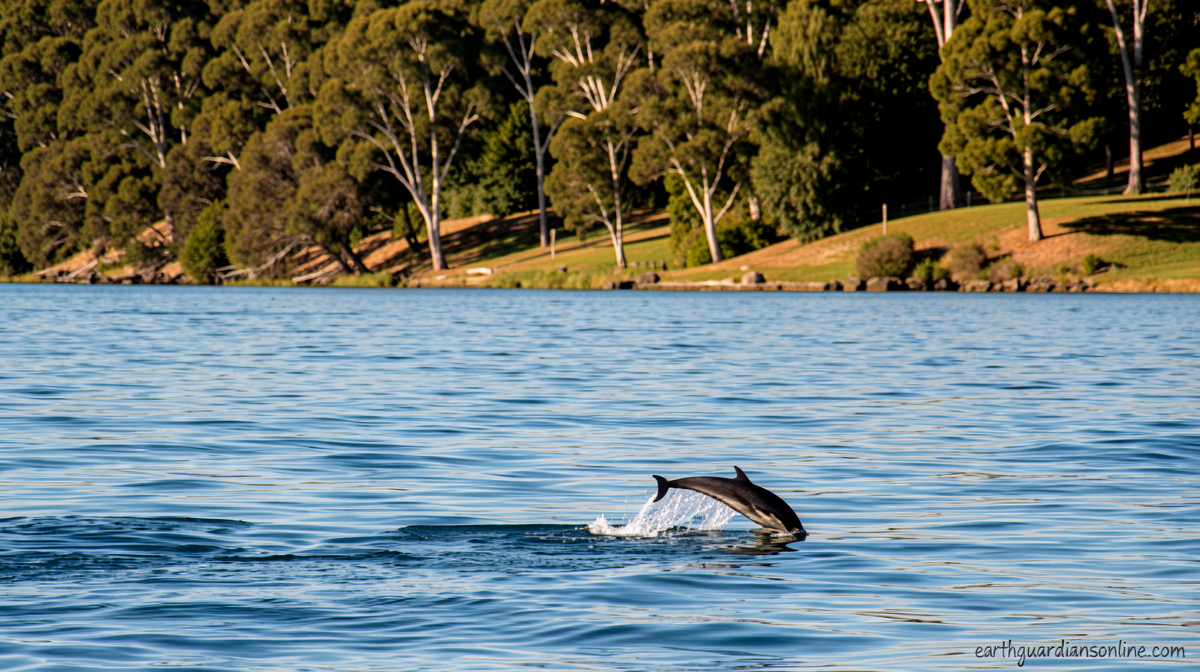
The waters surrounding Taranto are not merely symbolic. The Gulf of Taranto — the narrow inlet of the Ionian Sea tucked into the instep of Italy’s boot-shaped peninsula — hosts thousands of wild dolphins across several species, including bottlenose, spinner, and striped varieties. The warm, relatively sheltered waters provide consistent feeding grounds, making the area one of the most reliable places in the Mediterranean to observe these animals in their natural state.
Visitors who climb the ramparts of the Città Vecchia, the medieval old town, can frequently watch pods breaching the surface several hundred meters offshore. Organized day-trip boats carry thousands of tourists each year for closer encounters with the sociable mammals. The practice has generated both economic benefit and a growing public familiarity with dolphin behavior that conservationists consider valuable groundwork for broader protection efforts.
Europe’s First Sea-Based Dolphin Sanctuary
That familiarity is now being channeled into something unprecedented. A brand-new facility called the San Paolo Dolphin Refuge is taking shape in the waters adjacent to San Paolo Island, a tiny islet off Taranto’s coast that currently shelters a Napoleonic-era fort. The project represents the first sea-based sanctuary in Europe designed specifically to receive dolphins that have spent years or decades in captivity.
The refuge occupies roughly seven hectares of open water, its boundaries demarcated by four yellow buoys. Those buoys double as environmental sensors, continuously streaming data on water quality, air quality, and underwater acoustic noise back to a control room at the project’s headquarters on land. Underwater cameras and an artificial-intelligence monitoring layer sit beneath the surface, capable of flagging irregularities to biologists stationed ashore. A floating cabin provides space for food preparation and storage, staff quarters, and a dedicated veterinary platform where animal-health care can be delivered without removing the dolphins from their aquatic environment.
The Man Behind the Mission
Carmelo Fanizza, a marine biologist whose weathered complexion speaks to years of working under the Pugliese sun, founded the Jonian Dolphin Conservation association (JDC), the organization at the center of Taranto’s dolphin-protection work. He has spent nearly a decade building the scientific, logistical, and political infrastructure that makes the refuge possible. Speaking from a rigid inflatable boat moored beside the island, he described the monitoring architecture with the quiet pride of someone watching a long project reach its final phase.
“We have an area of seven hectares,” Fanizza says, pointing to four yellow buoys marking the boundaries. “The buoys are monitoring buoys … we collect information about the quality of the water, the quality of the air, also we have a hydrophone for measurement of the acoustic noise in the water. All that information arrives in the control room in our headquarters.”
Why France’s New Law Creates Urgency
The immediate catalyst for the refuge’s construction is a legislative shift in France. A new law taking effect in December 2026 will prohibit public shows featuring cetaceans — dolphins, whales, and their relatives — effectively closing the marine parks that have housed captive animals for generations. Conservationists and animal-welfare organizations have broadly welcomed the measure. Yet the closure of those facilities raises a practical question that has no ready answer: where do the animals go?
“The French government has taken a very important step because they have closed the facilities, or facilitated the closure of some structures,” Fanizza says. “But the problem is that nobody has in mind the solution, because if you close one structure, you need to have a solution for the animals that are in the structure.”
Simply releasing long-captive dolphins into open ocean is not a viable option. Animals that have spent their entire lives in concrete tanks lack the foraging skills, predator-avoidance instincts, and social structures needed to survive in the wild. The San Paolo refuge is designed as an intermediate environment — open water, but bounded, monitored, and staffed — where formerly captive dolphins can acclimate to natural conditions under continuous veterinary and behavioral oversight.
For Taranto, the project completes a circle that began with a myth. The dolphin that once carried a founder to shore now anchors a city’s commitment to protecting the very species that has lived beside its gulf for thousands of years. The ancient symbol on the coat of arms is no longer merely decorative; it is operational policy, written in salt water and monitored by satellite-linked sensors.
Related Reading
Frequently Asked Questions
What is A dolphin saved its founder 4 000?
A dolphin saved its founder 4 000 is the main topic of this guide. The article explains the context, practical details, and next steps readers should understand.
Why does A dolphin saved its founder 4 000 matter?
A dolphin saved its founder 4 000 matters because readers are looking for a useful answer, not just a short summary. Good content should match search intent and help them decide what to do next.