The world’s most delicious pancakes

Daftar Isi
From Crêpe to Latke: A Global Tour of the World’s Most Extraordinary Pancakes
Earthguardiansonline.com – Long before any single cuisine claimed ownership of the flat, round disc of cooked batter, pancake-making had already threaded its way through kitchens on every inhabited continent. The practice stretches back thousands of years, predating modern national borders and religious divisions alike. What unites these preparations — whether they lean toward sweetness or savoriness, whether they rely on wheat, buckwheat, chickpea, potato, or hemp — is a deceptively simple act: pour a liquid mixture into a hot surface and let it set. From that humble gesture, an astonishing spectrum of flavors and textures has emerged, spanning Europe, Africa, Asia, and the Americas.
Because traditional batters typically incorporate butter and eggs — ingredients historically associated with abundance — pancakes have long occupied a ritual slot just before periods of religious fasting. They also anchor weekend brunches and holiday tables, functioning as both comfort food and cultural marker. Pinning down a single universal definition of “pancake” is nearly impossible, and attempting to do so would spark endless debate among food historians. What follows instead is a survey of preparations that push the concept to its most creative and delicious extremes.
The American Stack: Buttermilk, Bacon, and a 229-Year-Old Recipe
No discussion of global pancakes can begin without acknowledging the towering, syrup-drenched American classic. Thick, pillowy, and typically crowned with strips of crispy bacon, the American pancake represents a particular kind of indulgence that few other preparations match. The lineage traces back to 1796, when Amelia Simmons published American Cookery, a cookbook that included a recipe she called “Indian Slapjacks,” prepared from cornmeal. Those early versions have largely faded from memory, but the modern iteration owes its signature lightness to buttermilk, which introduces a subtle tang while producing a finer, airier crumb structure. The cultural imperative is simple: pile them high, drown them in maple syrup, and do not apologize for the excess.
French Crêpes: Three Centuries of Culinary Theater
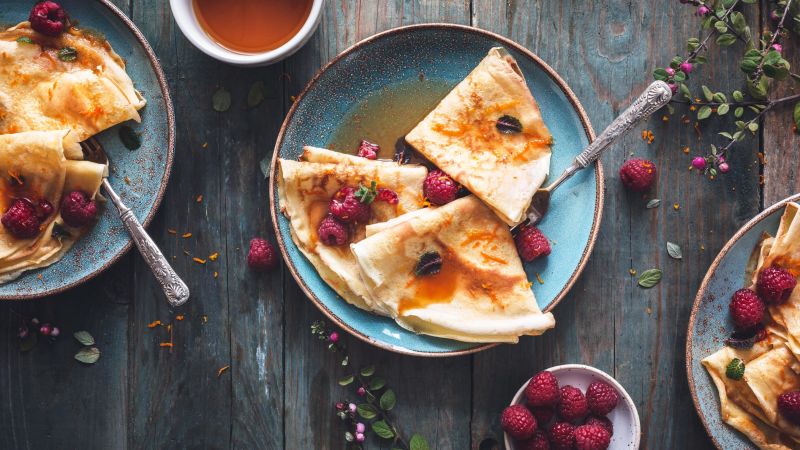
If a Pancake Hall of Fame existed, the French crêpe would occupy a permanent seat. Born in Brittany, the rugged northwest corner of France, during the 13th century, these paper-thin discs have since conquered dining tables worldwide. Their preparation is a small performance in itself: the batter is coaxed slowly to a precise consistency, then spread across a screaming-hot surface in a motion that demands genuine skill before being folded into quarters. Sweet versions carry fruit preserves, chocolate, or cascades of syrup; savory ones are famously loaded with ham and cheese melted to a glossy finish. The versatility is what has kept the crêpe relevant across seven centuries of evolving taste.
Socca: The Chickpea Flatbread That Bridges Two Coasts
Deeply rooted in the French Riviera city of Nice and the Ligurian coastline of neighboring Italy — where it goes by the name farinata — socca is built from an almost absurdly short ingredient list: chickpea flour, water, olive oil, and seasoning. Traditionally it is cooked in broad copper pans submerged in pools of oil, set inside wood-fired ovens, a method that imparts a smoky depth no electric appliance can replicate. The result is a golden, blistered disc that serves as a genuinely satisfying gluten-free alternative to pizza. In Nice and surrounding towns, socca operates as a quintessential street food, torn into paper cones and finished with a generous dusting of black pepper. Its position at the intersection of French and Italian coastal culture makes it a small but telling example of how border regions generate hybrid dishes that belong fully to neither side.
Blinis: Buckwheat, Caviar, and the Week Before Lent
Across Russia and the broader Slavic world, the blin occupies a place of deep seasonal significance. These thin, round pancakes are leavened with yeast and made from buckwheat flour, giving them a nutty, earthy flavor distinct from wheat-based counterparts. In fine-dining contexts they appear as small, elegant vessels topped with caviar or smoked salmon. But their traditional role is far more communal: blinis come to the fore during Maslenitsa, a week-long celebration of pancakes that marks the final feast before the Christian observance of Lent. A full week of daily pancake consumption, each day carrying its own name and custom, represents one of the most sustained pancake traditions in any culture.
Hottokeki: Japan’s Soufflé-Like Tower
The Japanese name essentially gives the game away — hottokeki is, in plain English, a hotcake. Yet the execution is anything but plain. These towering, impossibly fluffy discs owe their soufflé-like architecture to a technique borrowed from meringue-making: egg whites are whipped to stiff peaks and folded into the batter, trapping vast quantities of air. The result is a pancake of extraordinary height and cloud-like interior that has become a fixture of Instagram food culture. Toppings range from fresh berries and whipped cream to maple syrup and, for the savory-minded, strips of bacon. The visual spectacle is considered part of the experience; photographing the stack before the first bite has become an almost obligatory ritual.
Korean-Style Crispy Triangles: Dough, Not Batter
Departing sharply from the liquid-batter tradition, certain East Asian pancake preparations — including the crispy, fragrant triangles popular in Korean and Shanghai-influenced cooking — are actually rolled or pressed from a dough. This distinction yields a texture that is simultaneously flaky, chewy, and shatteringly crisp at the edges. Scallions are folded into the dough, lending a sharp, allium-forward kick. Some diners dip the finished pieces in soy-based or chili sauces, but many prefer them straight from the pan or wok, still crackling with residual heat. Regional variations push the decadence further: Shanghai-style versions incorporate rendered pork fat into the dough, adding richness and a deeper savory note.
Swiss Hemp Protein: Michelin-Starred Breakfast Engineering
At the Grand Resort Bad Ragaz in Switzerland, Michelin-starred chef Sven Wassmer runs a restaurant called Verve by Sven, where he serves gluten-free pancakes built entirely around hemp protein in place of conventional flour. Switzerland’s culinary identity leans heavily on wholesome, nutrient-dense breakfasts, and Wassmer’s interpretation fits that ethos while pushing it into haute-cuisine territory. The pancakes are finished with sliced bananas, toasted almonds, a drizzle of maple syrup, and — depending on the diner’s preference — a small swirl of whipped cream. The preparation demonstrates how dietary restrictions, far from limiting creativity, can catalyze entirely new flavor territories.
Latkes: The Potato’s Unexpected Pancake Role
A celebrated element of Ashkenazi Jewish cuisine, the latke introduces yet another unconventional base ingredient: the potato. Grated or shredded, the spud is bound with egg and a minimal amount of flour, then fried into golden, crisp discs. The dish carries particular weight during Hanukkah, when it is traditionally served alongside other fried foods to commemorate the oil miracle. Its presence in the global pancake landscape underscores how far the category stretches — from buckwheat to chickpea to potato to hemp, the “pancake” is less a fixed recipe than a shape, a technique, and an invitation to experimentation.
The pancake, in its thousands of regional guises, remains one of humanity’s most democratic foods: cheap to make, endlessly adaptable, and capable of carrying either the most austere fasting ritual or the most extravagant holiday excess.
Whether folded around a slice of camembert in a Breton bistro, torn from a paper cone on a Nice sidewalk, or stacked three-high with a river of syrup in a suburban American kitchen, the pancake endures because it asks nothing of its maker except a flat surface, a little heat, and the willingness to improvise.
Related Reading
Frequently Asked Questions
What is The world s most delicious pancakes?
The world s most delicious pancakes is the main topic of this guide. The article explains the context, practical details, and next steps readers should understand.
Why does The world s most delicious pancakes matter?
The world s most delicious pancakes matters because readers are looking for a useful answer, not just a short summary. Good content should match search intent and help them decide what to do next.