
Poised to accelerate a pivot away from Russia, Armenian prime minister claims election win
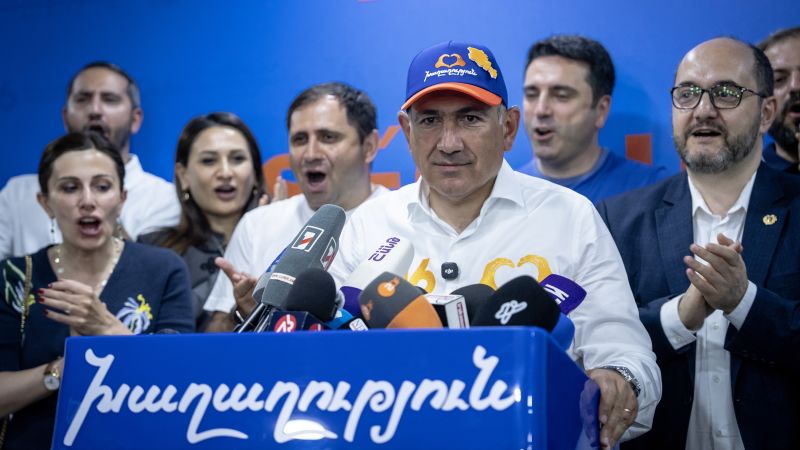
Poised to accelerate a pivot away from Russia, Armenian prime minister claims election win
Poised to accelerate a pivot away – Armenia’s parliamentary election results on Sunday have shown Prime Minister Nikol Pashinyan as a clear winner, yet the outcome has not delivered the sweeping mandate needed to fully shift the nation’s geopolitical course. The Central Election Commission announced on Monday that Pashinyan’s ruling Civil Contract party secured 49.81% of the vote, a significant lead over the opposition Strong Armenia party, according to Reuters. However, this margin may not be enough to solidify a decisive move away from Russia, the country’s long-standing security partner and major trade ally, and to advance negotiations for a lasting peace with Azerbaijan, its regional rival.
Electoral Success and Strategic Challenges
Pashinyan’s victory was anticipated, with early counts favoring his coalition. But the final allocation of parliamentary seats remains uncertain. Smaller parties must cross a 4% threshold to qualify for representation, and the current standings suggest that Pashinyan might not achieve the two-thirds majority required to implement his most ambitious reforms. This lack of a strong mandate could slow progress on his agenda, which includes deepening ties with the European Union, normalizing relations with Turkey, and pursuing a peace deal with Azerbaijan.
The election was widely seen as a test of public sentiment toward Armenia’s foreign policy direction. Pashinyan’s campaign promised a strategic realignment, positioning the country as a bridge between East and West. His efforts to rebrand Armenia’s international image have drawn support from U.S. President Donald Trump, who endorsed his re-election in a post on Truth Social. “With Nikol’s help, we will bring the United States, Armenia, the South Caucasus, and Central Asia to greater heights than ever before. Make (Armenia) Great Again,” Trump wrote, highlighting his vision of Armenia as a key player in global diplomacy.
“With Nikol’s help, we will bring the United States, Armenia, the South Caucasus, and Central Asia to greater heights than ever before. Make (Armenia) Great Again.”
Trump also emphasized his role in brokering peace between Armenia and Azerbaijan, framing the effort as part of his legacy as a global peacemaker. A proposed deal between the two nations included granting the U.S. exclusive rights to a transportation corridor through Armenia, dubbed the Trump Route for International Peace and Prosperity (TRIPP). This initiative underscores the strategic importance of the region and the potential for Western influence to reshape its future.
Russian Concerns and Economic Leverage
Russia has expressed irritation with Armenia’s growing alignment with the West, intensifying pressure through economic measures. In the weeks leading up to the election, Moscow imposed import bans on Armenian goods, such as fresh fruit, flowers, and spirits. These sanctions were meant to signal a warning: closer ties with the European Union and the United States would come at a cost to Armenia’s economy.
President Vladimir Putin echoed this sentiment during a pre-election press conference, highlighting the interconnectedness of regional politics. “We are currently living through everything that is happening in respect of Ukraine,” he remarked. “And how did it start? It started with Ukraine’s joining or attempting to join the EU.” Putin’s comments drew a parallel between Armenia’s potential shift and Ukraine’s geopolitical transformation, framing the move as a risky departure from Russian influence.
Armenia’s pivot toward the West has been a gradual process, but it accelerated after the 2023 military conflict with Azerbaijan. That war, which resulted in the loss of Nagorno-Karabakh—a majority Armenian breakaway territory—forced the country to reassess its reliance on Moscow for security. The defeat exposed vulnerabilities in Armenia’s defense strategy, prompting Pashinyan’s government to freeze its participation in the Russian-led Collective Security Treaty Organization. This decision marked a symbolic break from its eastern neighbor, signaling a broader realignment in foreign policy.
Despite the challenges, Pashinyan has remained steadfast in his pursuit of Western integration. Recent months have seen him actively engaging with the European Union, pushing for reforms to meet accession criteria and hosting the first EU-Armenia summit last month. These steps reflect a commitment to diversifying Armenia’s economic and political partnerships. The summit also included a meeting with Ukrainian President Volodymyr Zelensky, an event that further strained relations with Russia. The fact that Pashinyan and Zelensky discussed matters in English, rather than Russian, the language of the Soviet era, added a layer of symbolic defiance.
The Path Forward
While the election results provide Pashinyan with a mandate to continue his Western-oriented policies, the path ahead is complex. The EU has pledged support, with European Commission President Ursula von der Leyen calling Russia’s economic restrictions on Armenia “nothing short of economic coercion.” She announced plans for a support package and the easing of trade barriers on Armenian products, aiming to cushion the impact of Moscow’s sanctions.
Pashinyan’s government faces the dual challenge of maintaining stability while navigating the delicate balance between Russia and the West. The 49.81% vote share indicates strong public backing for his leadership, but it also reveals the cautiousness of Armenian voters. Many remain wary of abandoning Russia entirely, given its role as a security guarantor and economic partner. Yet, the election’s outcome suggests a growing appetite for change, driven by the desire to secure peace with Azerbaijan and reduce dependence on Moscow.
Armenia’s pivot to the West is not without risks. The country’s energy sector, for instance, remains heavily reliant on Russian gas, and its military infrastructure has historically been supported by Moscow. However, the 2023 conflict highlighted the need for a more diversified approach, prompting Pashinyan to seek stronger European partnerships. The success of this strategy will depend on the EU’s ability to deliver on promises of support and the effectiveness of Armenia’s internal reforms.
In the broader context, the election reflects a shift in the South Caucasus region, where Armenia is increasingly positioning itself as a mediator in regional disputes. This role could enhance its international standing but also complicate its relationships with both Russia and Azerbaijan. For Pashinyan, the challenge lies in translating electoral success into tangible progress on his foreign policy agenda, ensuring that Armenia’s aspirations for Western integration do not undermine its security or economic stability.
