On the brink: Black lawmakers could lose decades of gains in one year

On the Brink: Black Lawmakers Face Historic Loss of Representation
On the brink – The United States is poised for its most significant decline in Black congressional representation since the Voting Rights Act was established over six decades ago. With the upcoming midterms, House Democrats risk losing six Black members of Congress, a consequence of a redistricting strategy that gained momentum after the Supreme Court weakened the enforcement of the voting law. This shift has created a scenario where two current representatives from redrawn districts are expected to step down, while the remaining four face uncertain futures. Additionally, Republican Rep. Burgess Owens of Utah is departing the House following a court ruling that invalidated a map favoring the GOP. The combined effect of these changes could mark a pivotal moment in the erosion of Black political influence, especially in the South, where the majority of Black residents reside.
Redistricting as a Tool for Political Change
The mid-decade redistricting campaign has become a battleground for both major parties, with Republicans and Democrats vying to reshape the political landscape. The Supreme Court’s recent decision to limit the scope of racial discrimination claims under the Voting Rights Act has emboldened lawmakers to redraw district boundaries with greater precision. This effort aims to dilute the voting power of Black communities, a strategy that has historically been used to suppress their political influence. By altering the boundaries of electoral districts, the campaign seeks to ensure that Black voters are spread across more districts, reducing their ability to elect representatives who share their priorities. The focus on this tactic has intensified as the 2026 midterms approach, threatening decades of progress made by Black Americans in Congress.
While the stated goal of both parties was to secure electoral victories, the broader implication of their actions has been a challenge to racial representation. Redistricting efforts, now more aggressive than ever, have targeted not only current Black lawmakers but also the structural foundations that allowed their presence in Congress. This shift reflects a broader strategy to reconfigure political power, leveraging the Supreme Court’s ruling as a catalyst for change. The outcome of these maneuvers could redefine the balance of power in the House, particularly in states where Black populations have long been a key demographic.
Historical Context and the Legacy of the Voting Rights Act
For over a century after the nation’s founding, Black Americans were denied the right to vote, and for much of the following century, they fought tirelessly to secure it. The Civil War era marked a turning point, as former Confederate states began granting voting rights to Black citizens as a condition for rejoining the Union. Federal troops stationed in the South played a critical role in protecting Black voters, ensuring access to the ballot box. However, this support was soon withdrawn, leading to systematic efforts to suppress the Black vote, often through state-sponsored violence and intimidation.
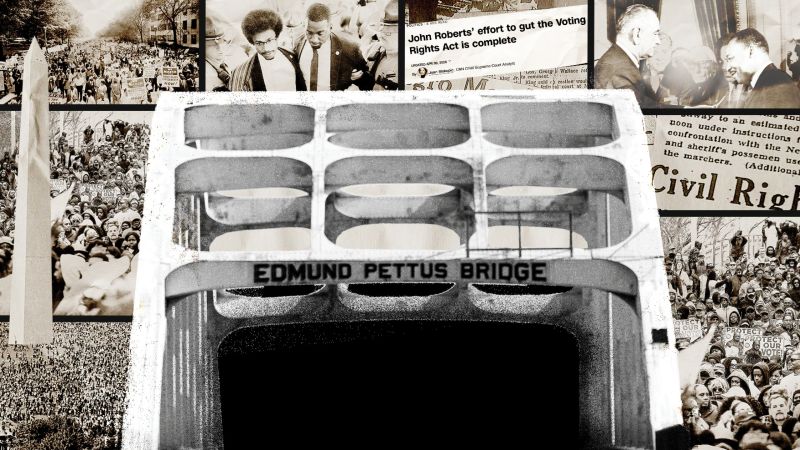
By 1877, the Reconstruction era had ended, and with it, the surge in Black representation in Congress. Over the next 30 years, only 20 Black representatives and two Black senators held office. This pattern shifted dramatically in 1965, when the Voting Rights Act was signed into law. The act emerged in response to the violent suppression of voting rights in Alabama, including the infamous “Bloody Sunday” on Selma’s Edmund Pettus Bridge, where batons and tear gas were used against peaceful demonstrators, including civil rights icon John Lewis. Five months later, President Lyndon B. Johnson enacted the law, which would go on to empower marginalized communities and elevate new leaders in the political arena.
Jim Clyburn, a prominent figure in South Carolina’s congressional history, is a testament to the Voting Rights Act’s impact. First elected in 1992, he became the ninth Black representative for the state and the first in nearly a century. His rise to power was fueled by the act, which enabled Black voters to influence elections and elect leaders who represented their interests. Clyburn’s role extended beyond his district, as he served as the third-ranking Democrat in the House and became the highest-ranking African American in Congress at the time. His endorsements played a crucial role in pivotal moments, including Barack Obama’s 2008 presidential campaign and Joe Biden’s 2020 bid for the presidency.
Clyburn’s influence has been a lifeline for Black voters in the Palmetto State, bringing federal resources to the region and amplifying their voices. Claire Wofford, a political scientist at the College of Charleston, noted that Clyburn’s presence has made South Carolina a hub for Black political activity, from infrastructure investments to support for historically Black colleges and universities. Yet, despite his stature, Clyburn has warned that the current redistricting push signals a return to patterns seen during Reconstruction. “This Supreme Court is resegregating this country,” he said, reflecting concerns that the political system is once again moving toward systemic exclusion.
A Political Power Struggle with Deep Roots
The recent redistricting efforts targeting Clyburn exemplify the intensity of the political battle over representation. A plan designed to weaken his influence was nearly passed in the state Senate but faltered at the last minute as Republican lawmakers hesitated to disrupt an ongoing primary. This near-miss underscored the stakes involved, as Clyburn’s district remains a focal point for both parties. While some South Carolinians were taken aback by the idea of targeting a Black leader, others recognized the historical precedent of such tactics.
“What the Supreme Court has done is sanction discrimination against African Americans in the political process,” Derrick Johnson, president of the NAACP, told CNN. “The only time in history that we’ve seen this is after Reconstruction.” Johnson’s statement highlights the perceived link between the current redistricting strategy and the historical erasure of Black political power. The Voting Rights Act, once a cornerstone of progress, is now under siege, with critics arguing that its weakening has allowed lawmakers to redraw maps that favor their party’s interests at the expense of minority representation.
The implications of these changes are far-reaching. By reducing the number of Black lawmakers, the redistricting campaign could signal a rollback of the gains made over the past half-century. Clyburn, who has spent 17 terms in office, has witnessed the evolution of Black political power firsthand. His journey from a small-town South Carolinian to a national figure has been shaped by the opportunities created by the Voting Rights Act. Yet, he now fears that the same forces that once oppressed Black voters are once again at work, this time through the manipulation of electoral boundaries.
As the midterms draw closer, the fight over redistricting has taken on new urgency. The success of these efforts will determine whether the current wave of Black representation in Congress is sustained or reversed. For many, the stakes are clear: the right to vote, once hard-won, is now under threat, and the consequences could echo through generations. The battle for political power is not just about numbers; it is about ensuring that Black voices continue to shape the nation’s future.