US Army attack helicopters crashing at historically high rate amid mechanical issues

Daftar Isi
Apache Helicopter Crash Rate Hits Near-Record Levels as Transmission Faults Plague Army Fleet
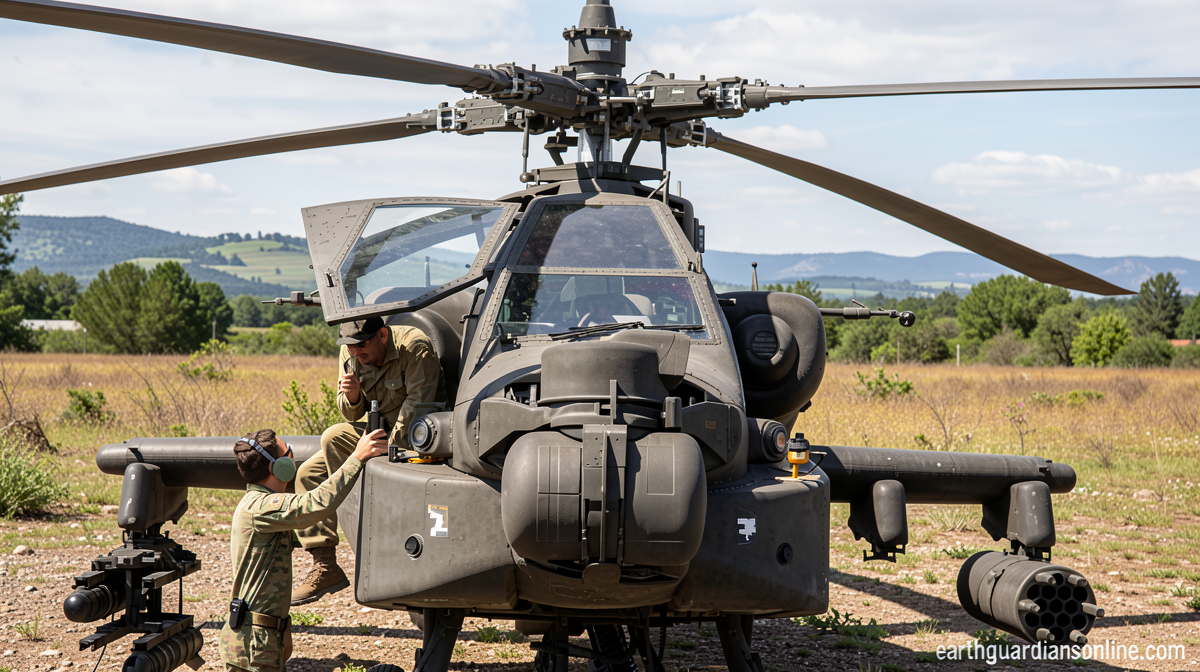
Earthguardiansonline.com – The United States Army’s primary attack helicopter is falling out of the sky at a pace that has not been seen since the modern variant entered service more than a decade ago. Five major crashes have struck the AH-64E Apache fleet since the start of fiscal year 2026, and a fatal accident in Texas earlier this month killed two soldiers, ignited a wildfire, and forced the service to ground routine training sorties for the aircraft type. The temporary flight ban, which did not apply to units already deployed in the Middle East, was lifted on Wednesday.
The cumulative effect places the current fiscal year on track to become the second-worst stretch for Apache flight accidents since the E-model rolled out in 2011. An analysis of publicly released military accident records, combined with flight-hour estimates supplied by Army safety officials, puts the major-crash rate at roughly 6.24 incidents per 100,000 flying hours through mid-August. That figure eclipses most years in the aircraft’s operational history and edges close to the worst rate recorded in fiscal year 2024, when nine major Apache crashes occurred amid a broader surge in accidents across every Army helicopter type.
The Texas Accident and Its Immediate Consequences
The most recent and most severe incident took place near Fort Hood, Texas, earlier this month. Two soldiers lost their lives, and the crash site caught fire, sending flames across surrounding terrain. In the wake of the event, Army leadership ordered a temporary suspension of routine Apache training flights for units not already in theater. The pause lasted until Wednesday, when normal operations resumed for domestic-based squadrons.
Army spokesperson Maj. Montrell Russell addressed the loss in a written statement:
“We express our deep sadness over the loss of the two Soldiers near Fort Hood.”
Russell declined to discuss the ongoing transmission investigation or reveal any preliminary findings tied to the Texas crash. He explained that “special controls and release protections” bar the service from sharing detailed “technical aviation information,” including how many of this year’s crashes trace back to the helicopters’ drivetrain.
A Transmission Problem at the Heart of the Crisis
Internal Army safety communications obtained through public records reveal the mechanical core of the problem. The E-model Apache’s transmission, introduced with the 2011 upgrade, drives the tail rotor, electrical power generation, and hydraulic systems. A failure in that single component can strip the helicopter of all three simultaneously, throwing the aircraft into a sudden, uncommanded spin and potentially eliminating flight-control authority altogether.
An initial safety message issued in April identified approximately 70 transmissions as potentially faulty and directed every unit to ground affected aircraft until repairs were completed. A follow-up bulletin in mid-July added ten more suspect units to the no-fly list while stating that the root cause remained “under investigation.” Taken together, the two directives affected roughly one-tenth of the Army’s total attack-helicopter fleet.
By early June, an Army official confirmed that all flagged Apaches were still on the ground. Questions about how many, if any, have since returned to flight went unanswered.
What Is Known — and What Remains Unclear — About Causes
The July edition of the Army’s official flight-safety newsletter attributed just over half of this year’s Apache accidents, counting both minor and major incidents, primarily to human error. For the most-severe crashes, however, the picture is murkier. The newsletter noted that “a catastrophic transmission failure was noted in one Class A mishap,” but did not specify how many of the five major accidents involved equipment breakdown versus pilot action.
By contrast, the fiscal year 2024 spike was attributed with greater confidence. Army leaders at the time ordered a special safety-training initiative and pointed to a combination of factors: reduced pilot experience levels, heightened training intensity and complexity, and a doctrinal pivot toward preparing for major-peer conflicts that accelerated after Russia’s full-scale invasion of Ukraine in February 2022. This year’s uptick lacks that clean explanatory narrative.
Understanding the Numbers
In Army terminology, a “Class A mishap” denotes any accident that kills or permanently disables a person, destroys an aircraft, or produces damage exceeding $2.5 million. The crash rate is calculated by dividing the number of such incidents by total flight hours logged by the aircraft type, using publicly released accident data alongside flight-hour figures provided by Army safety officials. Through August 15, the Apache fleet had accumulated approximately 80,171 hours in fiscal year 2026 — combining 42,971 hours recorded through March 31 in an internal safety newsletter with an estimated 37,200 additional hours logged between April and mid-August.
Fiscal year 2024, the benchmark worst year, carried a rate of 7.02 major crashes per 100,000 hours. The current trajectory of 6.24, while slightly lower, already exceeds every other year since the E-model’s introduction and signals a fleet reliability problem that has persisted across multiple quarters without a confirmed corrective action.
Broader Implications
The Apache remains the backbone of Army aviation’s close-air-support and armed-reconnaissance mission set. A sustained grounding of even a tenth of the fleet reduces sortie capacity at a time when the service is scaling up training tempo to meet post-Ukraine readiness goals. If the transmission defect proves systemic rather than isolated, the Army faces a choice between continued flight risk and a prolonged capability gap — a trade-off that will shape procurement, maintenance, and pilot-training decisions well into the next fiscal cycle.
Related Reading
Frequently Asked Questions
What is US Army attack helicopters crashing at historically?
US Army attack helicopters crashing at historically is the main topic of this guide. The article explains the context, practical details, and next steps readers should understand.
Why does US Army attack helicopters crashing at historically matter?
US Army attack helicopters crashing at historically matters because readers are looking for a useful answer, not just a short summary. Good content should match search intent and help them decide what to do next.