How the world’s highest bridge became a tourist hot spot in China

Daftar Isi
China’s Highest Bridge Is Drawing Tourists as Well as Traffic
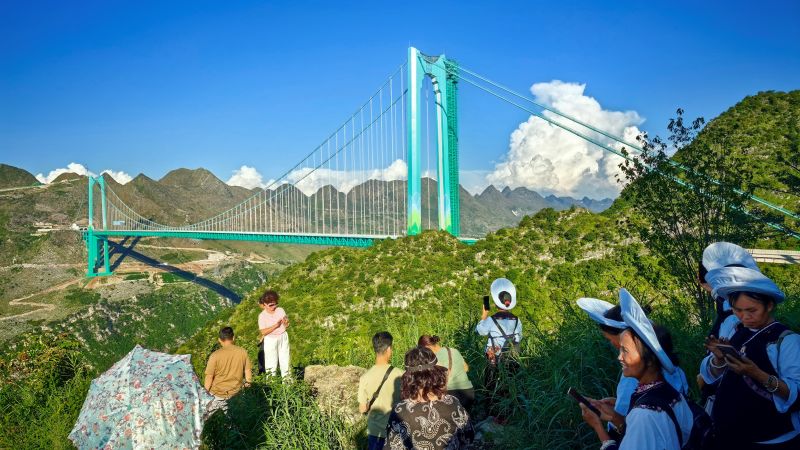
Earthguardiansonline.com – High above the Beipan River in southwestern China, a suspension bridge has become a destination in its own right. The Huajiang Grand Canyon Bridge rises 625 meters (2,051 feet) over the canyon in Guizhou province, a height recognized by Guinness World Records as the highest bridge in the world.
Its original purpose was practical: cutting a difficult canyon crossing that once took about two hours down to roughly two minutes. Since opening in September 2025, however, the bridge has also reshaped the area’s appeal for travelers, photographers and thrill-seekers. Local officials said it received about 3.3 million visitors from its opening through August 2026.
Set among Guizhou’s steep, ancient mountain terrain, the nearly 2.9-kilometer (1.8-mile) span is impossible to overlook. Two large teal towers rise from a gorge that drops dramatically toward the river below. The roadway stands nearly nine times farther above the water than San Francisco’s Golden Gate Bridge.
A View From Inside the Structure
Unlike most major road crossings, Huajiang offers visitors ways to experience the bridge beyond a drive across it. Glass viewing platforms inside the structure look directly down into the canyon, while an exposed route beneath the roadway lets harnessed guests walk through open air hundreds of meters above the ground.
The bridge also hosts an extreme bungee attraction. Before taking the leap, participants undergo equipment checks on a platform below the road deck. Once secured in a harness, they step into space and fall toward the canyon floor. The descent lasts about seven seconds before the cord pulls them upward again, often to applause from visitors watching nearby with phones in hand.
The attractions turn an engineering project into a place where the scale of the landscape can be felt rather than simply seen from a vehicle. For motorists, the bridge provides speed and connection. For visitors on foot, it creates a far more exposed encounter with the canyon, mountains and river valley.
New Business for Canyon Villages
The bridge’s significance extends beyond sightseeing. Communities in and around the canyon are finding new opportunities as travelers arrive in an area that previously had little reason to attract outsiders.
Lin Guoquan is among the local residents building businesses around that change. After working as a chef in Yunnan, Zhejiang and Guangdong, he returned to Guizhou and began transforming older properties into guesthouses, including his grandparents’ former home. He expected the new crossing to bring attention to his village, and demand soon expanded beyond his initial plans.
“When we first opened, we only had nine rooms. Now we have expanded to 52, and we still don’t have enough rooms for all our guests,” Lin said.
Tourism surged during the nine-day Chinese New Year holiday in February 2026, when the bridge’s service area recorded more than 300,000 visits. That figure exceeds the population of Buffalo, New York, illustrating the scale of interest generated by the attraction during a major travel period.
Lin has also used social media to introduce viewers to village life beneath the bridge. His livestreams on Douyin, China’s counterpart to TikTok, have attracted more than 100,000 followers. The videos show the scenery surrounding his community and the massive structure above it, while also helping prospective guests plan visits.
“Lots of people book rooms at my homestay after watching my videos. They ask me for travel advice,” he added.
A Physical Crossing and a Digital One
Road access alone is not enough for a remote tourism economy. Guesthouse owners, visitors and local businesses also need reliable mobile service to communicate, share travel information and promote the region online.
Mobile coverage around the canyon had previously been limited. China Mobile and Huawei have expanded the local network with additional base stations as visitor numbers have increased. The effort reflects the way modern tourism increasingly depends on both physical infrastructure and digital access.
“What people see is this mighty physical bridge,” said Zhou Jianguo, a member of Huawei’s China strategy and business development division. “Yet a bridge in the digital world is equally necessary.”
For decades, China has constructed major bridges to overcome challenging terrain and connect distant communities to wider transport routes. Huajiang represents the next stage of that story: a transport link that has become part of the visitor experience itself.
Its role now reaches in several directions at once. It shortens travel times, creates a dramatic landmark, supports local accommodation businesses and gives travelers a new reason to explore a mountainous part of Guizhou. What began as a solution to a difficult canyon crossing has become a gateway to the communities around it—and, for some visitors, a place to step into the air above one of the world’s most dramatic landscapes.
Related Reading
Frequently Asked Questions
What is How the world s highest bridge?
How the world s highest bridge is the main topic of this guide. The article explains the context, practical details, and next steps readers should understand.
Why does How the world s highest bridge matter?
How the world s highest bridge matters because readers are looking for a useful answer, not just a short summary. Good content should match search intent and help them decide what to do next.