
Officials race to cool down tank containing toxic chemical as 50,000 residents remain under evacuation in California
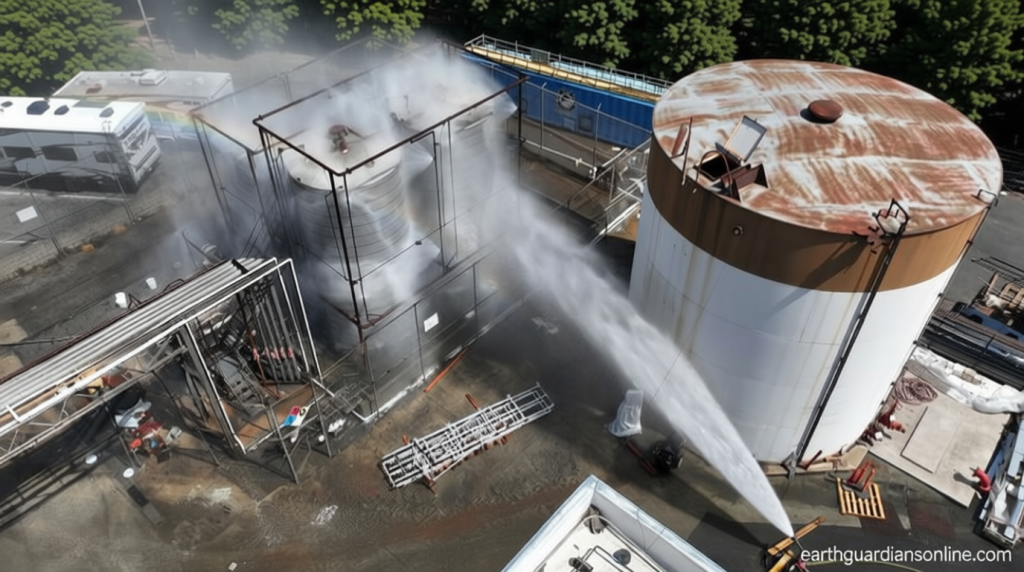
California Officials Mobilize to Stabilize Overheating Tank Amid Evacuation
Officials race to cool down tank – Emergency responders are intensifying efforts to prevent a tank storing a dangerous chemical from rupturing or detonating, as roughly 50,000 individuals in Orange County, California, continue to be evacuated. The situation escalated rapidly, prompting authorities to expand the area under threat after experts assessed the growing risk. Earlier reports indicated that 79,000 residents had been affected by the incident, but the number of people displaced has since stabilized at approximately 50,000. The chemical in question, methyl methacrylate (MMA), is commonly used in plastic manufacturing and poses significant health risks if released into the environment.
State of Emergency Declared to Coordinate Response
California Governor Gavin Newsom activated a state of emergency in Orange County on Saturday, signaling a heightened response to the hazardous chemical incident. This declaration allows for the deployment of additional resources and streamlined decision-making to address the crisis. The state is also expanding shelter capacity for displaced residents, with the Red Cross operating three facilities and preparing more as the situation evolves.
Orange County Fire Authority officials have been working nonstop for two days to mitigate the risk of explosion. The tank, which contains 7,000 gallons of MMA, began to overheat, raising concerns about its structural integrity. Initially, evacuation orders were confined to a 9-square-mile zone surrounding the facility, but the area was later expanded due to the volatile nature of the threat. “We’re in a race against time to stabilize this tank before it fails,” said Division Chief Craig Covey, who serves as the Unified Incident Commander.
“Unfortunately, I do have to report that the temperature was 90 degrees. Yesterday morning it was 77 degrees when we backed out. It’s been averaging about a degree an hour increasing, so that’s the bad news,” Covey said.
The fire authority initially believed the tank was cooling down, based on temperature readings gathered via drones. However, during a critical operation on Friday night, crews were exposed to the risk of failure as they attempted to neutralize a second tank at the site. Covey revealed that the temperature had steadily risen, putting the tank on a path toward potential ignition or explosion.
Strategies to Prevent Catastrophic Failure
Fire Captain Steve Concialdi emphasized the urgency of cooling the tank and neutralizing the chemical to prevent a chain reaction. “We’re trying to solidify the tank from the outside in, similar to how an ice cube freezes,” he explained. This method aims to harden the outer layers while keeping the interior liquid, which could slow the spread of any leak or explosion. However, Concialdi warned that the process is not guaranteed.
“A couple things could happen. … The tank could crack and start spilling out all that 7,000 gallons of chemical, or there could be a catastrophic explosion and the other two tanks would be affected as well,” Concialdi added.
Containment measures, including sand barriers and diking systems, are already in place or being set up to manage any potential spill. Officials remain uncertain about the exact temperature threshold at which the tank might ignite, adding to the complexity of the situation. “Letting this thing just fail and blow up is unacceptable to us,” Covey said. “Our goal is to find a solution and ensure it doesn’t damage our community or environment.”
Evacuation Challenges and School Closures
Evacuation orders were first issued Friday, with police coordinating the process through reverse 911 calls and social media updates. Garden Grove Police Chief Amir El-Farra noted that about 15% of residents—around 6,000 people—refused to leave, creating logistical challenges for emergency teams. The evacuation also affected 13 schools and two facilities within the Garden Grove Unified School District, which were closed on Friday morning as a precaution.
Meanwhile, the Red Cross has established three shelters, with two of them, located in Fountain Valley and La Palma, reaching full capacity. Residents are being directed to the Huntington Beach shelter, while additional facilities are being prepared. A fourth evacuation site, a high school in Anaheim, is also open and managed by a different organization. Nearby hotels have offered discounted rates during the holiday weekend to accommodate evacuees.
Impact on Local Infrastructure and Voting Processes
The evacuation has disrupted daily life, with officials urging displaced residents to cast their votes at any of the 38 remaining voting centers in the county. The Garden Grove voting center and ballot boxes were temporarily closed on Saturday, prompting the Orange County Registrar of Voters to coordinate alternative arrangements. This ensures that residents can still participate in the June 2 primary election despite the crisis.
Residents in the affected area have been advised to stay informed through local news and social media channels. The industrial site where the tank is located is approximately 5 miles from Disneyland and 4 miles from Knott’s Berry Farm, both of which are actively monitoring the situation. While the parks are outside the evacuation zone, they have taken steps to protect their visitors and staff, including issuing safety alerts and adjusting operations as needed.
Experts from the Environmental Protection Agency have confirmed that MMA exposure can lead to respiratory issues, underscoring the need for swift action. The ongoing efforts by emergency crews highlight the coordination between local and state authorities to minimize harm. “We’re doing everything possible to prevent this from becoming a larger disaster,” Covey said, reflecting the collective determination to safeguard public health and safety.
As the situation unfolds, the community remains in suspense. The success of the cooling process will determine whether the tank can be stabilized or if a major incident becomes inevitable. For now, officials continue their work, relying on real-time data and strategic interventions to avert disaster. The resilience of residents, combined with the preparedness of emergency services, will be critical in navigating the challenges posed by this chemical spill.
With the stakes high and the timeline tight, the incident serves as a reminder of the potential dangers associated with industrial chemical storage. The collaboration between agencies, the use of technology like drones for monitoring, and the expansion of evacuation zones all demonstrate a proactive approach to crisis management. While the immediate focus is on containing the tank, long-term considerations include assessing the environmental impact and implementing preventive measures for future incidents.
The evacuation has also sparked discussions about the need for improved infrastructure and emergency response protocols in industrial zones. Local leaders and experts are evaluating the situation to determine what lessons can be learned. “This is a test of our preparedness,” Covey remarked. “We have to ensure we’re not just reacting, but also building systems to prevent this from happening again.”
As the night progresses, the air in Orange County remains thick with tension. Residents wait in temporary shelters, while emergency crews remain on high alert. The fate of the tank—and the safety of the surrounding community—rests on the effectiveness of these stabilization efforts. With every passing hour, the risk grows, but so does the resolve to act decisively in the face of uncertainty.
