
Papyrus scroll burnt to a crisp during Vesuvius eruption deciphered with help of AI
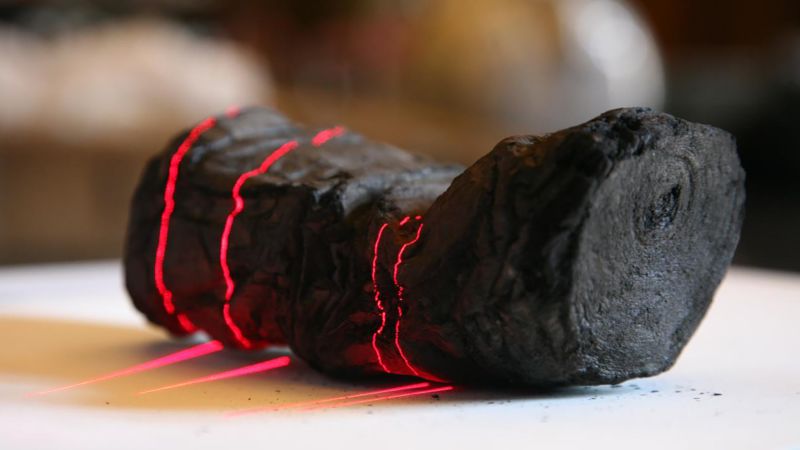
Ancient Papyrus Scroll from Vesuvius Eruption Deciphered via AI Breakthrough
Papyrus scroll burnt to a crisp – More than 1,800 years after Mount Vesuvius unleashed its catastrophic fury, a long-lost papyrus scroll has been brought back to life through the power of artificial intelligence. The artifact, known as PHerc. 1667, was carbonized and partially charred during the volcanic eruption of 79 AD that buried the ancient Roman town of Herculaneum. Now, researchers have successfully used AI to virtually unroll and decode a portion of its text, marking a major milestone in the effort to unlock the secrets of the Herculaneum collection.
The Herculaneum Scrolls: A Time Capsule of Classical Antiquity
Discovered in the 18th century by an Italian farmer near the ruins of Herculaneum, the scrolls were found preserved under layers of volcanic ash and mud in what is believed to have been the library of a villa belonging to the father-in-law of Julius Caesar. This collection of over 1,800 scrolls is considered the most extensive surviving repository of ancient texts, offering a rare glimpse into the intellectual and cultural life of the classical world. However, the scrolls’ delicate state has made them a challenge for scholars, as traditional methods of unrolling often risk tearing or destroying the fragile material.
The PHerc. 1667 scroll, in particular, has been described as a “blackened relic” due to its severe carbonization. Its small size—measuring about 8 centimeters in height and 2 centimeters in diameter—makes it seem almost unremarkable at first glance. Yet, the contents of this compact scroll could reshape our understanding of early philosophical thought. The recent breakthrough, achieved through a combination of advanced imaging and AI-driven analysis, has allowed researchers to access text that was previously thought indecipherable.
The Vesuvius Challenge: A New Approach to Decoding History
In 2023, a team of experts launched the Vesuvius Challenge, an ambitious initiative aimed at decoding the Herculaneum scrolls without physically unrolling them. Led by computer science professor Brent Seales of the University of Kentucky and entrepreneurs Nat Friedman and Daniel Gross, the project has enlisted global researchers to develop innovative techniques for reading the scrolls. This effort has been supported by funding and collaboration from academic institutions and private technology firms.
Traditional methods of unrolling the scrolls have included applying weights, chemicals, and even controlled bursts of gas to coax the delicate layers into a readable form. However, these techniques often caused damage, reducing the scrolls’ size or rendering them unusable. The Vesuvius Challenge instead focuses on virtual unwrapping, a process that uses high-resolution CT scans to create digital models of the scrolls. By analyzing these scans, researchers can simulate the unrolling process and apply AI to identify and reconstruct the text.
Virtual unwrapping involves slicing the coiled scroll into layers, then using algorithms to align and flatten them. This method has allowed scientists to examine the scrolls without direct contact, preserving their physical integrity. The recent success in fully unwrapping PHerc. 1667 is a testament to the team’s persistence and the potential of AI to revolutionize the study of ancient texts. “For nearly two millennia, many of these texts have been physically preserved but intellectually inaccessible,” said Seales in a statement released on Thursday. “Today, after years of interdisciplinary work, we are finally able to read them.”
A Philosophical Window into the Ancient World
The newly decoded text from PHerc. 1667 appears to be a philosophical discourse centered on ethics, the arts, and human behavior. Scholars believe it reflects Stoic thought, an ancient school of philosophy that emphasized rationality, self-discipline, and the pursuit of virtue. The scroll’s content includes references to the Stoic concept of “horme,” or impulse, which the unknown author warns can lead to destructive passions if left unchecked. Another key theme is “phronesis,” or practical wisdom, which is positioned as the pinnacle of Stoic virtue.
One of the most notable lines in the translation reads: “We will inquire into something, but we will not grasp it, if in some way we depart from ourselves and from our own nature.” This suggests the scroll’s author was exploring the relationship between human nature and knowledge, a central idea in Stoic philosophy. The text also includes discussions of moral dilemmas, the role of reason in daily life, and the interplay between emotions and ethical decisions. These insights provide a unique perspective on how ancient thinkers viewed the challenges of human existence.
Dr. Federica Nicolardi, an assistant professor of papyrology at the University of Naples Federico II, has been instrumental in interpreting the scroll’s contents. She led a team that developed machine learning models to analyze the AI-generated images of the text. “This scroll was considered completely unreadable when part of it was opened in the 1980s,” Nicolardi noted in a press release. “Only a few isolated letters were visible, and overlapping layers made the writing nearly invisible. The scroll received a readability score of zero, but now we can follow sustained arguments across multiple columns.”
According to Nicolardi, PHerc. 1667 is the only surviving fragment of a once-complete scroll. Its small size and carbonized state may have been the result of the intense heat from the volcanic eruption, which preserved it but also distorted its structure. The team’s work has not only revealed new text but has also shed light on the scroll’s age. Based on the handwriting and internal references, the scroll is estimated to date from the second century BC, or possibly the late third century BC, making it one of the oldest surviving examples in the Herculaneum collection.
Expanding the Horizons of Ancient Texts
The breakthrough with PHerc. 1667 has been accompanied by another significant discovery in the collection. Researchers successfully decoded a portion of the scorched layers of another scroll, PHerc. 139, revealing the title “Philodemus, On Gods, Book 8.” This finding confirms that the Greek philosopher Philodemus authored a series of at least eight books on the subject of divinity, a revelation that was previously unknown. Until now, only the first book of “On Gods” had been identified, but this new evidence suggests the work was more extensive than previously thought.
The team’s findings have been celebrated as a “historic breakthrough” by those involved in the project. The ability to virtually unwrap and read the scrolls has opened new avenues for understanding the intellectual traditions of the ancient world. By combining cutting-edge imaging technology with AI, researchers have overcome the limitations of physical unrolling, allowing for a more precise and non-invasive examination of these fragile artifacts. This approach has already yielded remarkable results, and future work promises to uncover even more hidden knowledge from the Herculaneum collection.
As the Vesuvius Challenge continues, the team is optimistic about the potential for further discoveries. The success with PHerc. 1667 and PHerc. 139 demonstrates the power of interdisciplinary collaboration, uniting computer science, classical studies, and engineering to solve one of history’s most enduring puzzles. These scrolls, once thought to be a lost treasure, are now offering a clearer picture of the intellectual landscapes that shaped ancient civilizations. The use of AI in this process not only highlights technological progress but also underscores the importance of preserving historical artifacts for future generations to study and understand.
