
Astronomers trace a ghostly cosmic particle to distant ‘Shadow Blaster’ galaxy
Astronomers trace a ghostly cosmic particle to distant ‘Shadow Blaster’ galaxy
Astronomers trace a ghostly cosmic particle – For the first time, scientists have pinpointed the source of a high-energy neutrino detected on Earth to a star-forming galaxy nearly 11 billion light-years away. This breakthrough, detailed in a study published June 17 in the journal *Nature Astronomy*, was achieved by identifying a cosmic coincidence: the galaxy, dubbed the “Shadow Blaster,” coincidentally brightened shortly after the neutrino’s arrival, offering a critical clue to its origin. The discovery marks a significant step in unraveling the mysteries of these elusive particles, which have long baffled researchers due to their ability to travel vast distances without interacting with matter.
The Enigma of Neutrinos
Neutrinos, often called ghost particles, are among the most abundant and mysterious entities in the universe. Their lack of electric charge and minimal mass allows them to slip through matter almost undetected, making their origins difficult to trace. These particles are produced by various cosmic phenomena, including supernovae, nuclear reactions in stars, and the decay of heavy elements. However, pinpointing their exact sources remains a challenge, as detectors like the IceCube Neutrino Observatory in Antarctica can only confirm that an energetic event occurred somewhere in the sky, not where it began or what caused it.
“Neutrinos alone tell us that something energetic happened somewhere in the sky, but they usually do not tell us exactly what the source is, how far away it is, or what kind of object produced them,” said Dr. Yuji Urata, lead author of the study and a researcher at Taiwan-based MITOS Science Co. Ltd. “To answer those questions, we need light: radio, submillimeter, infrared, optical, X-ray and gamma-ray observations.”
Despite their ghostly nature, neutrinos are key to understanding high-energy events in the cosmos. Their detection often triggers a search for corresponding celestial activity, such as gamma-ray bursts or supernovae. Yet, these signals can be fleeting and hard to associate with the neutrino’s path. For instance, the IceCube observatory, which has sensors embedded deep in Antarctic ice, typically detects a high-energy neutrino every two to three years. When one was recorded in 2021, the event—named IC 210922A—was initially linked to the Eridanus constellation. The observatory then issued an alert, prompting scientists to conduct rapid follow-up observations across multiple wavelengths of light.
These efforts, however, failed to locate any visible indicators of an energetic event, such as exploding stars, gamma-ray bursts, or X-ray emissions. The absence of such signals left the neutrino’s origin uncertain, as its trajectory could not be matched to any known celestial object. Dr. Urata and his team faced a unique dilemma: how to identify a source that remained hidden from optical and high-energy observations. The solution came unexpectedly, through a cosmic alignment that amplified their ability to detect the galaxy’s activity.
A Cosmic Coincidence
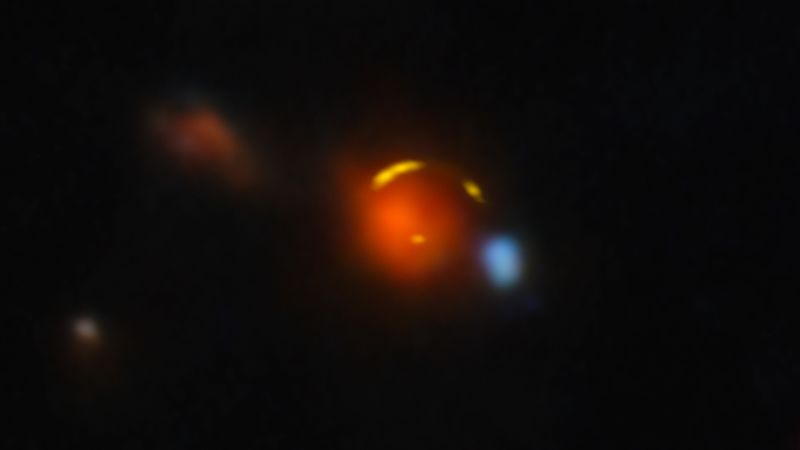
Days after the IceCube alert, Urata and his colleagues turned to the James Clerk Maxwell Telescope and the Submillimeter Array, both situated on Mauna Kea in Hawaii. Their observations revealed a galaxy rich in star formation, designated JCMT0402−0424, which emitted an extraordinary amount of infrared light—trillions of times more luminous than our sun. The team later named this galaxy the “Shadow Blaster” due to its dense dust clouds, which obscured it from visible light, X-rays, and gamma rays. Yet, the dust also hinted at intense activity within its core, potentially linking it to the neutrino’s origin.
“Blaster refers to the idea that despite its hidden nature, the galaxy may be a powerful source of high-energy particles and neutrinos,” Urata explained. “The nickname reflects its role in producing these elusive signals, even though we couldn’t see it clearly in traditional wavelengths.”
Further analysis using the Atacama Large Millimeter/submillimeter Array in Chile confirmed that the Shadow Blaster galaxy was positioned behind a gravitational lens. This phenomenon, caused by a massive galaxy in the foreground, bends and magnifies the light from the background object, effectively acting as a cosmic magnifying glass. The lensing effect made the Shadow Blaster galaxy appear brighter and more distinct, allowing the researchers to study a hidden, compact star-forming region that would have otherwise remained invisible.
Stellar nurseries like the one in the Shadow Blaster galaxy are known to generate the conditions necessary for high-energy particle production. These regions, teeming with dense gas and intense magnetic fields, can accelerate particles to extreme velocities, potentially creating neutrinos. The study’s success hinges on the interplay between these factors: the neutrino’s detection, the galaxy’s simultaneous brightening, and the gravitational lensing that enhanced visibility. This combination provided a rare opportunity to link a neutrino to its source, offering insights into the processes that shape the universe’s most energetic phenomena.
The discovery has broader implications for neutrino astronomy. By leveraging multi-wavelength observations and gravitational lensing, scientists can now explore hidden regions of the cosmos where energetic events might occur. The Shadow Blaster galaxy’s unique properties—its star-forming intensity, dust obscuration, and alignment with a lensing galaxy—make it an ideal candidate for further study. Researchers are now analyzing data to determine whether this galaxy consistently produces neutrinos or if the 2021 event was an isolated occurrence.
Urata’s team is not alone in their pursuit. Other observatories, including those in the Mediterranean Sea, have also contributed to neutrino research. A separate study highlighted the detection of a record-breaking “ghost particle” in the Mediterranean, underscoring the global effort to map neutrino sources. While each discovery is a step forward, the challenge remains: neutrinos are silent messengers, requiring complementary data from light emissions to decode their origins.
This breakthrough could revolutionize how scientists approach neutrino tracking. By combining gravitational lensing with multi-wavelength surveys, researchers may uncover more hidden sources of these particles. The Shadow Blaster galaxy serves as a reminder that even in the vast, uncharted regions of the universe, cosmic events leave traces—though they may take years of observation to reveal. As the field advances, such discoveries will help bridge the gap between the invisible and the observable, illuminating the universe’s most enigmatic secrets.
