
Trump posts new passport rendering — featuring a memorable photo of himself
Trump Unveils New Passport Design for America’s 250th Anniversary
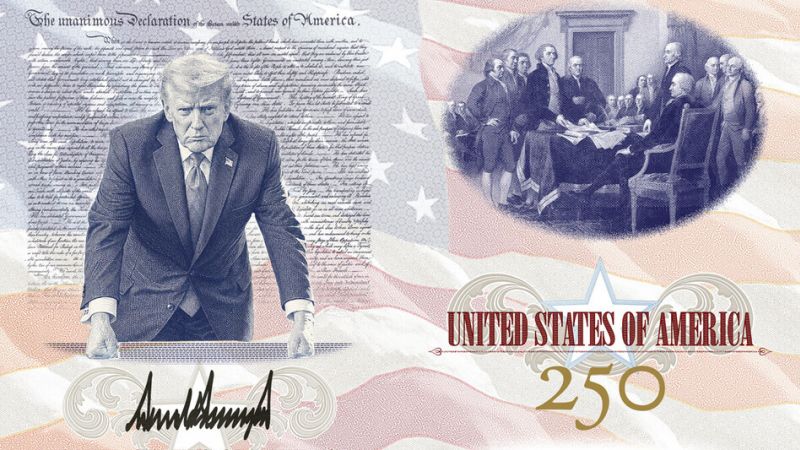
Trump posts new passport rendering – On Friday, President Donald Trump introduced a new version of a special commemorative U.S. passport that features his portrait. The limited-edition travel document, released to coincide with the nation’s 250th anniversary in 2026, showcases a striking image of the former president standing prominently over the Resolute Desk. The design also includes the original text of the Declaration of Independence in the background and a signature from Trump at the bottom of the page. This latest rendering, shared on Truth Social, marks a departure from earlier images of the president used by the State Department this year.
Details of the New Passport Design
Trump’s Truth Social post highlighted the passport’s unique elements, emphasizing the phrase “Welcome, but be good!” as part of its message. The front cover displays his image in a bold, commanding pose, while the reverse page features John Trumbull’s iconic painting of the Declaration of Independence. The choice of Trumbull’s artwork, which dates back to 1817, adds historical depth to the design, contrasting with the modern portrayal of Trump. This version appears to draw inspiration from a portrait of the president held at the Smithsonian National Portrait Gallery, differing from the State Department’s earlier releases.
White House and State Department Response
Following Trump’s announcement, the White House’s X account shared a similar image, captioning it “New U.S. Passport to Commemorate America’s 250th.” The post included the same visual as Trump’s Truth Social post, raising questions about the official status of the design. When asked if this was the definitive rendering for the commemorative passports, the White House directed inquiries to the State Department, leaving the agency to clarify its role. CNN has since contacted the State Department for further comments, awaiting confirmation on whether the new design will replace existing options.
History of the Commemorative Passport
The limited-edition passport was first announced in April as part of a broader celebration of the United States’ 250th anniversary. Officials described it as “a unique travel document to honor the nation’s founding milestone,” with custom artwork and enhanced images appearing on the front, back, and interior pages. At the time, the State Department indicated that this design would be the default option for those renewing passports in person at the Washington Passport Agency. However, online applicants and those using other locations would retain the standard passport format.
Current Passport Design and Its Significance
Currently, the interior front cover of most U.S. passports features a reproduction of Percy Moran’s 1930 painting of Francis Scott Key, the poet who wrote the Star-Spangled Banner. The image captures Key at dawn following the bombardment of Fort McHenry during the War of 1812, a pivotal event in American history. Lines from the anthem are also printed on the cover, reinforcing its cultural importance. The new commemorative design replaces this iconic image with Trump’s likeness and the Declaration of Independence, signaling a shift in how the nation’s heritage is represented in official documents.
Public Reaction and Debate
The release of the new passport design has sparked mixed reactions among the public. Supporters of Trump praised the bold visual, noting its ability to capture the president’s presence and leadership style. Critics, however, questioned the decision to feature a modern leader in a document traditionally linked to the country’s founding. The debate extends to the historical relevance of the design, with some arguing that the Declaration of Independence painting offers a more enduring symbol of American values. Meanwhile, the State Department’s previous renderings, which included a more conventional image of Trump, have been seen as a compromise between tradition and contemporary representation.
Context of the 250th Anniversary
The United States’ 250th anniversary, marking 250 years since the Declaration of Independence was signed in 1776, has been a focal point for national commemorations. Events such as museum exhibitions, historical reenactments, and special editions of currency and postage stamps have underscored the occasion. The passport design, however, has drawn particular attention due to its prominent placement of a current political figure. Trump’s version of the design includes both his portrait and the historical document that inspired the national anthem, creating a symbolic blend of past and present.
Design Process and Artistic Choices
Details about the design process remain unclear, though the passport’s aesthetic has been compared to the Smithsonian’s portrait of Trump. This image, which emphasizes his facial features and posture, aligns with the portrayal in the new design. The inclusion of the Resolute Desk—a historic symbol of presidential authority—adds a layer of significance, connecting the passport to the nation’s political legacy. By placing Trump’s image alongside the Declaration of Independence, the design aims to highlight his role in American history, even as it contrasts with the traditional imagery used in standard passports.
Comparisons to Other Commemorative Designs
Compared to the State Department’s earlier renderings, Trump’s version introduces a more dramatic visual narrative. The previous designs featured a more formal and static image of the president, while the new one emphasizes dynamism and presence. This change has been interpreted as a reflection of Trump’s personal brand, blending his political persona with the historical context of the anniversary. The decision to feature Trumbull’s painting on the opposite page further cements the design’s connection to the nation’s founding, even as it centers on Trump’s image.
Future Implications
As the commemorative passport moves closer to distribution, its impact on public perception and historical memory remains a topic of discussion. While the design is intended to celebrate the anniversary, it has also become a point of contention, with some viewing it as a political statement and others as a creative choice. The State Department’s role in finalizing the design is critical, as it must balance historical symbolism with the input of the current administration. Regardless of its reception, the passport serves as a tangible reminder of the United States’ enduring history and its evolution in representation.
With the 250th anniversary approaching, the commemorative passport represents a unique opportunity to blend national identity with contemporary leadership. Its release has not only highlighted the importance of visual design in political communication but also raised questions about the role of current figures in shaping historical narratives. As the document becomes available, it will be interesting to see how it is received by both the public and historians, offering a new lens through which to view America’s past and present.
Additionally, the passport’s design reflects broader trends in how the U.S. government markets its cultural heritage. By incorporating elements such as the Declaration of Independence and the Resolute Desk, it aims to evoke a sense of pride and continuity. However, the choice to feature Trump’s likeness has also sparked debates about who gets to represent the nation’s legacy in such symbols. This tension between tradition and modernity underscores the significance of the design in the context of a rapidly changing political landscape.
The White House’s collaboration with the State Department on this project highlights the interplay between executive leadership and bureaucratic processes. While the State Department maintains oversight of passport design standards, the inclusion of Trump’s image suggests a deliberate effort to align the commemorative document with the administration’s messaging. This partnership has been instrumental in bringing the design to life, yet it has also drawn scrutiny over the balance between artistic freedom and institutional consistency.
As the passport becomes available, it will likely serve as a conversation starter about the intersection of politics, art, and national identity. Whether it is seen as a celebration of American history or a reflection of current leadership, the document’s unique features ensure it will be remembered as a distinctive addition to the nation’s commemorative efforts. The debate surrounding its design is expected to continue, offering insights into how historical moments are framed through visual representation.
