Volcanic ash leaves 170,000 travelers stranded at eight Indonesian airports

Daftar Isi
Mount Anak Krakatau’s Second Day of Eruption Grounds Eight Airports and Strands 170,000 Passengers Across Indonesia
Earthguardiansonline.com – Indonesia’s aviation network came to a near standstill on Monday morning as volcanic ash from Mount Anak Krakatau continued to blanket the skies over Java and Sumatra. Eight airports — two of them serving the capital, Jakarta — remained shut as of early Monday, leaving roughly 170,000 travelers without flights. The transport ministry confirmed the closures were driven by safety concerns after the volcano, positioned roughly midway between the two major islands, erupted late Friday and has since produced repeated plumes of ash.
Airport Closures and Passenger Disruption
Operators of Jakarta’s primary international gateway announced on Monday, via their Instagram account, that the facility would stay closed until 6 p.m. local time. The remaining seven airports, which include those serving the neighboring provinces of Lampung and West Java, were ordered to remain shut until at least 08:59 a.m. Monday, according to Transport Minister Dudy Purwagandhi.
“We cannot ascertain when this will end due to the dynamic weather,” Minister Purwagandhi stated in a Monday briefing.
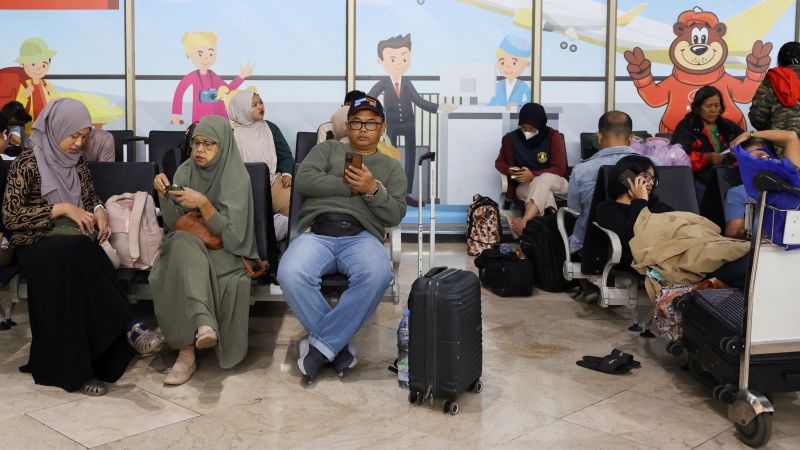
The minister’s remark underscored the uncertainty facing airlines, ground crews, and stranded passengers alike. With no reliable timeline for reopening, travelers at all eight affected terminals faced indefinite delays, rebooking chaos, and the prospect of overnight accommodations in unfamiliar cities. The scale of disruption — 170,000 individuals directly impacted by cancellations — made this one of the largest single-event aviation stoppages in recent Indonesian history.
Scale of the Volcanic Activity
The volcano monitoring agency logged the most recent eruption at 8:23 p.m. Sunday, marking the second consecutive day of major explosive activity. Meteorological agency BMKG reported that ash columns reached 20,000 feet (6,000 meters) above the Java-facing flank of the volcano and soared to 50,000 feet (15,000 meters) on the Sumatra side. Portions of Banten province on Java also received measurable ashfall.
“The probability of further eruptions in the coming periods remains high,” the monitoring agency warned on Monday.
That forecast, combined with shifting wind patterns that could carry ash unpredictably across flight corridors, made it impossible for air-traffic authorities to set a firm reopening schedule. Pilots and dispatchers typically require clear visibility and confirmed absence of ash within defined altitude bands before resuming operations over a region.
Public Safety Measures on the Ground
With ash drifting over populated areas, Indonesia’s national disaster agency urged residents to wear protective masks whenever traveling outdoors, aiming to reduce inhalation of fine particulate matter that can irritate lungs and eyes. In Jakarta and Lampung, schools shifted to remote-learning arrangements to keep students away from ash-laden air, as state news agency Antara reported.
For residents of affected provinces, the immediate practical concerns included water contamination from ashfall, reduced visibility for road travel, and respiratory strain for those with pre-existing conditions. Local health authorities were expected to monitor air-quality indices throughout the weekend and into Monday.
Geological Backdrop: The Ring of Fire and Krakatau’s Legacy
Indonesia sits astride the Pacific Ring of Fire, a horseshoe-shaped belt of tectonic plate boundaries where earthquakes and volcanic eruptions occur with regularity. The archipelago hosts more than 120 active volcanoes, making large-scale eruptions a recurring feature of national life rather than a once-in-a-generation anomaly.
Anak Krakatau — literally “child of Krakatau” — began rising from the seabed roughly a century ago in the waters that once held its predecessor, the volcano known internationally as Krakatoa. That older edifice obliterated itself in a cataclysmic series of eruptions in August 1883, generating tsunamis that killed more than 36,000 people across the Sunda Strait and beyond. The 1883 event remains one of the deadliest volcanic disasters in recorded history and reshaped global understanding of how island volcanoes can collapse and regenerate.
The younger Anak Krakatau has since produced its own catalogue of eruptions, some of which generated tsunamis that struck coastal communities on both Java and Sumatra. Its current two-day explosive phase, while significant, fits within a pattern of periodic activity that monitoring agencies track continuously. The question for travelers and residents alike is not whether the volcano will erupt again — it almost certainly will — but how long the ash will linger in the atmosphere and how quickly aviation corridors can be cleared.
As Monday progressed, the focus shifted from the initial shock of mass cancellations to the longer logistical challenge: rebooking hundreds of thousands of passengers, managing hotel overloads in secondary cities, and coordinating with airlines across Southeast Asia whose connecting flights through Jakarta were disrupted. For the transport ministry and airport operators, the priority remained clear — reopen gates only when ash concentrations have dropped below safe thresholds, regardless of commercial pressure to resume service sooner.
Related Reading
Frequently Asked Questions
What is Volcanic ash leaves 170 000 travelers?
Volcanic ash leaves 170 000 travelers is the main topic of this guide. The article explains the context, practical details, and next steps readers should understand.
Why does Volcanic ash leaves 170 000 travelers matter?
Volcanic ash leaves 170 000 travelers matters because readers are looking for a useful answer, not just a short summary. Good content should match search intent and help them decide what to do next.